


-
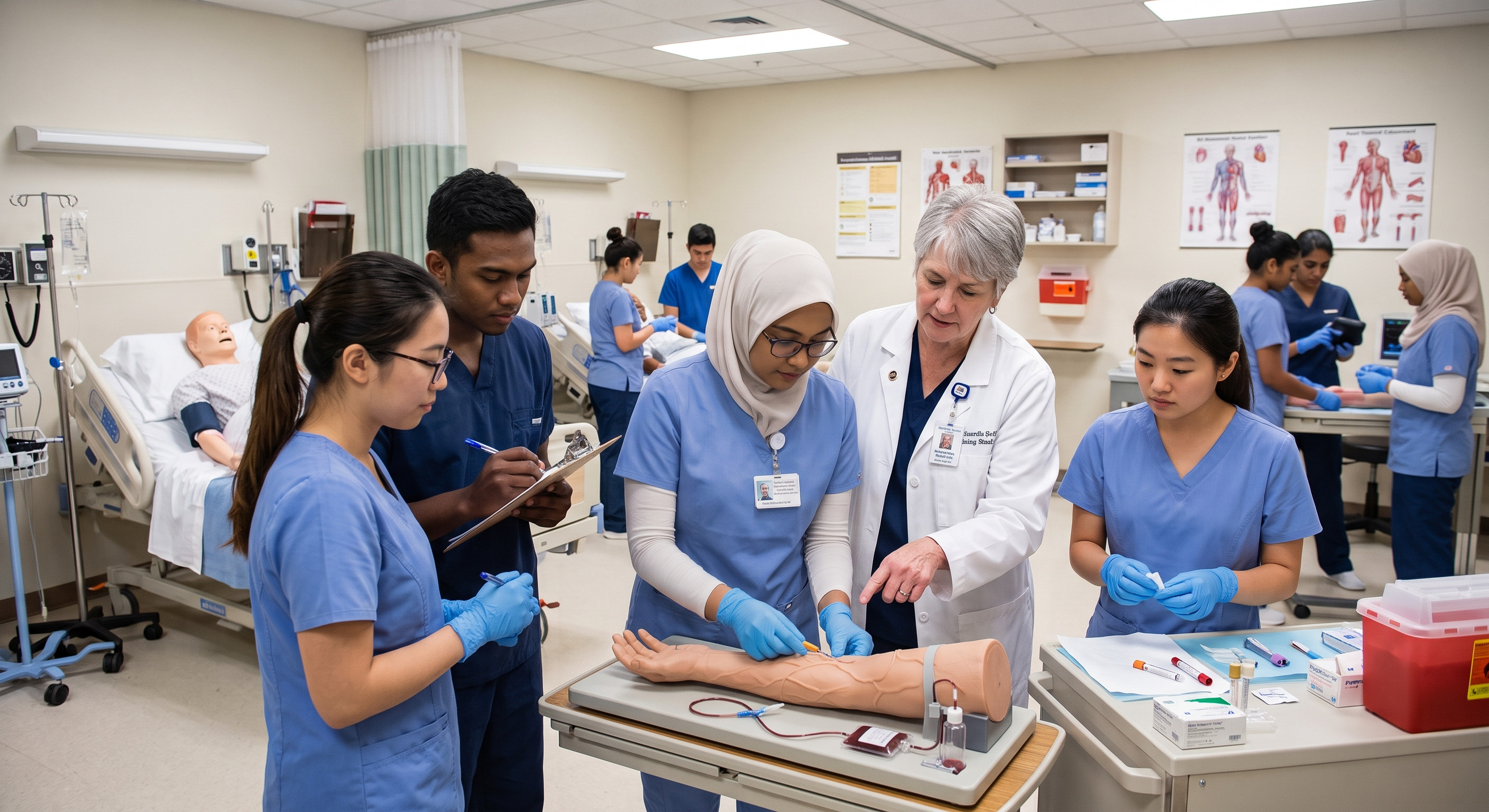
Developing communication skills, including history taking, counseling, and interpreting body language.
-
Measuring vital signs like body temperature, pulse, and blood pressure, alongside anthropometric measurements like BMI.
-
Conducting systematic examinations, including the respiratory, gastrointestinal, and nervous systems, as well as the eyes and ears.
-
Performing and interpreting Electrocardiograms (ECG), alongside procedures like venipuncture and rapid diagnostic tests.
-
Administering First Aid, managing patient transport, and providing Basic Life Support (BLS).
- Module Coordinator:
Dr Allia Najmie binti Muhammad Yusuf
allia.najmie@ums.edu.my
012-833 0105 - Deputy Coordinator:
Dr Nur Damia Iwani binti Zulkiflee
damia@ums.edu.my
011- 2193 3760 -
MLT In-Charge:
Mr Barblay Jolumas
barblay@ums.edu.my
014- 851 5868
- Teacher: JAEYRES BIN JANI
- Teacher: NICHOLAS PANG TZE PING -
- Teacher: RINA A/P NORGAINATHAI Cik
- Teacher: SYLAS SEBASTIAN A/L NEELA SEKHAR Dr
- Teacher: ALLIA NAJMIE MUHAMMAD YUSUF Dr.
- Teacher: AYE AYE WYNN Dr.
- Teacher: CARLOS SILVESTER Dr.
- Teacher: CHE ISMAIL BIN CHE NOH Dr.
- Teacher: DARWINUS LAJIM Dr.
- Teacher: DATU AGASI BIN MOHD KAMAL Dr.
- Teacher: HAZWANI HANUM BINTI HASHIM Dr.
- Teacher: JULIA A/P JOSEPH Dr.
- Teacher: KHAIRUN'NAIM BIN KHAIRUDDIN Dr.
- Teacher: KISTINA BINTI MOHAMED Dr.
- Teacher: LEE HIAN MUN Dr.
- Teacher: MAY ZAW SOE Dr.
- Teacher: MELONNEY PATRICK Dr.
- Teacher: MOHAMAD SHAHRUNIZAM BIN AWANG SETIA Dr.
- Teacher: MOHAMMAD FIRDAUS BIN BOLONG @ MOHD DARWIS Dr.
- Teacher: MOHD AMIRUDDIN BIN MOHD KASSIM Dr.
- Teacher: MOHD FARIZ BIN AMRI ALIAMAN Dr.
- Teacher: MOHD KHAIRULANWAR BIN BUNAIM Dr.
- Teacher: MOHD.HIJAZ MOHD SANI Dr.
- Teacher: NUR DAMIA IWANI BINTI ZULKIFLEE Dr.
- Teacher: NURFARAH LYDIA BINTI HAMBALI Dr.
- Teacher: RHANYE MAC GUAD Dr.
- Teacher: SADIA CHOUDHURY SHIMMI Dr.
- Teacher: SHAHLENI A/P PARAMASIVAM Dr.
- Teacher: SITI ZALEHA S. ABDULLAH Dr.
- Teacher: SYAZA PUTRI BINTI ZAINUDIN Dr.
- Teacher: SYLVES BIN PATRICK Dr.
- Teacher: TEAH KAI MING Dr.
- Teacher: THONG VIE CHEONG Dr.
- Teacher: TIN TIN THEIN Dr.
- Teacher: VENNILA GOPAL Dr.
- Teacher: WAN SALMAN WAN SAUDI Dr.
- Teacher: WOON FUI CHEE Dr.
- Teacher: NELLYSHA NAMELA MUHAMMAD ABDUL KADAR
- Teacher: SYLAS SEBASTIAN NEELA SEKHAR
- Teacher: EHAB HELMY Profesor Madya Dr.
- Teacher: NORNAZIRAH BINTI AZIZAN Profesor Madya Dr.
- Teacher: ALVIN OLIVER PAYUS Professor Madya Dr.
- Teacher: CAROLINE SUNGGIP Professor Madya Dr.
- Teacher: CHIN KAI LING Professor Madya Dr.
- Teacher: GEORGE GEORGE MATHEW Professor Madya Dr.
- Teacher: JUBAIDA BINTI PARAJA Professor Madya Dr.
- Teacher: KHALID BIN MOKTI Professor Madya Dr.
- Teacher: KHIN NYEIN YIN Professor Madya Dr.
- Teacher: LO ZHEN ZHEN Professor Madya Dr.
- Teacher: MOHAMAD HAMIM BIN MOHAMAD HANIFAH Professor Madya Dr.
- Teacher: MOHAMMAD ZAHIRUL HOQUE Professor Madya Dr.
- Teacher: MOHD NAZRI BIN MOHD DAUD Professor Madya Dr.
- Teacher: RICHARD AVOI Professor Madya Dr.
- Teacher: JECELYN LEASLIE JOHN Puan
- Teacher: JAEYRES BIN JANI Ts.
Module coordinator: Assoc. Prof. Dr. Chin Kai Ling
Tel: 014-6839539
E-mail: chinkl@ums.edu.my
Deputy module coordinator: Dr. Julia Joseph
Tel: 016-8281277
E-mail: julia@ums.edu.my
Introduction:
This module will equip the students with the knowledge of the structure, function, and metabolism of the musculoskeletal, cardiovascular, hemopoietic & respiratory systems. While anatomy provides the static image (Structure), physiology reveals the dynamic nature (Function) of the living body, and all body functions are incomprehensible without an understanding of the underlying biochemistry (Metabolism).
Sypnosis:
This course includes lectures on the gross anatomy and histology of the human body systems. It emphasizes the study of cells and their functional components, the body tissue, and every organ system in the body such as the musculoskeletal, cardiovascular, hematopoietic, and respiratory systems. Genetics and molecular biology and the application of this knowledge to clinical practice will be covered through seminars and Computer-Assisted Instruction (CAI).
Objectives:
For students to acquire knowledge and application of knowledge of body structure, function, and metabolism, basic to the practice of medicine by providing information on the gross anatomy and histology, metabolism and human genetics; cellular components of body tissues and organ systems.
Learning outcomes:
At the end of the module, the students can be able to:
- describe the structure, function, and metabolism of the normal human body.
- relate the function and metabolism of normal organ-system to the relevant human anatomical structures.
- explain the nutrient, metabolism as well as the maintenance of body biochemical homeostasis.
- apply the knowledge of the structure, function, and metabolism basic of the human body to the clinical practice of medicine.
Mode of Delivery:
Lecture, Self-learning package (SLP), Small group discussion, Seminars, Problem-based learning, Practical
Teaching-learning and assessment strategy:
| Teaching-learning strategy | Assessment strategy |
|
Lecture |
End of module exam (MCQ, MEQ, LEQ) |
|
Self-Learning Package |
End of module exam (MCQ, MEQ, LEQ) |
|
Small group discussion |
End of module exam (MCQ, MEQ, LEQ) |
|
Seminars |
Presentation |
|
Self-Study Module (SSM) |
Assignment |
|
Practicals |
End of module exam (OSPE) |
The pass mark for the course is 65%.
References supporting the course:
- Tortora GJ, Derrickson BH. 2017. Principles of Anatomy and Physiology. Global edition. John Wiley & Sons.
- Moore KL, Dalley AF & Agur AMR. 2018. Clinically oriented Anatomy. 8th edition. Lippincott Williams Wilkins.
- Drake RL, Vogl AW, Mitchell AWM. 2019. Gray's Anatomy for Students. 4th edition. Elsevier.
- Sadler, TW. Langman's Medical Embryology. 2019. 14th edition. Wolters Kluwer.
- Mescher AL. 2018. Junqueira's Basic Histology: Text and Atlas. 15th edition. Lange
- Netter FH. 2018. Atlas of Human Anatomy. 7th edition. Elsevier.
- Eroschenko VP. 2017. Fiore's Atlas of Histology with Functional Correlations.13th Edition. Lippincott Williams & Wilkins.
- Guyton & Hall 2016. Textbook of Medical Physiology. 13th edition. John E Hall. Elsevier.
- Barrett KE, Barman SM, Boitano S, Brooks H. 2016. Ganong’s Review of Medical Physiology. 25th edition. Lange Medical Books/McGraw-Hill.
- Lieberman MA, Peet A. 2018. Marks’ Basic Medical Biochemistry: A Clinical Approach, 5th Edition. Lippincott Williams & Wilkins.
- Teacher: RINA A/P NORGAINATHAI Cik
- Teacher: ALLIA NAJMIE MUHAMMAD YUSUF Dr.
- Teacher: CARLOS SILVESTER Dr.
- Teacher: DATU AGASI BIN MOHD KAMAL Dr.
- Teacher: JULIA A/P JOSEPH Dr.
- Teacher: KISTINA BINTI MOHAMED Dr.
- Teacher: LEE HIAN MUN Dr.
- Teacher: MELONNEY PATRICK Dr.
- Teacher: NUR DAMIA IWANI BINTI ZULKIFLEE Dr.
- Teacher: SADIA CHOUDHURY SHIMMI Dr.
- Teacher: VENNILA GOPAL Dr.
- Teacher: WAN SALMAN WAN SAUDI Dr.
- Teacher: NELLYSHA NAMELA MUHAMMAD ABDUL KADAR
- Teacher: RAHMAWATI BINTI PARE Dr.
- Teacher: CAROLINE SUNGGIP Professor Madya Dr.
- Teacher: CHIN KAI LING Professor Madya Dr.
- Teacher: D. MARYAMA BTE AG. DAUD Professor Madya Dr.
- Teacher: FONG SIAT YEE @ ALISON Professor Madya Dr.
- Teacher: JECELYN LEASLIE JOHN Puan
- Teacher: JAEYRES BIN JANI Ts.
- Teacher: AIZUDDIN BIN HIDRUS Dr.
- Teacher: MOHD AZIZI BIN SUHAILI Encik
- Teacher: KHALID BIN MOKTI Professor Madya Dr.
- Teacher: RICHARD AVOI Professor Madya Dr.
This course aims to teach the student about medical developments generally as well as those specific to Malaysia. Students will be exposed to the Medical Act and Ethics in the medical profession. They will be trained to acquire the skills and characteristics of a good doctor and develop proper ethical relationships between the doctor and his/her patient. This course will emphasis proper methods of communication with patients as well as the medical service professionals, adopt appropriate counselling procedures and instil in them the need to pursue continuous medical education. They also need to understand the significance of systematic self-study and working in small Groups, as well as manage time effectively and cope with stress, develop good communication skills and diplomacy. They also learn to acquire knowledge from e learning. For understanding the community and the patient more effectively, they hold discussions on cultural issues, sensitivities, and ethnic medicine They are first introduced to the medical discipline and the patient through mastery of medical terminology and interaction with the patient and the community, understanding the role of sickness and acquisition of skill in handling medical equipment.
References:
1. Fadem, B. (2017). Behavioral Science (7th ed.). Philadelphia, PA: Wolters Kluwer.
2. Elkins, D. N. (2016). The Human Elements of Psychotherapy: A Nonmedical Model of Emotional Healing. Washington, DC: American Psychological Association.
3. Knapp, S. J., Gottlieb, M. C., & Handelsman, M. M. (2015). Ethical Dilemmas in Psychotherapy: Positive Approaches to Decision Making. Washington, DC: American Psychological Association
4. Brooks, ML, Brooks DL. (2015). Exploring Medical Language- A student-directed approach- 10th edition. Elsevier
- Teacher: NICHOLAS PANG TZE PING -
- Teacher: SYLAS SEBASTIAN A/L NEELA SEKHAR Dr
- Teacher: CHE ISMAIL BIN CHE NOH Dr.
- Teacher: DATU AGASI BIN MOHD KAMAL Dr.
- Teacher: JULIA A/P JOSEPH Dr.
- Teacher: KISTINA BINTI MOHAMED Dr.
- Teacher: LEE HIAN MUN Dr.
- Teacher: MELONNEY PATRICK Dr.
- Teacher: MOHD AMIRUDDIN BIN MOHD KASSIM Dr.
- Teacher: MOHD.HIJAZ MOHD SANI Dr.
- Teacher: NUR DAMIA IWANI BINTI ZULKIFLEE Dr.
- Teacher: RHANYE MAC GUAD Dr.
- Teacher: SADIA CHOUDHURY SHIMMI Dr.
- Teacher: THONG VIE CHEONG Dr.
- Teacher: VENNILA GOPAL Dr.
- Teacher: ZAINUL AMIRUDDIN BIN ZAKARIA Prof. Ts. Dr.
- Teacher: CHIN KAI LING Professor Madya Dr.
- Teacher: FONG SIAT YEE @ ALISON Professor Madya Dr.
- Teacher: JECELYN LEASLIE JOHN Puan
