 iTEL
iTEL
Search results: 84
RC31403(UMSFLEC) Perladangan Persis [2-2025/2026]
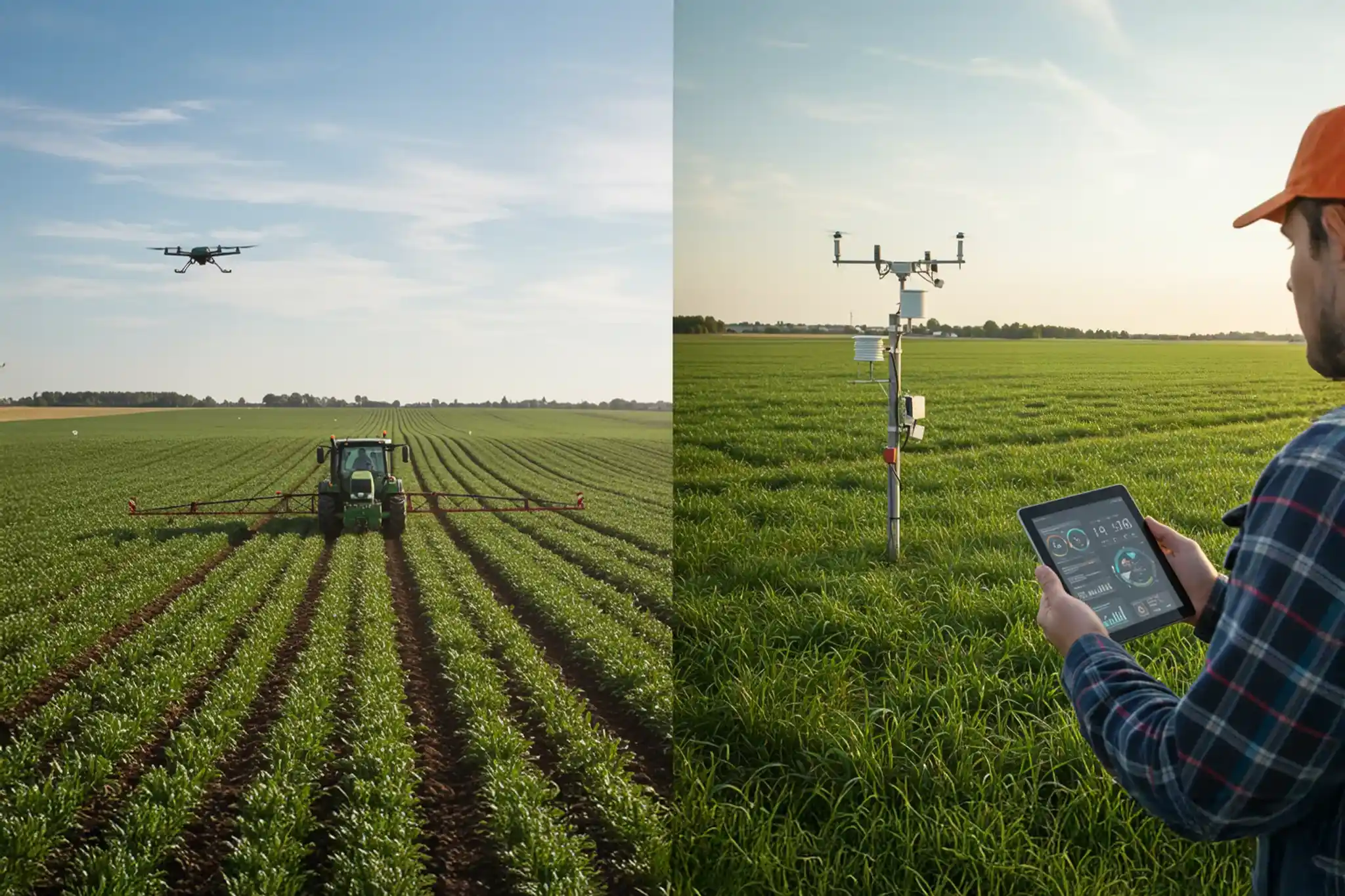
This course introduces students to the concepts, technologies and applications involved in precision farming (PF). This entails the use of ICT and some high-technology equipment for assessing field conditions and applying variable rates of production inputs for management of soil nutrients, weeds, pest & diseases. Topics include sampling procedures, and measurements of parameters through environmental sensors, GNSS, RS and PS. Data input into GIS or analysis using Geo-statistical & Mapping software to accomplish primary spatial data management tasks, creation of spatial variability maps for mechanized applications of farm inputs. Students will also be exposed to precision technologies in livestock production for locating as well as feeding, reproduction and health management. Students will participate in some hands-on experience in the use of enabling hardware and software in PF applications.
![RH40202 PERANCANGAN DAN PENGURUSAN TAMAN [1-2025/2026]](https://itel.ums.edu.my/pluginfile.php/1585117/course/overviewfiles/IMG_6885.JPEG)
RH40202 PERANCANGAN DAN PENGURUSAN TAMAN [1-2025/2026]
Garden Planning and Management introduces students to the ethical, systemic, and justice-based dimensions of planning at multiple scales, building on the foundations of design practice. Where Landscape Design focused on site-scale composition and inclusion, this course expands to examine landscapes as interconnected systems shaped by history, policy, and power. Students critically engage with planning frameworks that govern land use, heritage, food systems, and waste, while exploring how circularity, conservation, and community agency can inform just and sustainable futures.
Through lectures, digital mapping exercises, case studies, and field-based inquiry, the course equips students to analyse planning challenges across ecological, social, and cultural domains. It emphasises both critique and application: students will interrogate planning as a political and ethical act, while also developing inclusive strategies that support community resilience, regenerative design, and professional pathways in landscape management.
Through lectures, digital mapping exercises, case studies, and field-based inquiry, the course equips students to analyse planning challenges across ecological, social, and cultural domains. It emphasises both critique and application: students will interrogate planning as a political and ethical act, while also developing inclusive strategies that support community resilience, regenerative design, and professional pathways in landscape management.
![RL10503 PRINSIP PENTERNAKAN LESTARI [1-2023/2024]](https://itel.ums.edu.my/pluginfile.php/408503/course/overviewfiles/farm-livestock550-jpg.jpg)
RL10503 PRINSIP PENTERNAKAN LESTARI [1-2023/2024]
This course will explore a range of different livestock production systems and the opportunities and challenges of implementing sustainable practices. This course provides an introductory to explore and draw connections between key sustainability issues related to livestock production systems. Interactive lectures, readings, activities, and field trips will provide exposure to a wide range of interdisciplinary topics including agro-ecology, natural resource management, crop production, livestock production, biodiversity, land use, livelihoods, nutrition, animal food products, and policy.
![RL10503 PRINSIP PENTERNAKAN LESTARI [1-2024/2025]](https://itel.ums.edu.my/pluginfile.php/961328/course/overviewfiles/images.jpg)
RL10503 PRINSIP PENTERNAKAN LESTARI [1-2024/2025]
This course will explore a range of different livestock production systems and the opportunities and challenges of implementing sustainable practices. This course provides an introductory to explore and draw connections between key sustainability issues related to livestock production systems. Interactive lectures, readings, activities, and field trips will provide exposure to a wide range of interdisciplinary topics including agro-ecology, natural resource management, crop production, livestock production, biodiversity, land use, livelihoods, nutrition, animal food products, and policy.
![RL10503 PRINSIP PENTERNAKAN LESTARI [1-2025/2026]](https://itel.ums.edu.my/pluginfile.php/1585129/course/overviewfiles/pngtree-farmhouse-animals-clipart-cute-farm-animals-gathered-around-a-barn-cartoon-vector-png-image_6867888.png)
RL10503 PRINSIP PENTERNAKAN LESTARI [1-2025/2026]
This course will explore a range of different livestock production systems and the opportunities and challenges of implementing sustainable practices. This course provides an introductory to explore and draw connections between key sustainability issues related to livestock production systems. Interactive lectures, readings, activities, and field trips will provide exposure to a wide range of interdisciplinary topics including agro-ecology, natural resource management, crop production, livestock production, biodiversity, land use, livelihoods, nutrition, animal food products, and policy.
![RL21103 PENGELUARAN RUMINAN KECIL [1-2025/2026]](https://itel.ums.edu.my/pluginfile.php/1585141/course/overviewfiles/the-laboratory-small-ruminant-1.jpg)
RL21103 PENGELUARAN RUMINAN KECIL [1-2025/2026]
This course will explore a range of different livestock production systems and the opportunities and challenges of implementing sustainable practices. This course provides an introductory to explore and draw connections between key sustainability issues related to livestock production systems. Interactive lectures, readings, activities, and field trips will provide exposure to a wide range of interdisciplinary topics including agro-ecology, natural resource management, crop production, livestock production, biodiversity, land use, livelihoods, nutrition, animal food products, and policy.
![RT20101 KERJA LAPANGAN [1-2025/2026]](https://itel.ums.edu.my/pluginfile.php/1585161/course/overviewfiles/Screenshot%202025-10-12%20at%2010.44.18%E2%80%AFPM.png)
RT20101 KERJA LAPANGAN [1-2025/2026]
Discover the world of agriculture with RC20101- Fieldwork. This course opens the door to exciting opportunities in crop production, horticulture, landscaping, and livestock management. You’ll gain the essential knowledge and hands-on skills needed to thrive in the agricultural field, from learning how to use farm tools and equipment to mastering good farm management practices.
Through hands-on farm activities under expert guidance from our Ladang staff, you’ll experience the latest in modern and sustainable farming techniques. Cultivate your passion for agriculture while building the skills that shape the future of food and farming.
And... be ready to get your hands dirty!
Through hands-on farm activities under expert guidance from our Ladang staff, you’ll experience the latest in modern and sustainable farming techniques. Cultivate your passion for agriculture while building the skills that shape the future of food and farming.
And... be ready to get your hands dirty!
![RT20203 MIKROBIOLOGI PERTANIAN [2-2022/2023]](https://itel.ums.edu.my/pluginfile.php/47524/course/overviewfiles/Bacterium.JPG)
RT20203 MIKROBIOLOGI PERTANIAN [2-2022/2023]
This course offers basic knowledge of microbes and their roles in ecosystems. The early parts of the topics are related to morphology and structures, microbial diversity, metabolisms, growth, and genetics. Later parts of the course will cover applied aspects of microorganisms in agriculture, such as the manipulation of microbial products in industrial microbiology production, the roles of microbes in soil, environment, ecology, biogeochemical cycles, and foods. Several basic techniques essential in microbiology will be taught in practical sessions. The concepts of field and laboratory diagnostic procedures, and the Koch's Postulates will be taught in practical sessions.
RT40103 PERLADANGAN PERSIS [1-2025/2026] - Active
Welcome to the course.
This course introduces students to the concepts, technologies and applications involved in precision farming (PF). This entails the use of ICT and some high-technology equipment for assessing field conditions and applying variable rates of production inputs for management of soil nutrients, weeds, pest & diseases. Topics include sampling procedures, and measurements of parameters through environmental sensors, GNSS, RS and PS. Data input into GIS or analysis using Geo-statistical & Mapping software to accomplish primary spatial data management tasks, creation of spatial variability maps for mechanized applications of farm inputs. Students will also be exposed to precision technologies in livestock production for locating as well as feeding, reproduction and health management. Students will participate in some hands-on experience in the use of enabling hardware and software in PF applications.
Enjoy the course, have fun and work hard.
Aim for A+
You can do it.
This course introduces students to the concepts, technologies and applications involved in precision farming (PF). This entails the use of ICT and some high-technology equipment for assessing field conditions and applying variable rates of production inputs for management of soil nutrients, weeds, pest & diseases. Topics include sampling procedures, and measurements of parameters through environmental sensors, GNSS, RS and PS. Data input into GIS or analysis using Geo-statistical & Mapping software to accomplish primary spatial data management tasks, creation of spatial variability maps for mechanized applications of farm inputs. Students will also be exposed to precision technologies in livestock production for locating as well as feeding, reproduction and health management. Students will participate in some hands-on experience in the use of enabling hardware and software in PF applications.
Enjoy the course, have fun and work hard.
Aim for A+
You can do it.
SK34003 BAHAN INORGANIK TERMAJU [2-2023/2024]
This course discusses advancements in inorganic materials and relates them to coordination chemistry, organometallic compounds, solid-state phenomena, and bioinorganic interactions, providing insights into element properties, reactivity, and catalysis. The course also explores the interdisciplinary field that drives innovation in energy, environment, and healthcare, with nanomaterials and some coordination polymers offering practical applications in catalysis, electronics, and medicine. Inorganic reaction mechanisms are studied to understand chemical transformations crucial for synthesis and industrial processes.
SK34803 TEKNOLOGI NANO [2-2023/2024]
This course focuses on the definition, history, scope, impacts, and challenges within the rapidly emerging and revolutionary field of nanotechnology. The course discusses techniques of the production of various nanomaterials such as graphenes, silicenes, nanotubes, nanorods, colloids, dots, clusters, wires, thin films etc. The pros and cons of the “top down” and “bottom up” approach in the nanotechnology will be discussed. The state-of-the-art instruments such as spectroscopy, radiation scattering, scanning electron microscopy, transmission electron microscopy and X-ray diffraction etc. that are important for the characterization of nanomaterial and nanotechnology will be discussed too.
SK34803 TEKNOLOGI NANO [2-2025/2026]
This course focuses on the definition, history, scope, impacts, and challenges within the rapidly emerging and revolutionary field of nanotechnology. The course discusses techniques of the production of various nanomaterials such as graphenes, silicenes, nanotubes, nanorods, colloids, dots, clusters, wires, thin films etc. The pros and cons of the “top down” and “bottom up” approach in the nanotechnology will be discussed. The state-of-the-art instruments such as spectroscopy, radiation scattering, scanning electron microscopy, transmission electron microscopy and X-ray diffraction etc. that are important for the characterization of nanomaterial and nanotechnology will be discussed too.
![SM13103 MATEMATIK I [1-2023/2024]](https://itel.ums.edu.my/pluginfile.php/531200/course/overviewfiles/iTel%20Card%20%283%29.jpg)
SM13103 MATEMATIK I [1-2023/2024]
This course provides a comprehensive introduction to several important areas of mathematics, including foundational concepts (logic, set theory, real numbers) and more advanced topics (complex numbers and calculus). It establishes a strong foundation for advancing in the study of mathematics and applying it across various fields.
![SM14103 MATEMATIK I [1-2023/2024]](https://itel.ums.edu.my/pluginfile.php/409781/course/overviewfiles/SM1.jpg)
SM14103 MATEMATIK I [1-2023/2024]
This course provides a comprehensive introduction to several important areas of mathematics, including foundational concepts (logic, set theory, real numbers) and more advanced topics (complex numbers and calculus). It establishes a strong foundation for advancing in the study of mathematics and applying it across various fields.
![SM14103 MATEMATIK I [1-2024/2025]](https://itel.ums.edu.my/pluginfile.php/962264/course/overviewfiles/iTel%20Card.jpg)
SM14103 MATEMATIK I [1-2024/2025]
This course provides a comprehensive introduction to several important areas of mathematics, including foundational concepts (logic, set theory, real numbers) and more advanced topics (complex numbers and calculus). It establishes a strong foundation for advancing in the study of mathematics and applying it across various fields.
![SM14103 MATEMATIK I [1-2025/2026]](https://itel.ums.edu.my/pluginfile.php/1585735/course/overviewfiles/SM14103.jpg)
SM14103 MATEMATIK I [1-2025/2026]
This course provides an introduction to essential areas of mathematics, beginning with logic, set theory, real numbers, and complex numbers. It then explores the concepts of functions, limits, and continuity, which form the basis for differentiation and integration, including their techniques and applications. By the end of the course, students will have developed problem-solving skills and a solid mathematical foundation to support further studies in mathematics and related fields.
![SM34502 PENGOPTIMUMAN [1-2024/2025]](https://itel.ums.edu.my/pluginfile.php/962282/course/overviewfiles/iTel%20Card.jpg)
SM34502 PENGOPTIMUMAN [1-2024/2025]
This advanced optimization course focuses on complex models. Building upon the concepts of linear and non-linear programming introduced in Operations Research, this course covers sensitivity and duality analysis, network optimization, dynamic programming, and queuing theory. Students will explore various methods and approaches to optimize systems, processes, and decisions, preparing them for practical applications in diverse fields.
![SM34502 PENGOPTIMUMAN [1-2025/2026]](https://itel.ums.edu.my/pluginfile.php/1585747/course/overviewfiles/itel%20opt.png)
SM34502 PENGOPTIMUMAN [1-2025/2026]
This course introduces fundamental optimization techniques used to support effective decision-making and problem-solving in various fields. It covers transportation, assignment, network, queueing, and deterministic dynamic programming models. Students will enhance their analytical and problem-solving skills by applying appropriate optimization methods to real-life scenarios through manual computation, critical analysis, and chapter review activities.
SQ31203 BIOMETRI DAN REKABENTUK EKSPERIMEN [1-2024/2025]
This module is basically concerning quantitative statistical methodologies that are used for analyzing quantitative data derived from commonly conducted biological experiments. Topics covered in this course also include basic experimental design for biological experiments conducted in the field or under controlled conditions in the laboratory or other such setting. Real data from the field and laboratory experiments will be used in all statistical tests carried out. Computer cum tutorial classes will be conducted to demonstrate how the statistical analyses are carried out using popular statistical software programs and to discuss the results obtained. This course will give focus on the application of the quantitative analytical skills to solve real world problems.
![SS33003 INSTRUMENTASI SEKITARAN [2-2022/2023]](https://itel.ums.edu.my/pluginfile.php/48508/course/overviewfiles/cover.png)
SS33003 INSTRUMENTASI SEKITARAN [2-2022/2023]
This course prepares the student to a variety of analytical techniques and instruments utilized in environmental analysis. It is designed to couple theory of equipment operation and their applications in the fields of environmental studies.
 iTEL
iTEL