 iTEL
iTEL
Search results: 263
![BT11703(UMSFLEC) MAKROEKONOMI [2-2025/2026]](https://itel.ums.edu.my/pluginfile.php/2025979/course/overviewfiles/WIJAYA%20KAMAL%20RAMLAN%20%2810%29.png)
BT11703(UMSFLEC) MAKROEKONOMI [2-2025/2026]
Course Description
This course provides introductory materials for macroeconomics. The syllabus focuses on applications and policy while explaining the formal economic theory. The first three chapters introduce students to the economist’s view of the world, the role of assumptions in developing theory or models, and the role of economists in making policy. The coverage of macroeconomics includes how to measure national income, cost of living, and the behavior of the real economy, money, and prices in the long run. The last few chapters present the macroeconomics of open economies, maintaining the long-run assumptions of price flexibility and full employment.
Course Learning Outcomes
At the end of the course, the students should be able to:
• Analyse key macroeconomic concepts and theories with clarity and accuracy in foundational economic contexts. (PLO1, C4)
• Analyse fundamental macroeconomic concepts to evaluate contemporary economic issues using logical reasoning and systems thinking to understand their interrelationships. (PLO2, C4)
• Demonstrate effective communication skills when discussing contemporary macroeconomic issues in both written and oral formats. (PLO5, A3)
• Demonstrate personal skills in analyzing macroeconomic concept in relation to current and global economics issues. (PLO9, A3)
![BT11903 (UMSFLEC) KOMUNIKASI KORPORAT [1-2025/2026]](https://itel.ums.edu.my/pluginfile.php/1654584/course/overviewfiles/Brown%20and%20Orange%20Simple%20Business%20Communication%20Presentation%20%281%29.png)
BT11903 (UMSFLEC) KOMUNIKASI KORPORAT [1-2025/2026]
This course is designed to give students an overall appreciation of the importance of communications. It is developed to help students improve their writing and oral skills while providing practice in its essential forms. The course content will also provide students with a comprehensive understanding of communication principles and why achieving effective communication skills are vital in the corporate world. Students are, therefore, highly encouraged to think about their own careers and the communication skills they will need to develop, in order to be successful.
![BT11903(PLUMS) KOMUNIKASI KORPORAT [2-2023/2024]](https://itel.ums.edu.my/pluginfile.php/765465/course/overviewfiles/communications-01-1200w.jpg)
BT11903(PLUMS) KOMUNIKASI KORPORAT [2-2023/2024]
This course is designed to give students an overall appreciation of the importance of communication. It was developed to help students improve their writing and oral skills while providing practice in its essential forms. The course content will also provide students with a comprehensive understanding of communication principles and why achieving effective communication skills is vital in the corporate world. Therefore, students are highly encouraged to think about their careers and the communication skills they will need to develop to be successful.
![BT12303 (UMSFLEC) PENGURUSAN [1-2025/2026]](https://itel.ums.edu.my/pluginfile.php/1654606/course/overviewfiles/mgt1.jpg)
BT12303 (UMSFLEC) PENGURUSAN [1-2025/2026]
This course is about management and managers in an organization. It is all about managing people towards mutual needs and organizational goals. Furthermore, with globalization and the changing world that is faced by managers, understanding the right management process and strategic management is important to ensure organizational goals are achieved effectively. The course covers the core management functions of planning, organizing, leading, and controlling an organization.![BT12303(PLUMS) PENGURUSAN [2-2022/2023]](https://itel.ums.edu.my/pluginfile.php/198712/course/overviewfiles/Screenshot%202023-03-28%20223935.jpg)
BT12303(PLUMS) PENGURUSAN [2-2022/2023]
This course is about management and managers in an organization. It is all about managing people towards mutual needs and organizational goals. Furthermore, with the globalization and the changing world that faced by managers, understanding the right management process and strategic management is important to ensure organizational goals achieved effectively. The course covers the core management functions of planning, organizing, leading and controlling in an organization.
![BT12303(PLUMS) PENGURUSAN [2-2023/2024]](https://itel.ums.edu.my/pluginfile.php/765468/course/overviewfiles/PLUMS.png)
BT12303(PLUMS) PENGURUSAN [2-2023/2024]
This course is about management and managers in an organization. It is all about managing people towards mutual needs and organizational goals. Furthermore, with globalization and the changing world that is faced by managers, understanding the right management process and strategic management is important to ensure organizational goals are achieved effectively. The course covers the core management functions of planning, organizing, leading, and controlling an organization.
![BT12303(UMSFLEC) PENGURUSAN [2-2024/2025]](https://itel.ums.edu.my/pluginfile.php/1341221/course/overviewfiles/Screenshot%202025-03-19%20155037.png)
BT12303(UMSFLEC) PENGURUSAN [2-2024/2025]
This course is about management and managers in an organization. It is all about managing people towards mutual needs and organizational goals. Furthermore, with globalization and the changing world that is faced by managers, understanding the right management process and strategic management is important to ensure organizational goals are achieved effectively. The course covers the core management functions of planning, organizing, leading, and controlling an organization.
![BT21303(SEKSYEN 1) PERLAKUAN ORGANISASI [2-2024/2025]](https://itel.ums.edu.my/pluginfile.php/1330070/course/overviewfiles/Purple%20Gradient%20Management%20Class%20Google%20Classroom%20Header.png)
BT21303(SEKSYEN 1) PERLAKUAN ORGANISASI [2-2024/2025]
This course will enriched students knowledge about the concepts and issues of human behaviors in organizations. Organizational behavior is closely linked to human behavior, at individual, group and organizational level. The main goal of the course is to enable students as future managers to understand the concept of organizational behavior as a mechanism to improve employee productivity, motivation, satisfaction and performance besides to reduce negative work behaviors.
![BT21303(SEKSYEN 2) PERLAKUAN ORGANISASI [2-2022/2023]](https://itel.ums.edu.my/pluginfile.php/198994/course/overviewfiles/Screenshot%202023-03-28%20181308.jpg)
BT21303(SEKSYEN 2) PERLAKUAN ORGANISASI [2-2022/2023]
This course will enriched students knowledge about the concepts and issues of human behaviours in organisations. Organisational behaviour is closely linked to human behaviour, at individual, group and organisational level. The main goal of the course is to enable students as future managers to understand the concept of organisational behaviour as a mechanism to improve employee productivity, motivation, satisfaction and performance besides to reduce negative work behaviours.
![BT22103(SEKSYEN 3) SISTEM MAKLUMAT PERNIAGAAN [2-2025/2026]](https://itel.ums.edu.my/pluginfile.php/1906444/course/overviewfiles/Screenshot%202026-03-16%20124732.png)
BT22103(SEKSYEN 3) SISTEM MAKLUMAT PERNIAGAAN [2-2025/2026]
This course equips students with practical know-how on how to effectively utilize technology to enhance business operations. It begins by creating awareness of the evolving business landscape in the information technology era. The course then introduces fundamental information technology concepts, including an overview of hardware, software, technological advancements, and their applications across various business functions. In addition, students are exposed to business-related software and systems, with a focus on commonly used applications adopted by industry practitioners. To integrate this knowledge, the course further examines the managerial decision-making considerations involved in evaluating, acquiring, implementing, and adopting technological investments within a business organization. The practical component of the course emphasizes experiential learning through hands-on project work and learning the features of artificial intelligence tools.
![BT22103(SEKSYEN 4) SISTEM MAKLUMAT PERNIAGAAN [2-2023/2024]](https://itel.ums.edu.my/pluginfile.php/734505/course/overviewfiles/BIS%20SECTION4.jpg)
![BT22303(SEKSYEN 1) PENGURUSAN SUMBER MANUSIA [2-2025/2026]](https://itel.ums.edu.my/pluginfile.php/1906453/course/overviewfiles/BT22303%20HRM%201%2020252026.png)
BT22303(SEKSYEN 1) PENGURUSAN SUMBER MANUSIA [2-2025/2026]
Human resource management (HRM) refers to the process of recruiting and developing a company's workforce. It focuses on the function of people within the business, ensuring best work practices are in place at all times, identifying talent gaps in a company, advertising for positions, evaluating potential candidates, hiring top talent, and keeping employees safe, healthy, and satisfied, as well as bridging the gap between employees' performance and the organisation's strategic objectives.
![BT22303(SEKSYEN 3) PENGURUSAN SUMBER MANUSIA [2-2025/2026]](https://itel.ums.edu.my/pluginfile.php/1906459/course/overviewfiles/Screenshot%202026-03-12%20172723.png)
BT22303(SEKSYEN 3) PENGURUSAN SUMBER MANUSIA [2-2025/2026]
This course introduces the principles, practices, and strategic role of Human Resource Management (HRM) in contemporary organisations. It focuses on how HR activities and practices support organisational effectiveness and sustainability through integrated problem-solving and strategic thinking. Students will examine key HR functions, including job design, recruitment and selection, training and development, performance management, compensation, employee relations, and workplace safety. The course also introduces HR standards, HR information systems, and data-driven decision-making. Emphasis is placed on collaborative learning, where students work with team members to develop inclusive and sustainable solutions to HR-related challenges in dynamic organisational environments.
![BT22303(SEKSYEN 4) PENGURUSAN SUMBER MANUSIA [2-2025/2026]](https://itel.ums.edu.my/pluginfile.php/1906462/course/overviewfiles/COVER%20PAGE%20.png)
BT22303(SEKSYEN 4) PENGURUSAN SUMBER MANUSIA [2-2025/2026]
This course introduces the principles, practices, and strategic role of Human
Resource Management (HRM) in contemporary organizations. It focuses on
how HR activities and practices support organizational effectiveness and
sustainability through integrated problem solving and strategic thinking.
Students will examine key HR functions such as job design, recruitment and
selection, training and development, performance management,
compensation, employee relations, and workplace safety. The course also
introduces HR standards, HR information systems, and data-driven decisionmaking.
Emphasis is placed on collaborative learning, where students work
with team members to develop inclusive and sustainable solutions to HRrelated
challenges in dynamic organizational environments.
Resource Management (HRM) in contemporary organizations. It focuses on
how HR activities and practices support organizational effectiveness and
sustainability through integrated problem solving and strategic thinking.
Students will examine key HR functions such as job design, recruitment and
selection, training and development, performance management,
compensation, employee relations, and workplace safety. The course also
introduces HR standards, HR information systems, and data-driven decisionmaking.
Emphasis is placed on collaborative learning, where students work
with team members to develop inclusive and sustainable solutions to HRrelated
challenges in dynamic organizational environments.
![BT22303(SEKSYEN 6) PENGURUSAN SUMBER MANUSIA [2-2025/2026]](https://itel.ums.edu.my/pluginfile.php/1906468/course/overviewfiles/Image.jpeg)
BT22303(SEKSYEN 6) PENGURUSAN SUMBER MANUSIA [2-2025/2026]
This course introduces the principles, practices, and strategic role of Human Resource Management (HRM) in modern organizations. It focuses on how HR activities support organizational effectiveness and sustainability through integrated problem-solving and strategic thinking. Students will explore key HR functions (like job design, recruitment, training, performance management, and compensation), alongside HR standards, information systems, and data-driven decision-making. The course strongly emphasizes collaborative learning to develop inclusive and sustainable solutions for dynamic organizational environments.
BT23203 (SEKSYEN 1) UNDANG-UNDANG PERNIAGAAN [2-2025/2026]
The course aims to provide the students with a general understanding of legal issues in a business environment. It enables the students to develop an understanding of the legal framework of business, develop an understanding of the purpose and logic of the law, develop a vocabulary that will be helpful in the future, and develop a general knowledge of how the law affects the business world. The important aspects to be covered in this course include an introduction to the Malaysian legal system, business entities, law of contract, in particular, the elements of a valid and enforceable contract, conditions and warranties, discharge of contract, remedies, the doctrine of privity, and exemption clauses. The course also discusses the law of agency, the law relating to sales of goods, consumer protection law, introduction to employment law, and introduction to intellectual property law.
![BT23303(SEKSYEN 1) DATA ANALITIK DAN KECERDASAN PERNIAGAAN [1-2025/2026]](https://itel.ums.edu.my/pluginfile.php/1584999/course/overviewfiles/White%20and%20Red%20Illustrative%20Data%20Analysis%20Presentation.png)
BT23303(SEKSYEN 1) DATA ANALITIK DAN KECERDASAN PERNIAGAAN [1-2025/2026]
This course provides students with theoretical understanding and practical applications of data analytics and business intelligence. Students will be exposed to various analytical techniques and how they can be employed to address business and/or economics issues and make decisions. This course offers students with a managerial perspective to data analytics beginning with descriptive analytics (e.g. data visualization and numerical measures), predictive analytics (e.g. hypothesis testing and regression analysis), and followed by prescriptive analytics (what-if analysis). Students will also learn to run data analysis using Microsoft Excel.
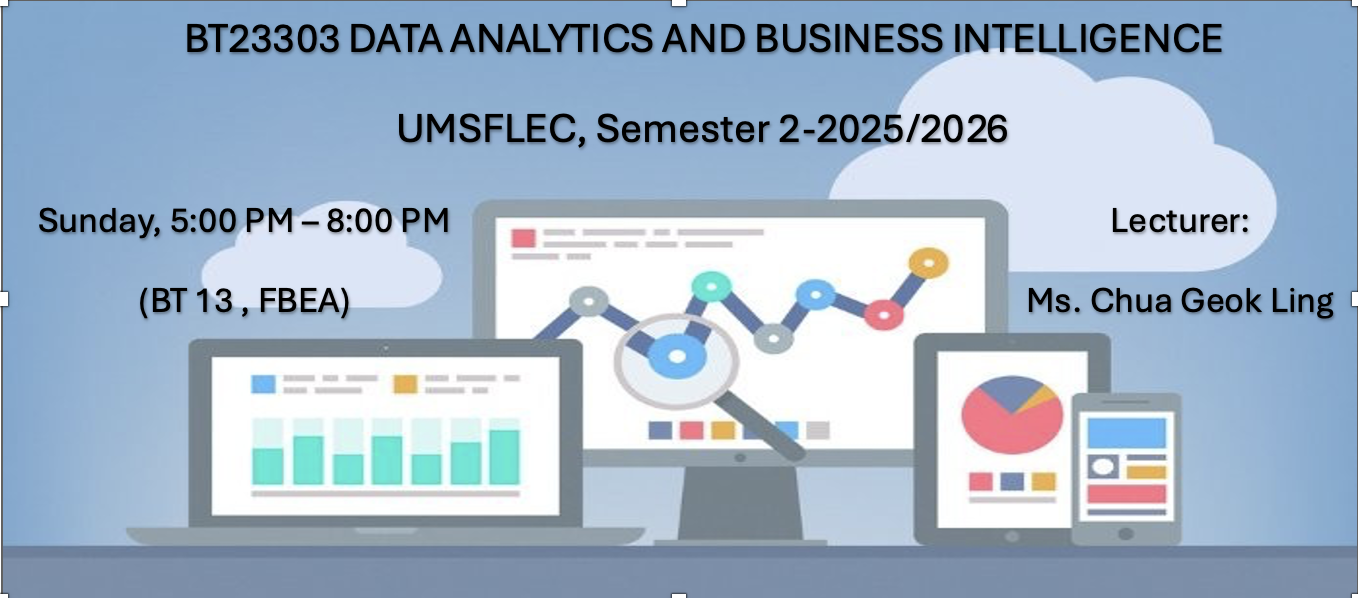
BT23303(SEKSYEN 5) DATA ANALITIK DAN KECERDASAN PERNIAGAAN [2-2025/2026]
This course provides students with theoretical understanding and practical applications of data analytics and business intelligence. Students will be exposed to various analytical techniques and how they can be employed to address business and/or economics issues and make decisions. This course offers students with a managerial perspective to data analytics beginning with descriptive analytics (e.g. data visualization and numerical measures), predictive analytics (e.g. hypothesis testing and regression analysis), and followed by prescriptive analytics (what-if analysis). Students will also learn to run data analysis using Microsoft Excel.
 iTEL
iTEL