 iTEL
iTEL
Search results: 65
![NF20502 MAKANAN DAN BUDAYA [2-2022/2023]](https://itel.ums.edu.my/pluginfile.php/37171/course/overviewfiles/Introduction%20of%20NF20502.jpg)
NF20502 MAKANAN DAN BUDAYA [2-2022/2023]
This course is a theoretical and empirical exploration of human food choices from an ecological, political and sociological perspective. The course is designed to discuss the socio-cultural dimensions of food production, preparation and consumption that included dimensions of individual, family, community and societal structures, as well as ideological, religious and cultural identities embodied in gender, race, ethnicity and socioeconomic status.
![NF40302 PEMBELIAN MAKANAN SECARA BERKUANTITI [1-2023/2024]](https://itel.ums.edu.my/pluginfile.php/409403/course/overviewfiles/Welcome%20NF40302.jpg)
NF40302 PEMBELIAN MAKANAN SECARA BERKUANTITI [1-2023/2024]
This course provides exposure on principles and theory of quantity purchasing, whereby aspects such as specifications required in the selection of food ingredient. In addition, on making a purchase, the students will be exposed to the method of acceptance, receiving and storage in foodservice facilities.
![NF40302 PEMBELIAN MAKANAN SECARA BERKUANTITI [1-2024/2025]](https://itel.ums.edu.my/pluginfile.php/961892/course/overviewfiles/NF40302%20MUKA%20HADAPAN.jpg)
NF40302 PEMBELIAN MAKANAN SECARA BERKUANTITI [1-2024/2025]
This course provides exposure on principles and theory of quantity purchasing, whereby aspects such as specifications required in the selection of food ingredient. In addition, on making a purchase, the students will be exposed to the method of acceptance, receiving and storage in foodservice facilities.
![NF40603 KEPIMPINAN ORGANISASI DALAM PERKHIDMATAN MAKANAN [1-2025/2026]](https://itel.ums.edu.my/pluginfile.php/1585501/course/overviewfiles/Leadership%20in%20Foodservice%20Innovation.png)
NF40603 KEPIMPINAN ORGANISASI DALAM PERKHIDMATAN MAKANAN [1-2025/2026]
This course introduces the theories and practices of leadership and organization, emphasizing their application in communication, decision-making, and effective management. Teaching and learning strategies include interactive lectures, case studies, role-play activities, and participation in community-based programs, while assessments consist of assignments, projects, practical exercises, and a final examination. By the end of the course, students will be able to demonstrate skills in managing meetings, making decisions, completing tasks, preparing documentation, and implementing organizational plans. Elements of Future Ready Curriculum (FRC) are embedded through experiential learning, the development of soft skills, and projects that foster collaboration, social engagement, and leadership in diverse organizational contexts.
![NN20604 PEMAKANAN LANJUTAN [2-2024/2025]](https://itel.ums.edu.my/pluginfile.php/1319402/course/overviewfiles/COVER.jpg)
NN20604 PEMAKANAN LANJUTAN [2-2024/2025]
This Advanced Nutrition course focuses on nutrient metabolism and biochemical pathways in both normal and abnormal states. Students will develop a comprehensive understanding of the objectives, scope, and principles of biochemistry in relation to human nutrition and biological processes. The course includes a combination of theoretical and practical learning, where students will be assessed through written exams, lab reports, lab practical skills assessments, and a nutritional biochemistry project. By the end of the semester, students will have a strong foundation in biochemical processes related to nutrition, enhanced critical thinking and problem-solving skills in metabolic pathways, and hands-on experience in laboratory techniques for nutritional biochemistry. This course equips students with the biochemical knowledge and practical skills essential for careers in nutrition and research
![NN20604 PEMAKANAN LANJUTAN [2-2025/2026]](https://itel.ums.edu.my/pluginfile.php/1907965/course/overviewfiles/pic%20front%20NN20604%20BN24.png)
NN20604 PEMAKANAN LANJUTAN [2-2025/2026]
This Advanced Nutrition course focuses on nutrient metabolism and biochemical pathways in both normal and abnormal states. Students will develop a comprehensive understanding of the objectives, scope, and principles of biochemistry in relation to human nutrition and biological processes. The course includes a combination of theoretical and practical learning, where students will be assessed through written exams, lab reports, lab practical skills assessments, and a nutritional biochemistry project. By the end of the semester, students will have a strong foundation in biochemical processes related to nutrition, enhanced critical thinking and problem-solving skills in metabolic pathways, and hands-on experience in laboratory techniques for nutritional biochemistry. This course equips students with the biochemical knowledge and practical skills essential for careers in nutrition and research
![PA20503 KANAK-KANAK DALAM KELUARGA BERMASALAH / CHILDREN IN TROUBLED FAMILIES [1-2024/2025]](https://itel.ums.edu.my/pluginfile.php/961064/course/overviewfiles/PA20503%20ITEL.jpg)
PA20503 KANAK-KANAK DALAM KELUARGA BERMASALAH / CHILDREN IN TROUBLED FAMILIES [1-2024/2025]
ABOUT THIS COURSE This course offers a unique opportunity for HA20 2nd Year Students and HA52 3rd Year Students to dive into a thought-provoking and essential topic: Children in Troubled Families. Whether you're taking this course as a requirement or as an elective, you’ll embark on a journey to explore the complex realities that children face when living in difficult, often heart-wrenching, circumstances. Throughout this course, you’ll gain a deep understanding of key definitions, concepts, and theories that help explain the struggles these children experience. We will uncover the psychological, mental, and emotional challenges they endure, and explore real-world issues that continue to affect children living with disadvantaged families or in troubled environments. You will be introduced to a variety of critical topics, such as how these conditions impact both children and their families, and you’ll engage in discussions that focus on the why and how behind these situations. What forces drive these family challenges? What ripple effects do they create on the children’s lives? This course doesn’t just focus on the problems—it’s also about solutions. Together, we will brainstorm and discuss practical ways to minimize the negative impacts these circumstances can have on children. Expect a mix of in-depth theory, real-world examples, and solution-based discussions to empower you to understand and, perhaps, influence positive change for children in troubled families. WEEKLY LECTURE: MONDAY (9.00AM - 11.00AM) VENUE: SEMINAR ROOM 2 (BS2) TUTORIALS: SECTION 1 (8.00AM - 9.00AM) elective Social Work SECTION 2 (9.00AM - 10.00AM) elective Social Work SECTION 3 (10.00AM - 11.00AM) Core Course SECTION 4 (11.00AM - 12.00PM) Core Course
PD6313 KAUNSELING KELOMPOK UNTUK PENAGIH DADAH [2-2022/2023]
This course aims to provide understanding and skills in conducting/managing the appropriate types of groups in various drug rehabilitation settings, emphasizing psychoeducational process groups. The typology of "Task-Process Group" and "Social-Process Group" will be studied in terms of objectives, role expectations, and behavior of the leader/counselor, as well as group members, theoretically and practically. Concerning the group psychoeducational process, students will examine theoretically and practically a model of the group counseling process that leads to the construction of group intelligence as a preparation and initial condition for the problem-solving process or therapy in the group.
PK6373 PROSES DAN PERKEMBANGAN KERJA KELOMPOK [2-2022/2023]
This course aims to provide knowledge and skills in managing various types of groups suitable for different work environments. Emphasis is given to the process, namely group counseling, psycho-educational group, and task group. Students will be exposed to practical objectives, role expectations, and behavior of leaders and group members. Building group cohesion will be emphasized as a prerequisite for therapeutic problem-solving or therapy in a group setting.
![PT10403 PENGENALAN PSIKOLOGI PERKEMBANGAN [1-2023/2024]](https://itel.ums.edu.my/pluginfile.php/408746/course/overviewfiles/WhatsApp%20Image%202023-10-06%20at%202.03.48%20PM.jpeg)
PT10403 PENGENALAN PSIKOLOGI PERKEMBANGAN [1-2023/2024]
WELCOME TO PT10403 COURSE
This course is important for students because it provides exposure to the development that every human being goes through, starting from conception to death. The development that an individual goes through includes physical growth and maturity, cognitive development, and socio-emotional and personality development. The life-span course approach that touches on each phase of human development through various theoretical perspectives is an important foundation for students to deepen any aspect of future psychological development.
This course is important for students because it provides exposure to the development that every human being goes through, starting from conception to death. The development that an individual goes through includes physical growth and maturity, cognitive development, and socio-emotional and personality development. The life-span course approach that touches on each phase of human development through various theoretical perspectives is an important foundation for students to deepen any aspect of future psychological development.
PZ30203 PRESKRIPSI SENAMAN [1-2024/2025]
This course offers in-depth coverage of individual exercise prescription, emphasizing the factors that influence exercise capacity in various contexts. Students will learn to assess and identify individuals at risk, with a focus on appropriate screening methods, exercise therapy interventions, or medical referrals for treatable conditions. Hands-on experiences are a core part of the curriculum, allowing students to assess, predict, and monitor exercise program outcomes. Students will refine skills in evaluating individual strengths and limitations, setting achievable goals, assessing progress, and making real-time adjustments to enhance program effectiveness. A key feature of this course is the integration of the Service Learning Malaysia–University for Society (SULAM) project, an experiential learning approach. Through SULAM, students apply theoretical knowledge and practical skills to tackle real-world health issues within communities, aligning their work with the Sustainable Development Goals (SDGs), specifically SDG 3 (Good Health and Well-being) and SDG 4 (Quality Education). This initiative empowers students and community members alike to foster healthier, more sustainable lifestyles. Continuous assessment ensures students’ engagement with practical tasks, reinforcing their ability to translate theory into practice while strengthening critical thinking, problem-solving, and teamwork skills.
![RH20303 PROPAGASI TUMBUHAN DAN PENGURUSAN SEMAIAN [1-2025/2026]](https://itel.ums.edu.my/pluginfile.php/1585107/course/overviewfiles/Screenshot%202025-10-12%20at%208.45.56%E2%80%AFPM.png)
RH20303 PROPAGASI TUMBUHAN DAN PENGURUSAN SEMAIAN [1-2025/2026]
Welcome to RH20303 : Plant Propagation and Nursery Management!
In this exciting course, you will explore how new plants are created and nurtured from seed to seedling, and from cuttings to fully grown plants. You’ll gain a solid understanding of both sexual propagation (through seeds) and asexual propagation (using vegetative parts), while also discovering the fascinating world of in vitro micropropagation as an advanced plant multiplication method. Beyond propagation techniques, this course will guide you through the establishment, maintenance, and management of plant nurseries, highlighting sustainable and effective practices used in modern horticulture.
Join us and develop the practical skills and knowledge that form the foundation of successful plant production. Let’s grow together, i mean literally!
In this exciting course, you will explore how new plants are created and nurtured from seed to seedling, and from cuttings to fully grown plants. You’ll gain a solid understanding of both sexual propagation (through seeds) and asexual propagation (using vegetative parts), while also discovering the fascinating world of in vitro micropropagation as an advanced plant multiplication method. Beyond propagation techniques, this course will guide you through the establishment, maintenance, and management of plant nurseries, highlighting sustainable and effective practices used in modern horticulture.
Join us and develop the practical skills and knowledge that form the foundation of successful plant production. Let’s grow together, i mean literally!
RT40402 ISU DAN PERKEMBANGAN SEMASA PERTANIAN [1-2025/2026]
RT40402 critically explores Malaysia’s agri-food systems through four interconnected modules:
1. Land, Adat, and Colonial Conservation
2. Trade Injustice, Price Inequality, and Market Power
3. Climate Governance and False Solutions
4. Commons, Cooperatives, and Sovereignty
Students will engage with concepts such as agrarian political economy, legal pluralism, climate justice, food sovereignty, and commons-based stewardship. Emphasis is placed on comparative regionalism, recognising Sabah and Sarawak as legally and historically distinct from Peninsular Malaysia.
1. Land, Adat, and Colonial Conservation
2. Trade Injustice, Price Inequality, and Market Power
3. Climate Governance and False Solutions
4. Commons, Cooperatives, and Sovereignty
Students will engage with concepts such as agrarian political economy, legal pluralism, climate justice, food sovereignty, and commons-based stewardship. Emphasis is placed on comparative regionalism, recognising Sabah and Sarawak as legally and historically distinct from Peninsular Malaysia.
![SF32303 FIZIK STATISTIK [1-2022/2023]](https://itel.ums.edu.my/pluginfile.php/1120/course/overviewfiles/SF32910_Cover.jpg)
SF32303 FIZIK STATISTIK [1-2022/2023]
In Thermodynamics it is shown that the thermal properties of a system compound of a very large number of particles is characterised by a relatively small number of quantities such as the internal energy, the temperature, the pressure, the volume, the entropy etc. Thermodynamics was developed without any hypothesis about a microscopic picture of the matter in its three forms: solid, liquid or gas. However with the development of the atomic theory, it began to be possible to look for the link between the macroscopic world and a microscopic picture. At the end of the 19th century and at the beginning of the 20th century, the first steps towards a theory relating the macroscopic world and a microscopic picture were proposed by Boltzmann and Gibbs. At this time the term Statistical Mechanics was coined by Gibbs.
This course will give an insights to students to develop a working knowledge of statistical physics at the undergraduate level and to use this knowledge to explore various applications in physics. This course develops the methods of statistical in classical physics and quantum physics.
This course will give an insights to students to develop a working knowledge of statistical physics at the undergraduate level and to use this knowledge to explore various applications in physics. This course develops the methods of statistical in classical physics and quantum physics.
![SF32903 FIZIK STATISTIK [1-2023/2024]](https://itel.ums.edu.my/pluginfile.php/409559/course/overviewfiles/SF32902_Cover%202.jpg)
SF32903 FIZIK STATISTIK [1-2023/2024]
In Thermodynamics it is shown that the thermal properties of a system compound of a very large number of particles is characterised by a relatively small number of quantities such as the internal energy, the temperature, the pressure, the volume, the entropy etc. Thermodynamics was developed without any hypothesis about a microscopic picture of the matter in its three forms: solid, liquid or gas. However with the development of the atomic theory, it began to be possible to look for the link between the macroscopic world and a microscopic picture. At the end of the 19th century and at the beginning of the 20th century, the first steps towards a theory relating the macroscopic world and a microscopic picture were proposed by Boltzmann and Gibbs. At this time the term Statistical Mechanics was coined by Gibbs.
This course will give an insights to students to develop a working knowledge of statistical physics at the undergraduate level and to use this knowledge to explore various applications in physics. This course develops the methods of statistical in classical physics and quantum physics.
This course will give an insights to students to develop a working knowledge of statistical physics at the undergraduate level and to use this knowledge to explore various applications in physics. This course develops the methods of statistical in classical physics and quantum physics.
![SG40106 PROJEK SAINTIFIK II [1-2023/2024]](https://itel.ums.edu.my/pluginfile.php/409616/course/overviewfiles/WhatsApp%20Image%202023-10-04%20at%208.50.05%20PM.jpeg)
SG40106 PROJEK SAINTIFIK II [1-2023/2024]
*Enroll at your own risk. This subject is not for the faint of heart.
Final Year Project 2: Where Science Meets Shenanigans! 🧪🎉
In the thrilling realm of Final Year Project 2, students morph into scientific superheroes with a side of mischief. It's a magical place where equations dance, test tubes tango, and beakers become the backdrop for academic adventures. Whether they're trying to build the world's smartest robot or cracking the code of the cosmos, this is where innovative ideas flourish and laughter echoes through the halls of knowledge.
But it's not just about data and discoveries; it's about embracing the quirks of the scientific journey. From quirky experiments to accidental explosions (don't worry, just metaphorical ones🥵), students emerge from Final Year Project 2 as seasoned geoscientists with a twinkle in their eyes and a pocketful of unforgettable memories. So, welcome to the laboratory of laughter and learning, where every hypothesis is an adventure waiting to happen! 🚀🔬😄 And owh...thesis writing 🥳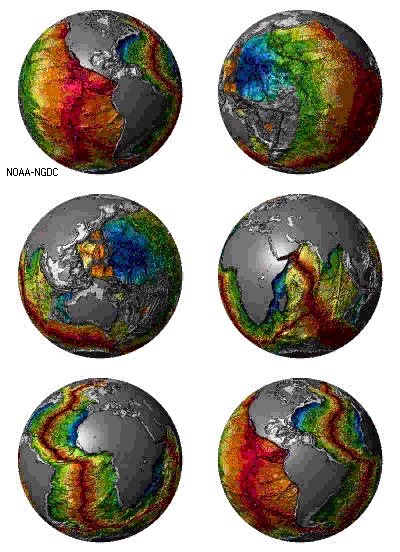
![SM14103 MATEMATIK I [1-2025/2026]](https://itel.ums.edu.my/pluginfile.php/1585735/course/overviewfiles/SM14103.jpg)
SM14103 MATEMATIK I [1-2025/2026]
This course provides an introduction to essential areas of mathematics, beginning with logic, set theory, real numbers, and complex numbers. It then explores the concepts of functions, limits, and continuity, which form the basis for differentiation and integration, including their techniques and applications. By the end of the course, students will have developed problem-solving skills and a solid mathematical foundation to support further studies in mathematics and related fields.
![SQ11203 PENGURUSAN KUALITI AIR [2-2022/2023]](https://itel.ums.edu.my/pluginfile.php/48442/course/overviewfiles/water.png)
SQ11203 PENGURUSAN KUALITI AIR [2-2022/2023]
This course provides an understanding of water quality that helps make aquaculture more environment-friendly and productive. Factors that affect water quality are explained. Water management and disposal methods are given emphasis. Topics of discussion include effects of pollution on aquaculture – problems associated with survival, growth and reproduction of cultured animals and public health problems.
Kursus ini memberi kefahaman tentang pengurusan kualiti air agar aktivti akuakultur yang dijalankan lebih mesra alam dan produktif. Faktor-faktor yang mempengaruhi kualiti air akan turut dijelaskan. Pengurusan air dan kaedah pelupusan air buangan juga akan diberikan penekanan. Topik perbincangan termasuklah kesan-kesan pencemaran terhadap akuakultur, masalah berkaitan dengan kemandirian, pertumbuhan dan pembiakan haiwan kulturan serta masalah berkaitan dengan kesihatan awam.
Kursus ini memberi kefahaman tentang pengurusan kualiti air agar aktivti akuakultur yang dijalankan lebih mesra alam dan produktif. Faktor-faktor yang mempengaruhi kualiti air akan turut dijelaskan. Pengurusan air dan kaedah pelupusan air buangan juga akan diberikan penekanan. Topik perbincangan termasuklah kesan-kesan pencemaran terhadap akuakultur, masalah berkaitan dengan kemandirian, pertumbuhan dan pembiakan haiwan kulturan serta masalah berkaitan dengan kesihatan awam.
![SQ21202 PENGURUSAN SUMBER PERIKANAN [2-2024/2025]](https://itel.ums.edu.my/pluginfile.php/1319720/course/overviewfiles/IMG_20240916_065445.jpg)
SQ21202 PENGURUSAN SUMBER PERIKANAN [2-2024/2025]
This course is designed to provide the students with an understanding of the management of fisheries resources encompassing capture fisheries and culture-based fisheries. The emphasis will be on knowledge-based management consistent with the principles of sustainable development. Topics of discussion include diversity of fishery resources and their habitats, dynamics of exploited fish populations, methods used in capture fisheries and responsible stock enhancement, sustainable fisheries - marine biodiversity linkage, ecosystem approach to fisheries management and effects of conservation interventions. Climate change adaptations in tropical fisheries will also be elaborated.
![SS21303 ANALISIS KUALITI UDARA DAN HINGAR [1-2022/2023]](https://itel.ums.edu.my/pluginfile.php/1226/course/overviewfiles/Presentation1.jpg)
SS21303 ANALISIS KUALITI UDARA DAN HINGAR [1-2022/2023]
This course covers theoretical and practical aspects of characteristics and methodologies of air quality and noise analyses. Topics that will be explored and discussed include atmospheric composition and its characteristics, atmospheric chemistry and air pollution, noise pollution, air quality and noise measurement techniques and analyses (both indoor and ambient environment). In addition, related air and noise guidelines and regulations, both national and international standards will be included in class lectures.
 iTEL
iTEL