 iTEL
iTEL
Search results: 263
![BC6023(SECTION 1) INTERCULTURAL MANAGEMENT [3-2023/2024]](https://itel.ums.edu.my/pluginfile.php/894051/course/overviewfiles/cultural-management.jpg)
BC6023(SECTION 1) INTERCULTURAL MANAGEMENT [3-2023/2024]
As a result of the strong developments that have taken place in telecommunications and transportation, the world seems to have shrunk and is often referred to as a ‘global village’. This has brought about an increased interaction between managers from various cultures. The increase in the number and strength of multinational corporations from America, Europe, Japan, South Korea and emerging market nations has often times brought about a clash with local cultures. As a result, it is important that managers of today understand culture and the implications of culture in the development of individual and group culture as well as management style. This course will emphasize on the differences in management practices because of differences in culture. Focus will be given towards looking at the differences between the Western and Eastern management styles. Topics that will be discussed include the interaction between culture and organization, strategy and culture, human resource and culture, leadership and culture, as well as on communication and negotiation. Class discussions will focus on the practices of Western multinational and Eastern multinational corporations.
![BC6023(SECTION 5) INTERCULTURAL MANAGEMENT [3-2023/2024]](https://itel.ums.edu.my/pluginfile.php/894057/course/overviewfiles/image.png)
BC6023(SECTION 5) INTERCULTURAL MANAGEMENT [3-2023/2024]
As a result of the strong developments that have taken place in telecommunications and transportation, the world seems to have shrunk and is often referred to as a ‘global village’. This has brought about an increased interaction between managers from various cultures. The increase in the number and strength of multinational corporations from America, Europe, Japan, South Korea and emerging market nations has often times brought about a clash with local cultures. As a result, it is important that managers of today understand culture and the implications of culture in the development of individual and group culture as well as management style. This course will emphasize on the differences in management practices because of differences in culture. Focus will be given towards looking at the differences between the Western and Eastern management styles. Topics that will be discussed include the interaction between culture and organization, strategy and culture, human resource and culture, leadership and culture, as well as on communication and negotiation. Class discussions will focus on the practices of Western multinational and Eastern multinational corporations.
BD30006 LATIHAN ILMIAH/PRAKTIKUM [2-2023/2024]
This course aims to expose students to the real business environment in business, economics and management. Students will spend 12 weeks in organisations/firms of their choice and will be supervised by the organisations/firms management personnel. Apart from the immediate supervision, students will be visited by the academic supervisor. Student ability and performance in applying verbal and non-verbal skills will be assessed through their report writing ability, log book preparation and comments from their immediate supervisor.
![BD31803 PASARAN OPSYEN DAN KEWANGAN HADAPAN [2-2023/2024]](https://itel.ums.edu.my/pluginfile.php/712869/course/overviewfiles/FBEA%20Stock%20Lab%20Monday%20%40%208.00am.jpg)
BD31803 PASARAN OPSYEN DAN KEWANGAN HADAPAN [2-2023/2024]
Derivatives instruments are relatively new instruments compared to financial assets such as equities and bonds. It became crucial when a fund manager shorted the housing market and caused the Global Financial Crisis in 2009. Subsequently, regulators of every exchange intensified regulations in the derivatives market. This market has since become a focal point for institutions and individual traders looking to optimise strategies for speculation, hedging, and arbitrage to mitigate risks and maximise profits. As a result, this course carries immense importance for students who are actively seeking a career in the field of finance.
Derivatives are financial weapons of mass destruction - Warren Buffett
Derivatives are financial weapons of mass destruction - Warren Buffett
BD33103 (SEKSYEN 1) UNDANG-UNDANG DAN KAWAL SELIA KEWANGAN [2-2025/2026]
The course discusses the legal framework relating to banking and financial institutions in Malaysia as provided under the Financial Services Act 2013 (Act 758), Islamic Financial Services Act 2013 (Act 759), Central Bank of Malaysia Act 2009 (Act 701), and several other statutes. The important topics covered include the structure of the Malaysian banking system, banker and customer’s relationship, rights and duties of bankers and customers, customer’s mandate, types of customer accounts, regulation and supervision of banks by the Central Bank of Malaysia, negotiable instruments, electronic banking and internet banking, Islamic banking in Malaysia, the regulations on anti-money laundering and anti-terrorism financing in Malaysia, and the regulatory framework for Financial Markets in Malaysia. Related cases will be discussed to enable students to understand the course theoretically and practically. Knowledge of the law will be able to assist students in their every day relationships and is an asset in the face of their careers
BD33103 (UMSFLEC) UNDANG-UNDANG DAN KAWAL SELIA KEWANGAN [2-2025/2026]
The course discusses
the legal framework relating to banking and financial institutions in Malaysia
as provided under the Financial Services Act 2013 (Act 758), Islamic Financial
Services Act 2013 (Act 759), Central Bank of Malaysia Act 2009 (Act 701), and
several other statutes. The important topics covered include the structure of
the Malaysian banking system, banker and customer’s relationship, rights and
duties of bankers and customers, customer’s mandate, types of customer
accounts, regulation and supervision of banks by the Central Bank of Malaysia,
negotiable instruments, electronic banking and internet banking, Islamic
banking in Malaysia, the regulations on anti-money laundering and
anti-terrorism financing in Malaysia, and the regulatory framework for
Financial Markets in Malaysia. Related
cases will be discussed to enable students to understand the course
theoretically and practically.
![BG20103(SEKSYEN 1) KELAKUAN PENGGUNA [2-2023/2024]](https://itel.ums.edu.my/pluginfile.php/715797/course/overviewfiles/CB%20PIC.png)
BG20103(SEKSYEN 1) KELAKUAN PENGGUNA [2-2023/2024]
Hi all,
A big welcome to the BG20103 Consumer Behaviour Course. I am excited that we could all learn together some imperative in consumer behaviour that will help shape you as a marketing professional in the future.
This course focuses on understanding the major factors underlying consumer behavior. We explore theories and research emanating from marketing, psychology, and sociology, and learn to use these to better understand and predict how consumers will respond to marketing actions.
Hope we will have a great semester learning together.
Best regards,
DR BAMINI KPD BALAKRISHNAN
![BH20303 EKONOMI BURUH [2-2023/2024]](https://itel.ums.edu.my/pluginfile.php/712974/course/overviewfiles/Word-Art.jpeg)
BH20303 EKONOMI BURUH [2-2023/2024]
This course is designed to provide an introduction to the theory and practice of contemporary labour economics. The primary focus of this course will be on developing an understanding of the determinants of wage rate and employment levels in labour market. The analytical tools of neoclassical economics will be used to examine contemporary policy issues. Topics of discussion include supply and demand of labour, labour market equilibrium, wage determination and structure, and migration.
![BH6073 TECHNOLOGY APPLICATION IN HUMAN CAPITAL MANAGEMENT [2-2025/2026]](https://itel.ums.edu.my/pluginfile.php/1901689/course/overviewfiles/WhatsApp%20Image%202026-03-16%20at%201.03.58%20PM.jpeg)
BH6073 TECHNOLOGY APPLICATION IN HUMAN CAPITAL MANAGEMENT [2-2025/2026]
This course is designed to equip students with knowledge and practical skills in business analytics, with a particular focus on the application of data analytics and big data in Human Capital Management (HCM). The course introduces fundamental concepts of business analytics, including descriptive, predictive, and prescriptive analytics, and explores how these approaches can be applied to support data-driven decision making within organizations. Students will learn how workforce data can be collected, analyzed, and interpreted to improve key HR functions such as recruitment, employee performance management, training and development, and workforce planning. In addition, the course examines the role of emerging technologies such as people analytics platforms, Human Resource Information Systems (HRIS), and artificial intelligence in enhancing HR effectiveness and organizational performance. Through practical examples, case studies, and analytical exercises, students will develop the ability to interpret HR-related data and generate meaningful insights that support strategic human capital decisions in a rapidly evolving digital business environment.
BJ6072 ETHICS IN HUMAN CAPITAL MANAGEMENT [2-2025/2026]
This course examines ethical principles, professional values, and decision-making processes in managing human capital within contemporary organisations. It focuses on ethical dilemmas, rights and responsibilities in employment, ethical leadership, and the development of ethical learning cultures. Students will critically evaluate ethical frameworks and apply them to complex and emerging human capital management issues, including leadership practices, organisational governance, and digitalisation in HCM. Emphasis is placed on ethical judgement, interpersonal competence, and professional accountability in addressing real-world challenges. Through interactive lectures, case-based discussions, presentations, projects, and examinations, students will develop the ability to articulate ethical positions, design ethical leadership interventions, and make informed ethical decisions that anticipate consequences and support sustainable and responsible human capital management.
BLENDED LEARNING MASTERCLASS: Practical Tips, Tricks, and Pitfalls to Avoid
This Blended Learning Masterclass is a specialized session tailored for the UMS Faculty of Engineering, focusing on the strategic shift from traditional to hybrid pedagogy.
Led by PM Ts. Dr. Mohd Kamaruddin bin Abd Hamid, the sharing clarifies the critical distinctions between Blended Supplement and Blended Substitution models. Participants will gain actionable "tips and tricks" to optimize technical content delivery while learning to navigate common pedagogical pitfalls that often lead to student disengagement or faculty burnout. This session provides a practical roadmap for lecturers to enhance engineering education through efficient, high-impact blended strategies.
![BM7023(SECTION 1) HUMAN RESOURCE MANAGEMENT [2-2024/2025]](https://itel.ums.edu.my/pluginfile.php/1285745/course/overviewfiles/TEXT%20BOOK%20HRM.jpg)
BM7023(SECTION 1) HUMAN RESOURCE MANAGEMENT [2-2024/2025]
This course will expose students to concepts and knowledge in Human Resource Management in organization. The coverage will be all steps in human resource management including recruitment, placement, talent management, training and development, compensation and issues on human resource management. Students will be guided through lectures, cases, presentation, peer assessment, and group project.
![BP24103 PERCUKAIAN I [2-2025/2026]](https://itel.ums.edu.my/pluginfile.php/1906207/course/overviewfiles/WhatsApp%20Image%202026-03-10%20at%2014.45.57.jpeg)
BP24103 PERCUKAIAN I [2-2025/2026]
Course Description
This course provides an introduction to the Malaysian income tax system based on the Income Tax Act 1967. It explains the basic principles and objectives of taxation, sources of government revenue, and the role of the Inland Revenue Board of Malaysia in tax administration. The course covers the determination of individual residence status, taxation of employment income, capital allowances, and business income for sole proprietorships and partnerships. It also discusses other sources of income such as dividends, interest, rental, and royalties.
Students will learn how to compute individual tax liability, including aggregate income, total income, chargeable income, personal reliefs, tax rebates, and applicable tax rates. The course also introduces tax administration procedures, e-filing through the MyTax Portal, and ethical issues in taxation to encourage responsible tax compliance.
Learning Outcomes
At the end of the course the students will be able to:
1. Analyze the scope and implementation of the tax system and the obligations of taxpayers in Malaysia (PLO1, C4)
2. Evaluate various tax strategies on different circumstances according to the current Malaysian taxation system (PLO2, C5)
3. Collaborate effectively in analyzng tax dilemmas regarding tax evasion and the implementation of 'Aadab' in tax compliance (PLO4, A3)
4. Exhibit digital literacy in data search for current tax compliance environment in Malaysia (PLO6, C5)
BP27203(SEKSYEN 1,2) KEWANGAN KORPORAT [1-2025/2026]
This course provides a comprehensive framework for corporate financial decision-making from the perspective of an accountant and financial manager. Students will explore how financial managers leverage accounting information to drive strategic fianncial decisions that create and sustain firm value. The course covers the core pillars of financing, including the time value of money, risk and return, security valuation, and capital budgeting, with a constant emphasis on their interconnection with financial statements. Advanced topics such as determining the optimal cost of capital, evaluating capital structure, and formulating dividend policy are examined in depth. Ultimately, the course equips students with the knowledge, cognitive and numeracy skills to evaluate corporate performance, assess future prospects, and make strategic recommendations
![BP27203(SEKSYEN 1&2) KEWANGAN KORPORAT [1-2023/2024]](https://itel.ums.edu.my/pluginfile.php/408290/course/overviewfiles/Untitled-design-52.jpg)
BP27203(SEKSYEN 1&2) KEWANGAN KORPORAT [1-2023/2024]
This course aims to build the fundamental financial knowledge to address the following areas: efficient market hypothesis, working capital management, dividend policy, leverage and capital structure, merger and acquisition and risk management mechanism
Lecturer Office: Level 3, Room A-3-6
Email: allif@ums.edu.my
Lecturer Office: Level 3, Room A-3-6
Email: allif@ums.edu.my
![BP35103 SISTEM MAKLUMAT PERAKAUNAN I [2-2024/2025]](https://itel.ums.edu.my/pluginfile.php/1518457/course/overviewfiles/accounting-information-system-or-ais-for-financial-data-which-component-of-people-procedures-data-software-information-technology-infrastructure-internal-control-vector.jpg)
BP35103 SISTEM MAKLUMAT PERAKAUNAN I [2-2024/2025]
This course covers Accounting Information Systems (AIS) topics in three main parts. The first part introduces the basic concepts of AIS including its objectives, components, and subsystems. This section also introduces students to the techniques of documenting accounting systems. The second section discusses in depth the business processes (cycles) that include sales, purchasing, production, human resources, and general ledger. Integration of business processes in ERP environment is also highlighted. Use of selected accounting software will also take place at this stage. The final section discusses the emerging issues in computer crimes, computer ethics and the roles of internal controls. Finally, a special focus will be given to selected issues related to AIS considering selected issues in IT potentially affecting AIS.
![BP37203 ANALITIK DATA BESAR DAN KECERDASAN BUATAN UNTUK AKAUNTAN [2-2025/2026]](https://itel.ums.edu.my/pluginfile.php/1944256/course/overviewfiles/ChatGPT%20Image%20Mar%2011%2C%202026%2C%2010_41_30%20AM.png)
BP37203 ANALITIK DATA BESAR DAN KECERDASAN BUATAN UNTUK AKAUNTAN [2-2025/2026]
The course aims to develop students’ analytical skills and digital awareness for the modern accounting environment. It introduces students to the fundamental concepts and applications of Big Data Analytics and Artificial Intelligence (AI) in the accounting profession. It explores how emerging digital technologies are transforming accounting practices, enabling accountants to analyze large volumes of financial and non-financial data for improved decision-making. Additioanlly, it highlights the risks, governance, and ethical issues related to the use of big data and AI in accounting.
![BP37303 PASARAN DAN INSTITUSI KEWANGAN [2-2025/2026]](https://itel.ums.edu.my/pluginfile.php/1944265/course/overviewfiles/WhatsApp%20Image%202026-03-13%20at%2007.49.56.jpeg)
BP37303 PASARAN DAN INSTITUSI KEWANGAN [2-2025/2026]
Course Description
This course provides an overview of the structure, functions, and operations of financial markets and financial institutions, with emphasis on the Malaysian financial system. It examines the role of different markets such as money markets, capital markets, foreign exchange markets, and derivatives markets, as well as the institutions that facilitate financial intermediation. The course also explores regulatory frameworks, the role of the central bank, banking institutions, Islamic finance principles, and non-bank financial intermediaries. Students will gain an understanding of how financial markets operate, how financial instruments are traded, and how financial institutions contribute to economic development and financial stability in Malaysia.
Learning Outcomes
At the end of the course the students will be able to:
- Evaluate the structure, functions, instruments, and regulatory framework of Malaysian financial markets and institutions, including conventional and Islamic systems, within the context of Malaysian financial development (PLO1, C5)
- Evaluate appropriate financial market instruments and institutional mechanisms to address real-world financial and economic issues in Malaysia, including risk management, capital raising, and monetary policy implementation (PLO2, C5)
- Demonstrate analytical findings on Malaysian financial market developments, policies, and institutional roles using appropriate financial methodologies (PLO5, A3)
Learning Resources
Main:
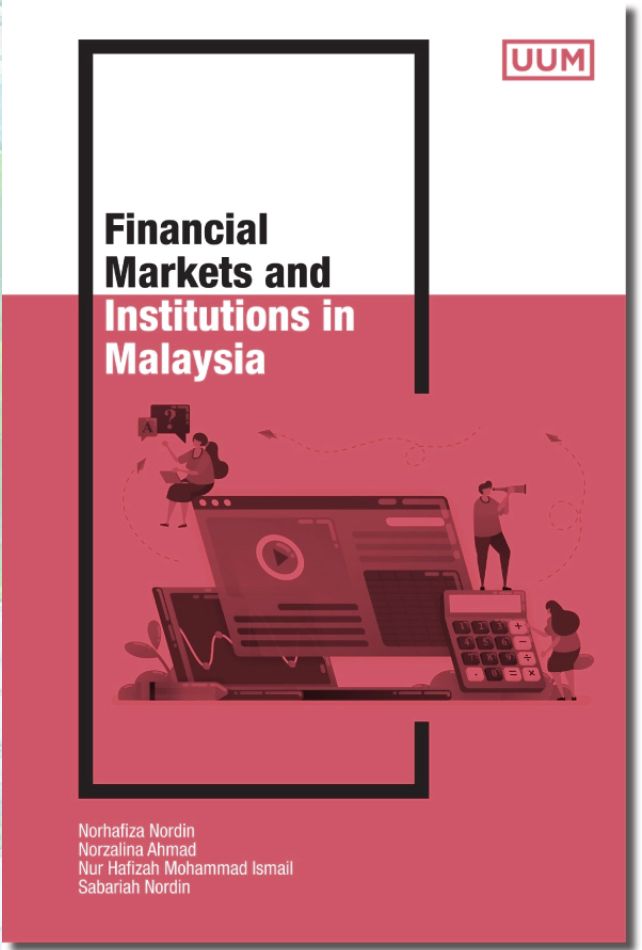
Norhafiza Nordin, Norzalina Ahmad , Nur Hafizah Mohammad Ismail & Sabariah Nordin (2025). Financial Markets and Institutions in Malaysia, UUM Press
Additional
- Taghizadeh‑Hesary, F., Mohd Thas Thaker, H., Bhatti, M. I., & Pitchay, A. A. (Eds.). (2025). Islamic financial markets and institutions: Challenges, financial stability, and inclusivity. Springer Singapore
- Haniff, M. N., Ali, N., Ismail, N., & Md Yusoff, N. (2022). Introduction to Malaysian financial markets
- Bank Negara Malaysia
- Islamic Financial Services Board. (2024). Islamic Financial Stability Report 2024. Islamic Financial Services Board.
![BT10903(PLUMS) MATEMATIK PERNIAGAAN [2-2023/2024]](https://itel.ums.edu.my/pluginfile.php/731130/course/overviewfiles/Mathematical%20Report%20Logo%20.png)
BT10903(PLUMS) MATEMATIK PERNIAGAAN [2-2023/2024]
This course aims to provide a balanced exposure to students in terms of conceptual understanding of mathematics, development and application of mathematical techniques in the context of business, economics and social sciences. Among the highlighted aspects include elementary functions, linear mathematics and calculus with both theoretical and real-life applications.
"Mathematics gives us hope that every problem has a solution"
![BT11703(SEKSYEN 2) MAKROEKONOMI [2-2025/2026]](https://itel.ums.edu.my/pluginfile.php/1906276/course/overviewfiles/WIJAYA%20KAMAL%20RAMLAN.png)
BT11703(SEKSYEN 2) MAKROEKONOMI [2-2025/2026]
Course Description
This course provides introductory materials for macroeconomics. The syllabus focuses on applications and policy while explaining the formal economic theory. The first three chapters introduce students to the economist’s view of the world, the role of assumptions in developing theory or models, and the role of economists in making policy. The coverage of macroeconomics includes how to measure national income, cost of living, and the behavior of the real economy, money, and prices in the long run. The last few chapters present the macroeconomics of open economies, maintaining the long-run assumptions of price flexibility and full employment.
Course Learning Outcomes
At the end of the course, the students should be able to:
• Analyse key macroeconomic concepts and theories with clarity and accuracy in foundational economic contexts. (PLO1, C4)
• Analyse fundamental macroeconomic concepts to evaluate contemporary economic issues using logical reasoning and systems thinking to understand their interrelationships. (PLO2, C4)
• Demonstrate effective communication skills when discussing contemporary macroeconomic issues in both written and oral formats. (PLO5, A3)
• Demonstrate personal skills in analyzing macroeconomic concept in relation to current and global economics issues. (PLO9, A3)
This course provides introductory materials for macroeconomics. The syllabus focuses on applications and policy while explaining the formal economic theory. The first three chapters introduce students to the economist’s view of the world, the role of assumptions in developing theory or models, and the role of economists in making policy. The coverage of macroeconomics includes how to measure national income, cost of living, and the behavior of the real economy, money, and prices in the long run. The last few chapters present the macroeconomics of open economies, maintaining the long-run assumptions of price flexibility and full employment.
Course Learning Outcomes
At the end of the course, the students should be able to:
• Analyse key macroeconomic concepts and theories with clarity and accuracy in foundational economic contexts. (PLO1, C4)
• Analyse fundamental macroeconomic concepts to evaluate contemporary economic issues using logical reasoning and systems thinking to understand their interrelationships. (PLO2, C4)
• Demonstrate effective communication skills when discussing contemporary macroeconomic issues in both written and oral formats. (PLO5, A3)
• Demonstrate personal skills in analyzing macroeconomic concept in relation to current and global economics issues. (PLO9, A3)
 iTEL
iTEL