 iTEL
iTEL
搜索结果: 84
![AK21103 PRINSIP PERHUBUNGAN AWAM [1-2025/2026]](https://itel.ums.edu.my/pluginfile.php/1586051/course/overviewfiles/Latif%20Lai%20Water%20Colour.png)
AK21103 PRINSIP PERHUBUNGAN AWAM [1-2025/2026]
This course introduces students to the foundational concepts and practices of public relations, tracing its historical evolution and examining its role in contemporary society. It provides a comprehensive overview of definitions, key theories, principles, and strategic planning approaches in communication management. Students will also explore career pathways and professional ethics within the field of public relations.
ABOUT THE LECTURER
Dr Lai is a Senior Lecturer in Communication at Universiti Malaysia Sabah (UMS), specialising in strategic communication and public engagement. As the head of the UMS–UNICEF C4D Research Unit, Dr Lai brings extensive experience in Social and Behaviour Change Communication (SBCC), working with government agencies, NGOs, and community stakeholders. His academic work bridges theory and practice, with a strong emphasis on ethical communication, strategic planning, and the societal impact of public relations. Dr Lai is passionate about guiding students to critically explore the evolution, principles, and professional pathways of public relations, equipping them with the analytical and practical skills needed to thrive in today’s dynamic communication landscape.
ABOUT THE LECTURER
Dr Lai is a Senior Lecturer in Communication at Universiti Malaysia Sabah (UMS), specialising in strategic communication and public engagement. As the head of the UMS–UNICEF C4D Research Unit, Dr Lai brings extensive experience in Social and Behaviour Change Communication (SBCC), working with government agencies, NGOs, and community stakeholders. His academic work bridges theory and practice, with a strong emphasis on ethical communication, strategic planning, and the societal impact of public relations. Dr Lai is passionate about guiding students to critically explore the evolution, principles, and professional pathways of public relations, equipping them with the analytical and practical skills needed to thrive in today’s dynamic communication landscape.
AS30903 UNDANG-UNDANG KEMANUSIAAN ANTARABANGSA [2-2022/2023]
The course explores the development and operation of International Humanitarian Law (IHL) in regulating the conduct of armed conflict and violence involving both combatants and non-combatants. This course provides a basic understanding of the historical and contemporary aspects of IHL. It explains the roles played by international bodies such as the International Committee of the Red Cross, United Nations, International Criminal Court, and States. In addition to the knowledge on IHL, the course also exposes the students to the field of humanitarian work and equip them with basic skills on responding to humanitarian emergencies such as first aid and disaster preparedness. This as an important social responsibility value among the youth.
![BD31103 ASAS EKONOMETRIK UNTUK KEWANGAN [1-2024/2025]](https://itel.ums.edu.my/pluginfile.php/960758/course/overviewfiles/BASIC%20ECONOMETRIC%20FOR%20FINANCE%20MONDAY%20%40%208.00%20A.M%20FBEA%20STOCKLAB.jpg)
BD31103 ASAS EKONOMETRIK UNTUK KEWANGAN [1-2024/2025]
“A good way to do econometrics is to look for good natural experiments and use statistical methods that can tidy up the confounding factors that Nature has not controlled for us.”
― Daniel McFadden
― Daniel McFadden
![BD31803 PASARAN OPSYEN DAN KEWANGAN HADAPAN [2-2023/2024]](https://itel.ums.edu.my/pluginfile.php/712869/course/overviewfiles/FBEA%20Stock%20Lab%20Monday%20%40%208.00am.jpg)
BD31803 PASARAN OPSYEN DAN KEWANGAN HADAPAN [2-2023/2024]
Derivatives instruments are relatively new instruments compared to financial assets such as equities and bonds. It became crucial when a fund manager shorted the housing market and caused the Global Financial Crisis in 2009. Subsequently, regulators of every exchange intensified regulations in the derivatives market. This market has since become a focal point for institutions and individual traders looking to optimise strategies for speculation, hedging, and arbitrage to mitigate risks and maximise profits. As a result, this course carries immense importance for students who are actively seeking a career in the field of finance.
Derivatives are financial weapons of mass destruction - Warren Buffett
Derivatives are financial weapons of mass destruction - Warren Buffett
![BG33703 PEMASARAN MASYARAKAT [2-2022/2023]](https://itel.ums.edu.my/pluginfile.php/47224/course/overviewfiles/BG33703%20WELCOME-2.png)
BG33703 PEMASARAN MASYARAKAT [2-2022/2023]
Social Marketing is all about – using techniques and proven theory from the field of Marketing to address social issues mainly through attempting to change behaviour in ways that benefit society. In this course, we take Marketing step-by-step to create a Social Marketing Plan. The new edition of the classic 1989 Kotler/Roberto text covers each area of traditional marketing as it relates to Social Marketing in extensive detail, with in-depth case studies and examples taken from hundreds of real-life Social Marketing campaigns.
![BM6013(SECTION 2) MANAGEMENT AND ORGANIZATIONAL BEHAVIOUR [1-2024/2025]](https://itel.ums.edu.my/pluginfile.php/956021/course/overviewfiles/Screenshot%202024-09-18%20153136.png)
BM6013(SECTION 2) MANAGEMENT AND ORGANIZATIONAL BEHAVIOUR [1-2024/2025]
This course is designed to give an overall understanding of the importance of management and organizational behaviour. The framework highlights behaviour, structure and processes in organisation. The contents are about the field of organisational behaviour, understanding and managing individual behaviour, group behaviour and interpersonal influence, organisational processes and organisational design, change and innovation.
![BM6013(SECTION 4) MANAGEMENT AND ORGANIZATIONAL BEHAVIOUR [1-2024/2025]](https://itel.ums.edu.my/pluginfile.php/956030/course/overviewfiles/Turquoise%20and%20Monochrome%20Photo%20Heading%20Website%20Facebook%20Cover.png)
BM6013(SECTION 4) MANAGEMENT AND ORGANIZATIONAL BEHAVIOUR [1-2024/2025]
This course is designed to give an overall understanding of the importance of management and organizational behaviour. The framework highlights behaviour, structure and processes in organisation. The contents are about the field of organisational behaviour, understanding and managing individual behaviour, group behaviour and interpersonal influence, organisational processes and organisational design, change and innovation.
![BT12503(SEKSYEN 2) KEWANGAN PERNIAGAAN [2-2023/2024]](https://itel.ums.edu.my/pluginfile.php/715536/course/overviewfiles/BUSINESS%20FINANCE.png)
BT12503(SEKSYEN 2) KEWANGAN PERNIAGAAN [2-2023/2024]
This course is an introduction to the field of finance. It covers the main idea in finance, which starts with a general background, conceptual framework, and techniques to assist in managing financial decisions.
The main focus is on fundamental principles, exercises, and modern financial management procedures. This subject will provide students with guidance in making personal, corporate, financial, and investment decisions, as well as give them a basic understanding of the field of finance.
(Dr. Salleh)
BT12503(SEKSYEN 2) PENGURUSAN KEWANGAN [1-2022/2023]
This course is an introduction course in the field of finance. It covers the main idea in finance that starts with a general background, conceptual framework and techniques to assist in managing financial decision. The main focuses are towards fundamental principal, exercises and modern financial management procedures. This subject will provide student the guidance in making personal, corporate, financial and investment decisions, as well as giving them the basic understanding in the field of finance.
![BT12503(SEKSYEN 3) KEWANGAN PERNIAGAAN [1-2024/2025]](https://itel.ums.edu.my/pluginfile.php/1070552/course/overviewfiles/Screenshot%202024-10-15%20195751.jpg)
BT12503(SEKSYEN 3) KEWANGAN PERNIAGAAN [1-2024/2025]
This course is an introduction to the field of finance. It covers the main idea in finance, which starts with a general background, conceptual framework, and techniques to assist in managing financial decisions. The main focus is on fundamental principles, exercises, and modern financial management procedures. This subject will provide students with guidance in making personal, corporate, financial, and investment decisions, as well as give them a basic understanding of the field of finance.
![BT12503(SEKSYEN 3) KEWANGAN PERNIAGAAN [2-2024/2025]](https://itel.ums.edu.my/pluginfile.php/1329935/course/overviewfiles/BUSINESS%20FINANCE%20SEM%202.jpg)
BT12503(SEKSYEN 3) KEWANGAN PERNIAGAAN [2-2024/2025]
This course is an introduction to the field of finance. It covers the main idea in finance, which starts with a general background, conceptual framework, and techniques to assist in managing financial decisions. The main focus is on fundamental principles, exercises, and modern financial management procedures. This subject will provide students with guidance in making personal, corporate, financial, and investment decisions, as well as give them a basic understanding of the field of finance.
![BT21503(SEKSYEN 1) ETIKA PERNIAGAAN [2-2024/2025]](https://itel.ums.edu.my/pluginfile.php/1330079/course/overviewfiles/ETHIC.jpg)
BT21503(SEKSYEN 1) ETIKA PERNIAGAAN [2-2024/2025]
This course is an introduction to the field of business ethics. It explores fundamental ethical theories, principles, and frameworks that guide decision-making in business. Emphasis is placed on ethical reasoning, real-world case studies, and the role of ethical leadership in fostering responsible business practices. This subject will provide students with the knowledge and analytical skills necessary to navigate ethical dilemmas in professional and corporate settings while promoting integrity and ethical awareness in business decision-making.
CV11102 ASAS LUKISAN I [1-2023/2024]
CV11102 ASAS LUKISAN I
Kursus ini memperkenalkan pengenalan tentang lukisan, peralatan dan bahan. Pelajar melukis bentuk geometrik dan organik secara asas dengan memfokuskan keberadaan cahaya berdasarkan dengan alam. Kemudian pelajar diberi kemahiran menggunakan peralatan, memahami teknik asas lukisan, mengeksploitasi media/bahan kering, kefahaman terhadap garisan, tonal, jalinan, ruang, rupa, bentuk dan struktur objek. Pelajar juga diperkenalkan tentang fungsi ruang melalui garisan perspektif dan titik lenyap dengan kaedah belajar di luar studio. Pelajar juga Di akhir kursus pelajar akan menghasilkan lukisan berdasarkan sumber alam benda dan alam semulajadi secara berkesan.
RujukanAlbert, G., Wolf, R. 1991. Basic Drawing Techniques. Cincinnati, Ohio: North Light Books. Betti, C., & Sale, T. 1997. Drawing AContemporary Approach. USA: Harcourt Brace College Pub. Bowen, R. 1992. Drawing Master Class. London: LeopardBooks. Jenny Rodwell. 1989. Drawing, USA: Hamlyn.Smolucha, L. 1996. The Visual Art Companion, New JerseyPrentice Hall.Florian Afflerbach. 2014. Basics Freehand Drawing. Birkhauser, Basel, Switzerland: Bert Bielefeld.2018. Basics Detail Drawing, Birkhauser, Basel, Switzerland: Alain Picard. 2016.Beginning Drawing :A multidimensional approach to learning the art of basic drawing.Walter Foster Publishing, Laguna Hills, CA, United States.
Kursus ini memperkenalkan pengenalan tentang lukisan, peralatan dan bahan. Pelajar melukis bentuk geometrik dan organik secara asas dengan memfokuskan keberadaan cahaya berdasarkan dengan alam. Kemudian pelajar diberi kemahiran menggunakan peralatan, memahami teknik asas lukisan, mengeksploitasi media/bahan kering, kefahaman terhadap garisan, tonal, jalinan, ruang, rupa, bentuk dan struktur objek. Pelajar juga diperkenalkan tentang fungsi ruang melalui garisan perspektif dan titik lenyap dengan kaedah belajar di luar studio. Pelajar juga Di akhir kursus pelajar akan menghasilkan lukisan berdasarkan sumber alam benda dan alam semulajadi secara berkesan.
RujukanAlbert, G., Wolf, R. 1991. Basic Drawing Techniques. Cincinnati, Ohio: North Light Books. Betti, C., & Sale, T. 1997. Drawing AContemporary Approach. USA: Harcourt Brace College Pub. Bowen, R. 1992. Drawing Master Class. London: LeopardBooks. Jenny Rodwell. 1989. Drawing, USA: Hamlyn.Smolucha, L. 1996. The Visual Art Companion, New JerseyPrentice Hall.Florian Afflerbach. 2014. Basics Freehand Drawing. Birkhauser, Basel, Switzerland: Bert Bielefeld.2018. Basics Detail Drawing, Birkhauser, Basel, Switzerland: Alain Picard. 2016.Beginning Drawing :A multidimensional approach to learning the art of basic drawing.Walter Foster Publishing, Laguna Hills, CA, United States.
EK00702 (SEKSYEN 1) PIDATO [1-2024/2025
|
|
Faculty/Pusat : Pusat Kokurikulum dan Pemajuan Pelajar
Course Code : EK00702 PIDATO
Semester : 1 – 2024/2025
Course Information:
Lecturer Information
Name : Mohammad Norazmi bin Haris
Office : Pusat Komunikasi Korporat, UMS
Phone Number : 014 675 7070
Email Address : mn_azmi@ums.edu.my
Lecture
Date : Saturday/Sunday (Base on PKPP timetable)
Time : 9.00 am - 11.00 am
Course Description:
This course aims to expose and educate students on the effective communication techniques used daily and for public speaking and elocution. Students will learn the language style and methods to choose suitable contents for public speaking. In class, students will be asked to familiarize themselves in speaking, building confidence and being smart in choosing the right words and sentence to convey specific meaning. Soft skills are a very important thing in this course, not only do we learn in speaking, but we will also learn soft skills for how to be someone who has various skills in the future.
Course Delivery Method:
- Lectures, discussion activities and LDK training.
- Activities based on modules prepared by PKPP UMS and carried out according to the current academic calendar.
- The lecture meeting session does not have to be conducted only in the lecture room, instead the location of the meeting can be changed according to the suitability of the topic and OBTAINING mutual AGREEMENT between the trainer and the student.
- Community activities outside the campus through the UMS SPRINT Program.
- Extracurricular Carnival Activities.
Used of Blended Learning:
- 70% Face-to-face Learning.
- 30% Online Learning
Course Materials:
- Field Lecture Slides according to course requirements:
§ Week 1 – Introduction Pidato Course
§ Week 2 – Field Course and Discussion for UMS-SPRINT Paperwork
§ Week 3 – Field Course and Presentation UMS-SPRINT Paperwork
§ Week 4 – Field Course and Submit UMS-SPRINT Paperwork (Online)
§
- Modul by PKPP UMS
§ Week 5 – Troubleshooting Module
§ Week 6 – Communication Module
§ Week 7 – Unity Module
§ Week 8 – Implementation of UMS-SPRINT for Pidato Course
§ Week 9 – Integrity Module
§ Week 10 – Patriotism Module
§ Week 11 – Personality Development Module
Week 12 – Personal Goals Through UMS-SPRINT
FC10303(SEKSYEN 1) DENDROLOGI [1-2024/2025]
SYNOPSIS
This course provides an in-depth exploration of botanical concepts relevant to Dendrology. Students will gain a solid understanding of the International Code of Botanical Nomenclature (ICBN) and learn essential herbarium management techniques. A comprehensive overview of plant taxonomic systems will equip students with the knowledge to apply taxonomic concepts effectively in Dendrology. Practical sessions will focus on utilizing flora checklists, plant and wood classification systems, and identifying key characteristics of dipterocarps and non-dipterocarps. Field discussions and hands-on experiences at Sandakan Herbarium and Forest Reserve will reinforce learning and provide opportunities to apply theoretical knowledge. The course will also delve into global vegetation patterns, with a particular focus on forest types in Malaysia and the world. Students will explore dominant tree species within each forest type and examine the relationships between these species and their specific habitats.
FC10303(SEKSYEN 1) DENDROLOGI [1-2025/2026]
Dendrology is the foundational science for forestry and conservation; it is impossible to be effective in either field without the ability to accurately identify and understand woody plants. Knowing the trees is the essential first step to knowing the forest.
FP10203 HIDROLOGI HUTAN [2-2022/2023]
This course will expose students to the field of physical hydrology in the forest ecosystem. Detail discussion on the water cycle components will help students to understand the importance of each process involved, and able to apply the knowledge further in the management of forest or specifically in water catchment area. Students will also be taught how to do hydrological data observation for example, rainfall, interception, infiltration, evaporation and river discharge. Other topics that will also be discussed are variation in the weather, climate change, monitoring and water quality analyses and human impacts on hydrological regime.
![KA20602 NUMERICAL ANALYSIS [2-2024/2025]](https://itel.ums.edu.my/pluginfile.php/1305074/course/overviewfiles/Screenshot%202025-03-09%20at%206.00.28%E2%80%AFPM.png)
KA20602 NUMERICAL ANALYSIS [2-2024/2025]
The aim of the course is to develop the students’ ability to solve complex engineering problems into more simpler and logical forms using numerical methods. It is designed to narrow down the gap between the fields of engineering and mathematics.
![KA41102 DATA SAINS UNTUK JURUTERA [1-2025/2026]](https://itel.ums.edu.my/pluginfile.php/1584479/course/overviewfiles/homepage-what-is-gis-static-dynamic.jpg)
KA41102 DATA SAINS UNTUK JURUTERA [1-2025/2026]
This course delves into the field of Data Science in the perspective of Civil Engineering by working with data using analytical and visualization techniques.
The course consists of two parts:
Part 1. Introduction of GIS Applications in Data Science
Students will learn the fundamentals of Geographic Information Systems (GIS), and explore on the vector and raster datasets, learn techniques for spatial data collection, preprocessing, analysis, and visualization.
Part 2. Python for Data Science
Students will learn the basics of Python programming and will proceed with handling data structures, such as NumPy arrays, and Pandas DataFrames. Students will also learn about data visualizations with Python libraries such as Matplotlib, made with actual datasets for the eventual goal of design optimization.
The course consists of two parts:
Part 1. Introduction of GIS Applications in Data Science
Students will learn the fundamentals of Geographic Information Systems (GIS), and explore on the vector and raster datasets, learn techniques for spatial data collection, preprocessing, analysis, and visualization.
Part 2. Python for Data Science
Students will learn the basics of Python programming and will proceed with handling data structures, such as NumPy arrays, and Pandas DataFrames. Students will also learn about data visualizations with Python libraries such as Matplotlib, made with actual datasets for the eventual goal of design optimization.
KC23203 BIOPROCESS PRINCIPLES [2-2022/2023]
Bioprocess principles involves a study of
the biological and biochemical principles supporting
the field of bioprocess engineering. It will be expected that students develop
an understanding of the science and engineering principles underlying modern
industrial practice in bioprocessing. For an engineer to solve problems in
bioprocesses, the understanding of microbiology and its related technology is
prerequisite. Hence, this course is aligned to equip engineering students with bioprocess
fundamental.
KE17103 KALKULUS PELBAGAI PEMBOLEHUBAH [1-2023/2024]
This course covers vector analysis and multivariable calculus. Topics include vectors, Dot product and Cross product, vector-valued functions in planar and space curves, line and plane in space, projectile motion, polar coordinates and curves, Tangential, Normal, and Binormal (TNB), partial derivatives and chain rule of multiple variables, directional derivatives and estimation, extreme values and Lagrange multiplier, double and triple integrals, integration in vector fields and flux. As its name suggests, multivariable calculus is the extension of calculus to more than one variable. In multivariable calculus, functions of two or more independent variables are involved. One key difference is that more variables means more geometric dimensions. This makes visualization of graphs both harder and more rewarding and useful. For example, in electricity and magnetism, the magnetic and electric fields are functions of the three space variables and one time variable. By the end of the course, student should know how to differentiate and integrate functions of several variables.
![KE17103 KALKULUS PELBAGAI PEMBOLEHUBAH [1-2024/2025]](https://itel.ums.edu.my/pluginfile.php/960314/course/overviewfiles/digits-7708860_1280.jpg)
KE17103 KALKULUS PELBAGAI PEMBOLEHUBAH [1-2024/2025]
This course covers vector analysis and multivariable calculus. Topics include vectors; dot- and cross-product; vector-valued functions in planar and space curves; line and plane in space; projectile motion; polar coordinates and curves; tangential, normal and binormal (TNB); partial derivatives and chain rule of multiple variables; directional derivatives and estimation; extreme values and Lagrange multiplier; double and triple integrals; integration in vector fields and flux. As its name suggests, multivariable calculus is the extension of calculus to more than one variable. In multivariable calculus, functions of two or more independent variables are involved. One key difference is that more variables means more geometric dimensions. This makes visualisation of graphs both harder and more rewarding and useful. For example, in electricity and magnetism, the magnetic and electric fields are functions of the three space variables and one time variable. By the end of the course, student should know how to differentiate and integrate functions of several variables.
KE17503 PENGATURCARAAN KEJURUTERAAN [1-2025/2026]
This course provides a technical introduction to the fundamentals of structured programming, focusing on developing clear, robust, and reasonably efficient code through top-down design, problem analysis, algorithm development, and effective testing and debugging. Starting from first principles, it covers a broad subset of C programming, including data types, expression evaluation, user-defined functions with parameters passed by value or by reference, selection and repetition constructs, arrays, and pointers, enabling students to build strong foundational programming skills. Emphasis is placed on applying these concepts to solve practical programming problems effectively and efficiently, bridging the gap between theory and practice. In addition, the course introduces embedded C programming for microcontrollers, providing students with the knowledge required to write firmware for hardware applications. By the end of the course, students will be able to design, implement, and test C programs, and apply their skills to program a microcontroller to perform basic input/output operations and simple control tasks. This integrated approach equips students with the ability to translate computational thinking into practical solutions for real-world engineering and embedded system challenges, preparing them for further studies and professional practice in the field.
KE21603 SAINS BAHAN DAN PERANTI ELEKTRONIK [2-2023/2024]
This is an introductory course on solid state electronic devices for undergraduate electrical and Electronic engineering students. The course is also multidisciplinary in nature integrating electrical engineering with materials science and engineering, mathematics, modern engineering physics and materials property as well.
Introduction to semiconductor materials, fundamentals of carrier phenomena, operating principles of p-n junction diodes, metal-semiconductor contacts (Schottky diodes), BJT and field-effect transistors (MOSFETS and JFETS), etc and knowledge leading to understanding of photo emitters, photo detectors, power electronics and other optoelectronic devices.
Introduction to semiconductor materials, fundamentals of carrier phenomena, operating principles of p-n junction diodes, metal-semiconductor contacts (Schottky diodes), BJT and field-effect transistors (MOSFETS and JFETS), etc and knowledge leading to understanding of photo emitters, photo detectors, power electronics and other optoelectronic devices.
KE21603 SAINS BAHAN DAN PERANTI ELEKTRONIK [2-2024/2025]
This is an introductory course on solid state electronic devices for undergraduate electrical and Electronic engineering students. The course is also multidisciplinary in nature integrating electrical engineering with materials science and engineering, mathematics, modern engineering physics and materials property as well.
Introduction to semiconductor materials, fundamentals of carrier phenomena, operating principles of p-n junction diodes, metal-semiconductor contacts (Schottky diodes), BJT and field-effect transistors (MOSFETS and JFETS), etc and knowledge leading to understanding of photo emitters, photo detectors, power electronics and other optoelectronic devices.
Introduction to semiconductor materials, fundamentals of carrier phenomena, operating principles of p-n junction diodes, metal-semiconductor contacts (Schottky diodes), BJT and field-effect transistors (MOSFETS and JFETS), etc and knowledge leading to understanding of photo emitters, photo detectors, power electronics and other optoelectronic devices.
KG05503 MULTIVARIABLE CALCULUS [2-2022/2023]
This
course educates the students on multivariable calculus to solve variety of
engineering problems. The topics covered include vector, vector-valued
function, partial derivatives, multiple integrals and integration in vector
fields.
KR05503 ENGINEERING MATHEMATICS 2 [2-2022/2023]
This course educate students on multivariable calculus, which is an extension of
introductory Calculus. This course equips students with understanding,
appreciation, and application of calculus as well as to solve variety of
engineering problems using multivariable calculus. The topics covered include vector, vector-valued
function, partial derivatives, multiple integrals and integration in vector
fields.
KR20803 PROCESS UTILITY AND FACILITIES [2-2022/2023]
This unit helps to develop knowledge and skills in utility system and facilities in Oil
and Gas production processes. The facilities include the Oil and Gas production
processes on Upstream, Midstream and Downstream. The utility systems involved
in Oil and Gas production processes are introduced; which include the Process
control systems, Digital oilfield, Power generation and distribution, Flare and
Atmospheric ventilation, Instrument air systems, Heating, Ventilation and Air
Conditioning system (HVAC), Water systems, Chemicals and additives, Diesel fuel
system, Drainage system, and Telecom.
KR20803 PROCESS UTILITY AND FACILITIES [2-2023/2024]
This unit helps to develop knowledge and skills in utility system and facilities in Oil and Gas production processes. The facilities include the Oil and Gas production processes on Upstream, Midstream and Downstream. The utility systems involved in Oil and Gas production processes are introduced; which include the Process control systems, Digital oilfield, Power generation and distribution, Flare and Atmospheric ventilation, Instrument air systems, Heating, Ventilation and Air Conditioning system (HVAC), Water systems, Chemicals and additives, Diesel fuel system, Drainage system, and Telecom.
KS32503 SISTEM TERBENAM [1-2024/2025]
This course is designed to give students a foundation in embedded systems, a core subject in the Electronic Engineering (Computer) field. This course enables students to write embedded system software that communicates effectively with various hardware devices. Students will use an integrated development environment (IDE) and handheld computer technology to design and construct complex embedded systems. This course will explore the fundamentals of embedded system hardware and firmware design. Issues such as embedded processor selection, hardware/firmware partitioning, circuit design and debugging, firmware design and debugging, and development tools will be discussed. The PIC16F887, one of the latest microcontrollers from Microchip, will be studied. The MPLAB IDE, Proteus ARES/ISIS, and Pickit4 are chosen to meet computation, resource, firmware, and hardware development. This course will gear to integrating hardware modules to construct complex embedded systems and the programming models and characteristics of various input/output interfaces.
![NB31003 PEMPROSESAN MAKANAN NOVEL [2-2022/2023]](https://itel.ums.edu.my/pluginfile.php/37066/course/overviewfiles/Course%20Image.jpg)
NB31003 PEMPROSESAN MAKANAN NOVEL [2-2022/2023]
This course will discuss an overview on several thermal and non-thermal processes such as ohmic heating, Pulsed Electric Field (PEF), High Hydrostatic Pressure (HPP), ionizing irradiation, UV light and etc. Their respective principles, potential applications, advantages and disadvantages of each technique will be discussed. This course enables students to catch up with latest technology involved in food processing.
![NE40502 PEMAKANAN MOLEKULAR [1-2024/2025] [HY07]](https://itel.ums.edu.my/pluginfile.php/961850/course/overviewfiles/Molecular%20Nutrition.png)
NE40502 PEMAKANAN MOLEKULAR [1-2024/2025] [HY07]
This course serves as an introduction to nutrition at the molecular level, focusing on the interactions between nutrients and genes. As an emerging field in nutrition research, students will explore how nutrients affect gene expression and the role of genetics in nutrition-related diseases, including Inborn Errors of Metabolism (IEM). The course emphasizes the application of scientific research findings to understand nutrient-gene interactions and their effects on human health.
![NE40502 PEMAKANAN MOLEKULAR [2-2022/2023]](https://itel.ums.edu.my/pluginfile.php/37702/course/overviewfiles/Slide%20Molecular%20Nutrition1.jpg)
NE40502 PEMAKANAN MOLEKULAR [2-2022/2023]
This is an introductory course to nutrition at the molecular level, an emerging field in nutrition research. Students will be exposed to gene-nutrient interactions including genetic disorders particularly Inborn Errors of Metabolisms (IEMs). Emphasis will be given to published scientific research findings.
![NN00306 PROJEK PENYELIDIKAN II [1-2025/2026]](https://itel.ums.edu.my/pluginfile.php/1611522/course/overviewfiles/NN00306.jpg)
NN00306 PROJEK PENYELIDIKAN II [1-2025/2026]
This course is the continuation of NN00206 Research Project 1, where students are required to complete their ongoing research project. In this course, students will focus on laboratory analyses and/or field work. It is the students’ responsibility to consult their supervisor regarding the final year project (FYP). At the end of the project, students will report their findings in the form of a FYP report, which will be submitted for examination by two examiners (not including the supervisor). The examiners shall be appointed by the course coordinator. All FYP reports submitted for examination must adhere to the scientific writing style and standards approved by UMS. Each student will be called to defend his/her FYP report in an oral examination, which will be conducted after submission of the report. After that, students are expected to do corrections as recommended by the supervisor and examiners.
![NN10203 PENGENALAN KEPADA PSIKOLOGI [2-2025/2026]](https://itel.ums.edu.my/pluginfile.php/1907947/course/overviewfiles/Itel%20pic_NN10203%20Introduction%20to%20psychology.png)
NN10203 PENGENALAN KEPADA PSIKOLOGI [2-2025/2026]
This course is designed to provide students with an understanding of psychology, the scientific study of the mind and behaviour. Key areas include major concepts and theoretical models in psychology and psychological principles as they apply to personal and health issues. This course utilises a combination of teaching methods such as lecture, tutorial, e-learning, fieldwork practical (Nutrition in Community Engagement, NICE) to facilitate learning. Students will be assessed through written exams and quiz as well as NICE activities in fieldwork and report. At the end of the semester, students will have good understanding in the context of the mind and behaviour when working with other individuals in nutrition-related matters.
![NN30204 PEMAKANAN KOMUNITI [2-2024/2025]](https://itel.ums.edu.my/pluginfile.php/1319405/course/overviewfiles/Picture1_community%20nutrition.png)
NN30204 PEMAKANAN KOMUNITI [2-2024/2025]
This course uses Project Based Learning alongside lectures and topical assignments. Within PBL, field work in the community or Nutrition in Community Engagement (NICE) for this semester requires students to plan a small, suitable nutrition intervention project to improve the diet.
![NN30204 PEMAKANAN KOMUNITI [2-2025/2026]](https://itel.ums.edu.my/pluginfile.php/1907968/course/overviewfiles/comm%20nutr%20pic%20in%20ITEL.png)
NN30204 PEMAKANAN KOMUNITI [2-2025/2026]
This course provides students with a comprehensive understanding of community nutrition issues, addressing undernutrition and over nutrition, social economic and cultural factors as well as the systematic process in nutrition intervention (needs assessment for identification of nutrition issues, planning, implementation, evaluation). This course utilises a combination of teaching methods such as lecture, e-learning, tutorials, case studies, and fieldwork practical to facilitate learning. Students will be assessed through written exams, practical assessment (Nutrition in Community Engagement, NICE fieldwork), NICE report, assignment and peer assessment. At the end of the semester, students should be able to apply their knowledge to address nutritional issues in the community with appropriate nutrition intervention from start to finish.
![NN30403 PENDIDIKAN, PROMOSI DAN KOMUNIKASI PEMAKANAN [2-2024/2025]](https://itel.ums.edu.my/pluginfile.php/1319408/course/overviewfiles/COVER.jpg)
NN30403 PENDIDIKAN, PROMOSI DAN KOMUNIKASI PEMAKANAN [2-2024/2025]
This course on Nutrition Education, Promotion, and Communication equips students with essential knowledge and practical skills to design, implement, and evaluate effective nutrition promotion programs. Students will explore key theories, behaviour change models, and current research while developing sustainable, culturally sensitive educational materials. The course emphasises real-world application through community-based fieldwork, where students will conduct nutrition education and promotion sessions for small groups, applying strategies learned in class. Assessments include quizzes, exams, workshops, fieldwork, and individual assignments. By course completion, students will have gained critical communication, problem-solving, digital promotion, and community engagement skills, preparing them to contribute effectively to nutrition education and promotion initiatives
![NN30403 PENDIDIKAN, PROMOSI DAN KOMUNIKASI PEMAKANAN [2-2025/2026]](https://itel.ums.edu.my/pluginfile.php/1907971/course/overviewfiles/NEPC%20COVER.jpg)
NN30403 PENDIDIKAN, PROMOSI DAN KOMUNIKASI PEMAKANAN [2-2025/2026]
This course on Nutrition Education, Promotion, and Communication equips students with essential knowledge and practical skills to design, implement, and evaluate effective nutrition promotion programs. Students will explore key theories, behaviour change models, and current research while developing sustainable, culturally sensitive educational materials. The course emphasises real-world application through community-based fieldwork, where students will conduct nutrition education and promotion sessions for small groups, applying strategies learned in class. Assessments include quizzes, exams, workshops, fieldwork, and individual assignments. By course completion, students will have gained critical communication, problem-solving, digital promotion, and community engagement skills, preparing them to contribute effectively to nutrition education and promotion initiatives
![NN40703 SEMINAR DAN REVOLUSI INDUSTRI [1-2023/2024]](https://itel.ums.edu.my/pluginfile.php/409460/course/overviewfiles/NN40703.jpg)
NN40703 SEMINAR DAN REVOLUSI INDUSTRI [1-2023/2024]
This course is designed to provide students with knowledge and skills to perform literature search, critical appraisial, and to deliever effective presentations on emerging topics in the field of nutrition. This course will utilize a combination of lectures, practical sessions on literature search and critical appraisal, and student presentations to facilitate learning. Students will be evaluated via individual or group presentations and written assignments based on their assigned or choosen nutrition-related topics. At the end of the course, students should be able to critically evaluate current scientific literature and demonstrate effective presentation skills in scholarly discussions.
![NN40703 SEMINAR DAN REVOLUSI INDUSTRI [1-2024/2025]](https://itel.ums.edu.my/pluginfile.php/961946/course/overviewfiles/Topics%20for%20seminar%20-%20class%20response%207%20Oct%202024.jpg)
NN40703 SEMINAR DAN REVOLUSI INDUSTRI [1-2024/2025]
This course is designed to provide students with knowledge and skills to perform literature search, critical appraisal, and to deliver effective presentations on emerging topics in the field of nutrition. This course will utilise a combination of lectures, practical sessions on literature search and critical appraisal, and student presentations to facilitate learning.
Students will be evaluated via individual or group presentations and written assignments based on their assigned or chosen nutrition-related topics.
At the end of the course, students should be able to critically evaluate current scientific literature and demonstrate effective presentation skills in scholarly discussions.
Students will be evaluated via individual or group presentations and written assignments based on their assigned or chosen nutrition-related topics.
At the end of the course, students should be able to critically evaluate current scientific literature and demonstrate effective presentation skills in scholarly discussions.
![NN40703 SEMINAR DAN REVOLUSI INDUSTRI [1-2025/2026]](https://itel.ums.edu.my/pluginfile.php/1585529/course/overviewfiles/Cover%20ITEL.jpg)
NN40703 SEMINAR DAN REVOLUSI INDUSTRI [1-2025/2026]
This course is designed to provide students with knowledge and skills to perform literature search, critical appraisal, and to prepare and deliver effective presentations on emerging topics in the field of nutrition to diverse audiences. This course will utilize a combination of lectures, practical sessions, and student presentations, with SULAM (Service Learning Malaysia–University for Society) embedded to strengthen community-engaged learning. Students will be evaluated via group projects, reflection, and supervisor assessment. At the end of the course, students should be able to critically evaluate current scientific literature and demonstrate effective presentation skills in scholarly discussions.
![PC30003 FISIOLOGI SUKAN GUNAAN [2-2022/2023]](https://itel.ums.edu.my/pluginfile.php/47608/course/overviewfiles/Isokinetic.jpeg)
PC30003 FISIOLOGI SUKAN GUNAAN [2-2022/2023]
Applied Exercise Physiology courses are designed to apply the principles of exercise physiology in a practical setting, such as in athletic training, rehabilitation, and fitness and to meet demand in the challenging field of sports and exercise science. The emphasis is on applying exercise physiology principles to help individuals achieve their performance, fitness goals and health.
PH610802 PRAKTIKAL [1-2024/2025]
PRACTICAL ATTACHMENT MODULE (PH 610802)
This module is the preliminary exposure to field work for the potential public health specialists as they, once graduated, would be spending most of their time in community based field practice. The module is essential for catering the real scene and feel of field activities to future health leaders so as to enhance early acclimatization towards public health practice.
This module is the preliminary exposure to field work for the potential public health specialists as they, once graduated, would be spending most of their time in community based field practice. The module is essential for catering the real scene and feel of field activities to future health leaders so as to enhance early acclimatization towards public health practice.
PH620503 ISU-ISU KESIHATAN AWAM [2-2023/2024]
This module will provide the candidates with the opportunities to extend in-depth studies in the fields of special public health interest. The candidates are expected to act independently directing their own learning discourse with minimal intervention from the module coordinators. The process will empowered themselves with self- directed leering skill which is highly conducive lifelong learning.
Learning outcomes:
1. Select the topic area of interest by rational means on Public Health issues
2. Formulate the learning objectives Plan and construct an appropriate learning strategies
3. Conduct the planned learning process and submit the learning outcomes
4. Identify and adapt the constraints and obstacles encountered during learning process
5. Presenting what they have learned in their topic of selection
Expected outcome:
1. Submission of Individual Report on Issues in Public Health Process and outcome
2. The requirement for the report should be :
a. Follow strictly “Gaya Penulisan UMS”
b. Should not be less than 20 pages
c. 20 pages should not include the contents, Indexes and references pages.
d. References should NOT be less than 25 recent references (5 years old).
e. Written in good English
f. “TurnItIn” should not be more than 20%.
3. Report to be submitted before OR on 18/6/24
4. Presentation to be done on 21/6/24 or can be changed depending on lecturer availability
5. Final Report (after correction) to be submitted on or before 24/6/24
6. Presentation will include the following:
a. Using PowerPoint /or similar program
b. 20 minutes presentation
c. 10 minutes for Q&A
Learning outcomes:
1. Select the topic area of interest by rational means on Public Health issues
2. Formulate the learning objectives Plan and construct an appropriate learning strategies
3. Conduct the planned learning process and submit the learning outcomes
4. Identify and adapt the constraints and obstacles encountered during learning process
5. Presenting what they have learned in their topic of selection
Expected outcome:
1. Submission of Individual Report on Issues in Public Health Process and outcome
2. The requirement for the report should be :
a. Follow strictly “Gaya Penulisan UMS”
b. Should not be less than 20 pages
c. 20 pages should not include the contents, Indexes and references pages.
d. References should NOT be less than 25 recent references (5 years old).
e. Written in good English
f. “TurnItIn” should not be more than 20%.
3. Report to be submitted before OR on 18/6/24
4. Presentation to be done on 21/6/24 or can be changed depending on lecturer availability
5. Final Report (after correction) to be submitted on or before 24/6/24
6. Presentation will include the following:
a. Using PowerPoint /or similar program
b. 20 minutes presentation
c. 10 minutes for Q&A
PI30803 ISU-ISU DALAM PSIKOLOGI INDUSTRI DAN ORGANISASI [2-2023/2024]
This course is designed to expose the students to psychological issues in the field of industrial and organizational psychology. The ‘why’ and ‘how’ the issue exists as well as the related theories and the impact of the issues will be discussed in-depth through seminars or workshops to be organised by students.
PT20903 STATISTIK SOSIAL [1-2024/2025]
This course introduces students to essential statistical concepts and techniques relevant to both psychology and social work. Students will develop practical skills in analyzing data and interpreting results within these fields. The course covers foundational topics such as the role of statistics in research, measurement scales, and data collection methods. Students will explore various data presentation techniques and delve into descriptive statistics, including measures of central tendency and variability. Key topics also include standard deviation, normal distribution, and probability. Statistical techniques, both parametric and non-parametric, are covered, such as correlation, linear regression, t-tests, ANOVA, and non-parametric tests like Chi-Square. By the end of the course, students will be able to apply these tools to solve research problems in psychology and social work.
![PZ30503 NUTRISI SUKAN GUNAAN [2-2022/2023]](https://itel.ums.edu.my/pluginfile.php/47797/course/overviewfiles/sports%20nutrition.jpg)
PZ30503 NUTRISI SUKAN GUNAAN [2-2022/2023]
Applied sports nutrition is a field of study that focuses on how nutrition can be used to enhance athletic performance, improve recovery, and reduce the risk of injury in athletes. The goal of sports nutrition is to optimize an athlete's nutritional status, which can have a significant impact on their physical and mental performance.
![RC02203 FISIOLOGI TANAMAN [1-2024/2025]](https://itel.ums.edu.my/pluginfile.php/961244/course/overviewfiles/Screenshot%202024-10-04%20110817.png)
RC02203 FISIOLOGI TANAMAN [1-2024/2025]
This is an advanced level course which recognized that physiological processes play determinant roles in controlling plant growth and crop yields. This course will emphasize the application of physiology and agronomy in crop production and environmental effects on crop growth, and biological and economic yield.
![RC02203 FISIOLOGI TANAMAN [2-2023/2024]](https://itel.ums.edu.my/pluginfile.php/713157/course/overviewfiles/086aa880-0b11-11ec-9143-058cd7c30004.jpg)
RC02203 FISIOLOGI TANAMAN [2-2023/2024]
This is an advanced level course which recognized that physiological processes play determinant roles in controlling plant growth and crop yields. This course will emphasize the application of physiology and agronomy in crop production and environmental effects on crop growth, and biological and economic yield.
![RC02203 FISIOLOGI TANAMAN [2-2024/2025]](https://itel.ums.edu.my/pluginfile.php/1318823/course/overviewfiles/c.jpg)
RC02203 FISIOLOGI TANAMAN [2-2024/2025]
This is an advanced level course which recognized that physiological processes play determinant roles in controlling plant growth and crop yields. This course will emphasize the application of physiology and agronomy in crop production and environmental effects on crop growth, and biological and economic yield.
![RC21203 PATOLOGI TUMBUHAN [2-2022/2023]](https://itel.ums.edu.my/pluginfile.php/47419/course/overviewfiles/79301-L.jpg)
RC21203 PATOLOGI TUMBUHAN [2-2022/2023]
This course will begin with a brief introduction to plant pathology and its importance. Biotic agents (bacteria, fungi, virus, nematodes, etc.) and some abiotic agents responsible for crop diseases will be highlighted. Disease cycle, plant responses to plant pathogens attack, the mechanisms of infection, and defense mechanisms against plant pathogens will be detailed. The disease symptoms and the control methods (chemical, cultural, and biotechnological measures) will be highlighted. The concepts of field and laboratory diagnostic procedures, and the Koch's Postulates will be taught in practical sessions
![RC21603(SEKSYEN 1) MEKANISASI LADANG [2-2025/2026]](https://itel.ums.edu.my/pluginfile.php/1906903/course/overviewfiles/background.png)
RC21603(SEKSYEN 1) MEKANISASI LADANG [2-2025/2026]
This course introduces the land application of farm mechanization in modern agriculture. This course also examines machinery used for land preparation, planting, crop maintenance, harvesting, and post-harvest processing. The construction, operation, and maintenance of common farm machinery will be discussed. Financial farm machinery performance and the economics of mechanization, including field efficiency, operating costs, fixed costs, and variable costs, for effective management decisions will be covered.
![RC21603/RL31403(UMSFLEC) Mekanisasi Ladang [2-2025/2026]](https://itel.ums.edu.my/pluginfile.php/2004070/course/overviewfiles/ChatGPT%20Image%20Mar%203%2C%202026%2C%2007_25_57%20AM.png)
RC21603/RL31403(UMSFLEC) Mekanisasi Ladang [2-2025/2026]
This course introduces the land application of farm mechanization in modern agriculture. This course also examines machinery used for land preparation, planting, crop maintenance, harvesting, and post-harvest processing. The construction, operation, and maintenance of common farm machinery will be discussed. Financial farm machinery performance and the economics of mechanization, including field efficiency, operating costs, fixed costs, and variable costs, for effective management decisions will be covered.
![RC30703(PLUMS) PATOLOGI TUMBUHAN [2-2022/2023]](https://itel.ums.edu.my/pluginfile.php/47440/course/overviewfiles/cover.jpg)
RC30703(PLUMS) PATOLOGI TUMBUHAN [2-2022/2023]
This course will begin with a brief introduction to plant pathology and its importance. Biotic agents (bacteria, fungi, virus, nematodes, etc.) and some abiotic agents responsible for crop diseases will be highlighted. Disease cycle, plant responses to plant pathogens attack, the mechanisms of infection, and defense mechanisms against plant pathogens will be detailed. The disease symptoms and the control methods (chemical, cultural, and biotechnological measures) will be highlighted. The concepts of field and laboratory diagnostic procedures, and the Koch's Postulates will be taught in practical sessions
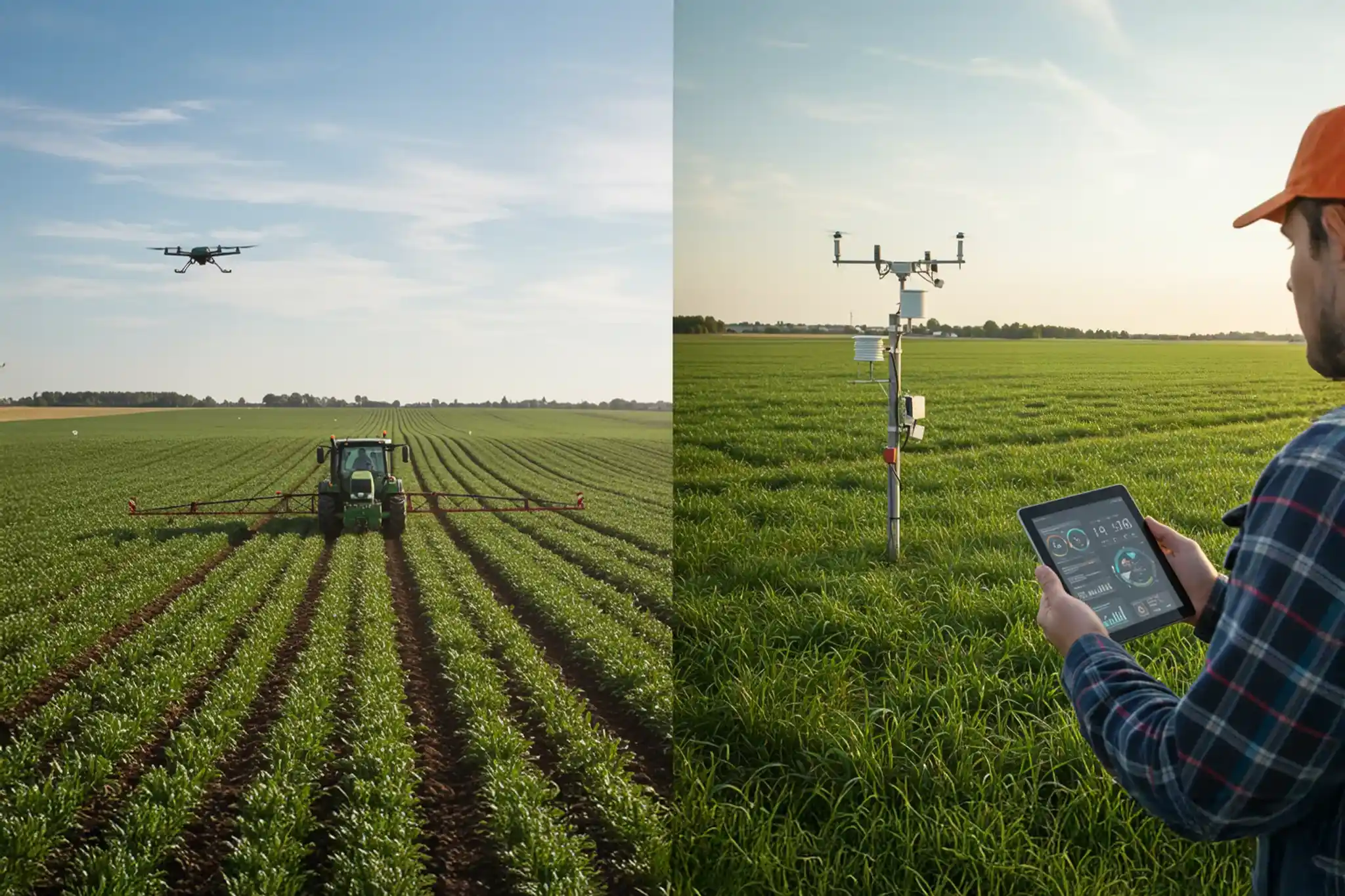
RC31403 PERLADANGAN PERSIS [2-2024/2025]
This course introduces students to the concepts, technologies and applications involved in precision farming (PF). This entails the use of ICT and some high-technology equipment for assessing field conditions and applying variable rates of production inputs for management of soil nutrients, weeds, pest & diseases. Topics include sampling procedures, and measurements of parameters through environmental sensors, GNSS, RS and PS. Data input into GIS or analysis using Geo-statistical & Mapping software to accomplish primary spatial data management tasks, creation of spatial variability maps for mechanized applications of farm inputs. Students will also be exposed to precision technologies in livestock production for locating as well as feeding, reproduction and health management. Students will participate in some hands-on experience in the use of enabling hardware and software in PF applications.
![RC31403(SEKSYEN 1) PERLADANGAN PERSIS [2-2025/2026]](https://itel.ums.edu.my/pluginfile.php/1906924/course/overviewfiles/1.jpg)
RC31403(SEKSYEN 1) PERLADANGAN PERSIS [2-2025/2026]
This course introduces students to the concepts, technologies and applications involved in precision farming (PF). This entails the use of ICT and some high-technology equipment for assessing field conditions and applying variable rates of production inputs for management of soil nutrients, weeds, pest & diseases. Topics include sampling procedures, and measurements of parameters through environmental sensors, GNSS, RS and PS. Data input into GIS or analysis using Geo-statistical & Mapping software to accomplish primary spatial data management tasks, creation of spatial variability maps for mechanized applications of farm inputs. Students will also be exposed to precision technologies in livestock production for locating as well as feeding, reproduction and health management. Students will participate in some hands-on experience in the use of enabling hardware and software in PF applications.
RC31403(UMSFLEC) Perladangan Persis [2-2025/2026]
This course introduces students to the concepts, technologies and applications involved in precision farming (PF). This entails the use of ICT and some high-technology equipment for assessing field conditions and applying variable rates of production inputs for management of soil nutrients, weeds, pest & diseases. Topics include sampling procedures, and measurements of parameters through environmental sensors, GNSS, RS and PS. Data input into GIS or analysis using Geo-statistical & Mapping software to accomplish primary spatial data management tasks, creation of spatial variability maps for mechanized applications of farm inputs. Students will also be exposed to precision technologies in livestock production for locating as well as feeding, reproduction and health management. Students will participate in some hands-on experience in the use of enabling hardware and software in PF applications.
![RH40202 PERANCANGAN DAN PENGURUSAN TAMAN [1-2025/2026]](https://itel.ums.edu.my/pluginfile.php/1585117/course/overviewfiles/IMG_6885.JPEG)
RH40202 PERANCANGAN DAN PENGURUSAN TAMAN [1-2025/2026]
Garden Planning and Management introduces students to the ethical, systemic, and justice-based dimensions of planning at multiple scales, building on the foundations of design practice. Where Landscape Design focused on site-scale composition and inclusion, this course expands to examine landscapes as interconnected systems shaped by history, policy, and power. Students critically engage with planning frameworks that govern land use, heritage, food systems, and waste, while exploring how circularity, conservation, and community agency can inform just and sustainable futures.
Through lectures, digital mapping exercises, case studies, and field-based inquiry, the course equips students to analyse planning challenges across ecological, social, and cultural domains. It emphasises both critique and application: students will interrogate planning as a political and ethical act, while also developing inclusive strategies that support community resilience, regenerative design, and professional pathways in landscape management.
Through lectures, digital mapping exercises, case studies, and field-based inquiry, the course equips students to analyse planning challenges across ecological, social, and cultural domains. It emphasises both critique and application: students will interrogate planning as a political and ethical act, while also developing inclusive strategies that support community resilience, regenerative design, and professional pathways in landscape management.
![RL10503 PRINSIP PENTERNAKAN LESTARI [1-2023/2024]](https://itel.ums.edu.my/pluginfile.php/408503/course/overviewfiles/farm-livestock550-jpg.jpg)
RL10503 PRINSIP PENTERNAKAN LESTARI [1-2023/2024]
This course will explore a range of different livestock production systems and the opportunities and challenges of implementing sustainable practices. This course provides an introductory to explore and draw connections between key sustainability issues related to livestock production systems. Interactive lectures, readings, activities, and field trips will provide exposure to a wide range of interdisciplinary topics including agro-ecology, natural resource management, crop production, livestock production, biodiversity, land use, livelihoods, nutrition, animal food products, and policy.
![RL10503 PRINSIP PENTERNAKAN LESTARI [1-2024/2025]](https://itel.ums.edu.my/pluginfile.php/961328/course/overviewfiles/images.jpg)
RL10503 PRINSIP PENTERNAKAN LESTARI [1-2024/2025]
This course will explore a range of different livestock production systems and the opportunities and challenges of implementing sustainable practices. This course provides an introductory to explore and draw connections between key sustainability issues related to livestock production systems. Interactive lectures, readings, activities, and field trips will provide exposure to a wide range of interdisciplinary topics including agro-ecology, natural resource management, crop production, livestock production, biodiversity, land use, livelihoods, nutrition, animal food products, and policy.
![RL10503 PRINSIP PENTERNAKAN LESTARI [1-2025/2026]](https://itel.ums.edu.my/pluginfile.php/1585129/course/overviewfiles/pngtree-farmhouse-animals-clipart-cute-farm-animals-gathered-around-a-barn-cartoon-vector-png-image_6867888.png)
RL10503 PRINSIP PENTERNAKAN LESTARI [1-2025/2026]
This course will explore a range of different livestock production systems and the opportunities and challenges of implementing sustainable practices. This course provides an introductory to explore and draw connections between key sustainability issues related to livestock production systems. Interactive lectures, readings, activities, and field trips will provide exposure to a wide range of interdisciplinary topics including agro-ecology, natural resource management, crop production, livestock production, biodiversity, land use, livelihoods, nutrition, animal food products, and policy.
![RL21103 PENGELUARAN RUMINAN KECIL [1-2025/2026]](https://itel.ums.edu.my/pluginfile.php/1585141/course/overviewfiles/the-laboratory-small-ruminant-1.jpg)
RL21103 PENGELUARAN RUMINAN KECIL [1-2025/2026]
This course will explore a range of different livestock production systems and the opportunities and challenges of implementing sustainable practices. This course provides an introductory to explore and draw connections between key sustainability issues related to livestock production systems. Interactive lectures, readings, activities, and field trips will provide exposure to a wide range of interdisciplinary topics including agro-ecology, natural resource management, crop production, livestock production, biodiversity, land use, livelihoods, nutrition, animal food products, and policy.
![RT20101 KERJA LAPANGAN [1-2025/2026]](https://itel.ums.edu.my/pluginfile.php/1585161/course/overviewfiles/Screenshot%202025-10-12%20at%2010.44.18%E2%80%AFPM.png)
RT20101 KERJA LAPANGAN [1-2025/2026]
Discover the world of agriculture with RC20101- Fieldwork. This course opens the door to exciting opportunities in crop production, horticulture, landscaping, and livestock management. You’ll gain the essential knowledge and hands-on skills needed to thrive in the agricultural field, from learning how to use farm tools and equipment to mastering good farm management practices.
Through hands-on farm activities under expert guidance from our Ladang staff, you’ll experience the latest in modern and sustainable farming techniques. Cultivate your passion for agriculture while building the skills that shape the future of food and farming.
And... be ready to get your hands dirty!
Through hands-on farm activities under expert guidance from our Ladang staff, you’ll experience the latest in modern and sustainable farming techniques. Cultivate your passion for agriculture while building the skills that shape the future of food and farming.
And... be ready to get your hands dirty!
![RT20203 MIKROBIOLOGI PERTANIAN [2-2022/2023]](https://itel.ums.edu.my/pluginfile.php/47524/course/overviewfiles/Bacterium.JPG)
RT20203 MIKROBIOLOGI PERTANIAN [2-2022/2023]
This course offers basic knowledge of microbes and their roles in ecosystems. The early parts of the topics are related to morphology and structures, microbial diversity, metabolisms, growth, and genetics. Later parts of the course will cover applied aspects of microorganisms in agriculture, such as the manipulation of microbial products in industrial microbiology production, the roles of microbes in soil, environment, ecology, biogeochemical cycles, and foods. Several basic techniques essential in microbiology will be taught in practical sessions. The concepts of field and laboratory diagnostic procedures, and the Koch's Postulates will be taught in practical sessions.
RT40103 PERLADANGAN PERSIS [1-2025/2026] - Active
Welcome to the course.
This course introduces students to the concepts, technologies and applications involved in precision farming (PF). This entails the use of ICT and some high-technology equipment for assessing field conditions and applying variable rates of production inputs for management of soil nutrients, weeds, pest & diseases. Topics include sampling procedures, and measurements of parameters through environmental sensors, GNSS, RS and PS. Data input into GIS or analysis using Geo-statistical & Mapping software to accomplish primary spatial data management tasks, creation of spatial variability maps for mechanized applications of farm inputs. Students will also be exposed to precision technologies in livestock production for locating as well as feeding, reproduction and health management. Students will participate in some hands-on experience in the use of enabling hardware and software in PF applications.
Enjoy the course, have fun and work hard.
Aim for A+
You can do it.
This course introduces students to the concepts, technologies and applications involved in precision farming (PF). This entails the use of ICT and some high-technology equipment for assessing field conditions and applying variable rates of production inputs for management of soil nutrients, weeds, pest & diseases. Topics include sampling procedures, and measurements of parameters through environmental sensors, GNSS, RS and PS. Data input into GIS or analysis using Geo-statistical & Mapping software to accomplish primary spatial data management tasks, creation of spatial variability maps for mechanized applications of farm inputs. Students will also be exposed to precision technologies in livestock production for locating as well as feeding, reproduction and health management. Students will participate in some hands-on experience in the use of enabling hardware and software in PF applications.
Enjoy the course, have fun and work hard.
Aim for A+
You can do it.
SK34003 BAHAN INORGANIK TERMAJU [2-2023/2024]
This course discusses advancements in inorganic materials and relates them to coordination chemistry, organometallic compounds, solid-state phenomena, and bioinorganic interactions, providing insights into element properties, reactivity, and catalysis. The course also explores the interdisciplinary field that drives innovation in energy, environment, and healthcare, with nanomaterials and some coordination polymers offering practical applications in catalysis, electronics, and medicine. Inorganic reaction mechanisms are studied to understand chemical transformations crucial for synthesis and industrial processes.
SK34803 TEKNOLOGI NANO [2-2023/2024]
This course focuses on the definition, history, scope, impacts, and challenges within the rapidly emerging and revolutionary field of nanotechnology. The course discusses techniques of the production of various nanomaterials such as graphenes, silicenes, nanotubes, nanorods, colloids, dots, clusters, wires, thin films etc. The pros and cons of the “top down” and “bottom up” approach in the nanotechnology will be discussed. The state-of-the-art instruments such as spectroscopy, radiation scattering, scanning electron microscopy, transmission electron microscopy and X-ray diffraction etc. that are important for the characterization of nanomaterial and nanotechnology will be discussed too.
SK34803 TEKNOLOGI NANO [2-2025/2026]
This course focuses on the definition, history, scope, impacts, and challenges within the rapidly emerging and revolutionary field of nanotechnology. The course discusses techniques of the production of various nanomaterials such as graphenes, silicenes, nanotubes, nanorods, colloids, dots, clusters, wires, thin films etc. The pros and cons of the “top down” and “bottom up” approach in the nanotechnology will be discussed. The state-of-the-art instruments such as spectroscopy, radiation scattering, scanning electron microscopy, transmission electron microscopy and X-ray diffraction etc. that are important for the characterization of nanomaterial and nanotechnology will be discussed too.
![SM13103 MATEMATIK I [1-2023/2024]](https://itel.ums.edu.my/pluginfile.php/531200/course/overviewfiles/iTel%20Card%20%283%29.jpg)
SM13103 MATEMATIK I [1-2023/2024]
This course provides a comprehensive introduction to several important areas of mathematics, including foundational concepts (logic, set theory, real numbers) and more advanced topics (complex numbers and calculus). It establishes a strong foundation for advancing in the study of mathematics and applying it across various fields.
![SM14103 MATEMATIK I [1-2023/2024]](https://itel.ums.edu.my/pluginfile.php/409781/course/overviewfiles/SM1.jpg)
SM14103 MATEMATIK I [1-2023/2024]
This course provides a comprehensive introduction to several important areas of mathematics, including foundational concepts (logic, set theory, real numbers) and more advanced topics (complex numbers and calculus). It establishes a strong foundation for advancing in the study of mathematics and applying it across various fields.
![SM14103 MATEMATIK I [1-2024/2025]](https://itel.ums.edu.my/pluginfile.php/962264/course/overviewfiles/iTel%20Card.jpg)
SM14103 MATEMATIK I [1-2024/2025]
This course provides a comprehensive introduction to several important areas of mathematics, including foundational concepts (logic, set theory, real numbers) and more advanced topics (complex numbers and calculus). It establishes a strong foundation for advancing in the study of mathematics and applying it across various fields.
![SM14103 MATEMATIK I [1-2025/2026]](https://itel.ums.edu.my/pluginfile.php/1585735/course/overviewfiles/SM14103.jpg)
SM14103 MATEMATIK I [1-2025/2026]
This course provides an introduction to essential areas of mathematics, beginning with logic, set theory, real numbers, and complex numbers. It then explores the concepts of functions, limits, and continuity, which form the basis for differentiation and integration, including their techniques and applications. By the end of the course, students will have developed problem-solving skills and a solid mathematical foundation to support further studies in mathematics and related fields.
![SM34502 PENGOPTIMUMAN [1-2024/2025]](https://itel.ums.edu.my/pluginfile.php/962282/course/overviewfiles/iTel%20Card.jpg)
SM34502 PENGOPTIMUMAN [1-2024/2025]
This advanced optimization course focuses on complex models. Building upon the concepts of linear and non-linear programming introduced in Operations Research, this course covers sensitivity and duality analysis, network optimization, dynamic programming, and queuing theory. Students will explore various methods and approaches to optimize systems, processes, and decisions, preparing them for practical applications in diverse fields.
![SM34502 PENGOPTIMUMAN [1-2025/2026]](https://itel.ums.edu.my/pluginfile.php/1585747/course/overviewfiles/itel%20opt.png)
SM34502 PENGOPTIMUMAN [1-2025/2026]
This course introduces fundamental optimization techniques used to support effective decision-making and problem-solving in various fields. It covers transportation, assignment, network, queueing, and deterministic dynamic programming models. Students will enhance their analytical and problem-solving skills by applying appropriate optimization methods to real-life scenarios through manual computation, critical analysis, and chapter review activities.
SQ31203 BIOMETRI DAN REKABENTUK EKSPERIMEN [1-2024/2025]
This module is basically concerning quantitative statistical methodologies that are used for analyzing quantitative data derived from commonly conducted biological experiments. Topics covered in this course also include basic experimental design for biological experiments conducted in the field or under controlled conditions in the laboratory or other such setting. Real data from the field and laboratory experiments will be used in all statistical tests carried out. Computer cum tutorial classes will be conducted to demonstrate how the statistical analyses are carried out using popular statistical software programs and to discuss the results obtained. This course will give focus on the application of the quantitative analytical skills to solve real world problems.
![SS33003 INSTRUMENTASI SEKITARAN [2-2022/2023]](https://itel.ums.edu.my/pluginfile.php/48508/course/overviewfiles/cover.png)
SS33003 INSTRUMENTASI SEKITARAN [2-2022/2023]
This course prepares the student to a variety of analytical techniques and instruments utilized in environmental analysis. It is designed to couple theory of equipment operation and their applications in the fields of environmental studies.
![SS40903 INSTRUMENTASI SEKITARAN [1-2024/2025]](https://itel.ums.edu.my/pluginfile.php/962408/course/overviewfiles/Cover.png)
SS40903 INSTRUMENTASI SEKITARAN [1-2024/2025]
This course prepares the student for a variety of analytical techniques and instruments utilized in environmental analysis. It is designed to couple the theory of equipment operation and their applications in the fields of environmental studies.
![SS40903 INSTRUMENTASI SEKITARAN [1-2025/2026]](https://itel.ums.edu.my/pluginfile.php/1585823/course/overviewfiles/cover.png)
SS40903 INSTRUMENTASI SEKITARAN [1-2025/2026]
This course prepares students for various analytical techniques and instruments used in environmental analysis. It is designed to couple the theory of equipment operation with its applications in the field of environmental studies.
![SW40703 MATEMATIK KABUR [1-2023/2024]](https://itel.ums.edu.my/pluginfile.php/409994/course/overviewfiles/fuzzy-logic.png)
SW40703 MATEMATIK KABUR [1-2023/2024]
Fuzzy sets are a mathematical framework that allows for representing and handling uncertainty and vagueness in decision-making and problem-solving. By applying the fundamental concepts of fuzzy sets, such as membership functions, fuzzy operations, and fuzzy reasoning, one can analyze and solve problems that involve ambiguity, imprecision, or uncertainty in data or decision-making processes. Fuzzy sets theory has applications in various fields, including engineering, computer science, economics, and decision science, among others. Mathematical problems often involve precise and deterministic calculations, but in some cases, the data or parameters may be uncertain or imprecise. Fuzzy techniques provide a way to model and analyze such problems by allowing for degrees of membership and fuzzy reasoning. By applying fuzzy techniques, one can analyze mathematical problems in a more flexible and adaptive manner, taking into account the inherent uncertainties and ambiguities in the data or parameters.
TE60204 THEORETICAL BASES OF LANGUAGE LEARNING [2-2024/2025]
This course aims to provide an overview of the background discipline which contributes to language learning and teaching, and to indicate what their contributions have been. The course includes a consideration of the history of language learning and teaching, language description, theories of language learning and theories of language use, among others. Materials used in the course are extracted from the field of English as a Second/Foreign Language Teaching, but what is covered should be relevant to the teaching of any foreign language. The goal of the course is to help learners to make sense of the multifarious influences that impinge upon them in their professional role. In so doing the course hopes to get learners to develop to rationale of language teaching, which enables them to make informed and principled choices between the conflicting claims of different theories.
 iTEL
iTEL