 iTEL
iTEL
Hasil pencarian: 263
![AI31303 STATISTIK DAN ISLAM [1-2025/2026]](https://itel.ums.edu.my/pluginfile.php/1584201/course/overviewfiles/AI31303%20Statistik%20%20Islam.png)
AI31303 STATISTIK DAN ISLAM [1-2025/2026]
Kursus ini akan membimbing graduat dalam memahami konsep demografi, frekuensi dalam Quran. Seterusnya, menunjukkan bagaimana penggunaan analisis analitikal berangka dibuat dengan menggunakan perisian komputer seperti Excel dan Statistical Package for Social Sciences Software (SPSS). Bukan itu sahaja, kursus ini juga dapat menafaatkan ayat-ayat Quran sebagai sumber data asas dalam agama Islam.
![AI40503 FIQH PERBANDINGAN [2-2025/2026]](https://itel.ums.edu.my/pluginfile.php/1904530/course/overviewfiles/%40reallygreatsite.png)
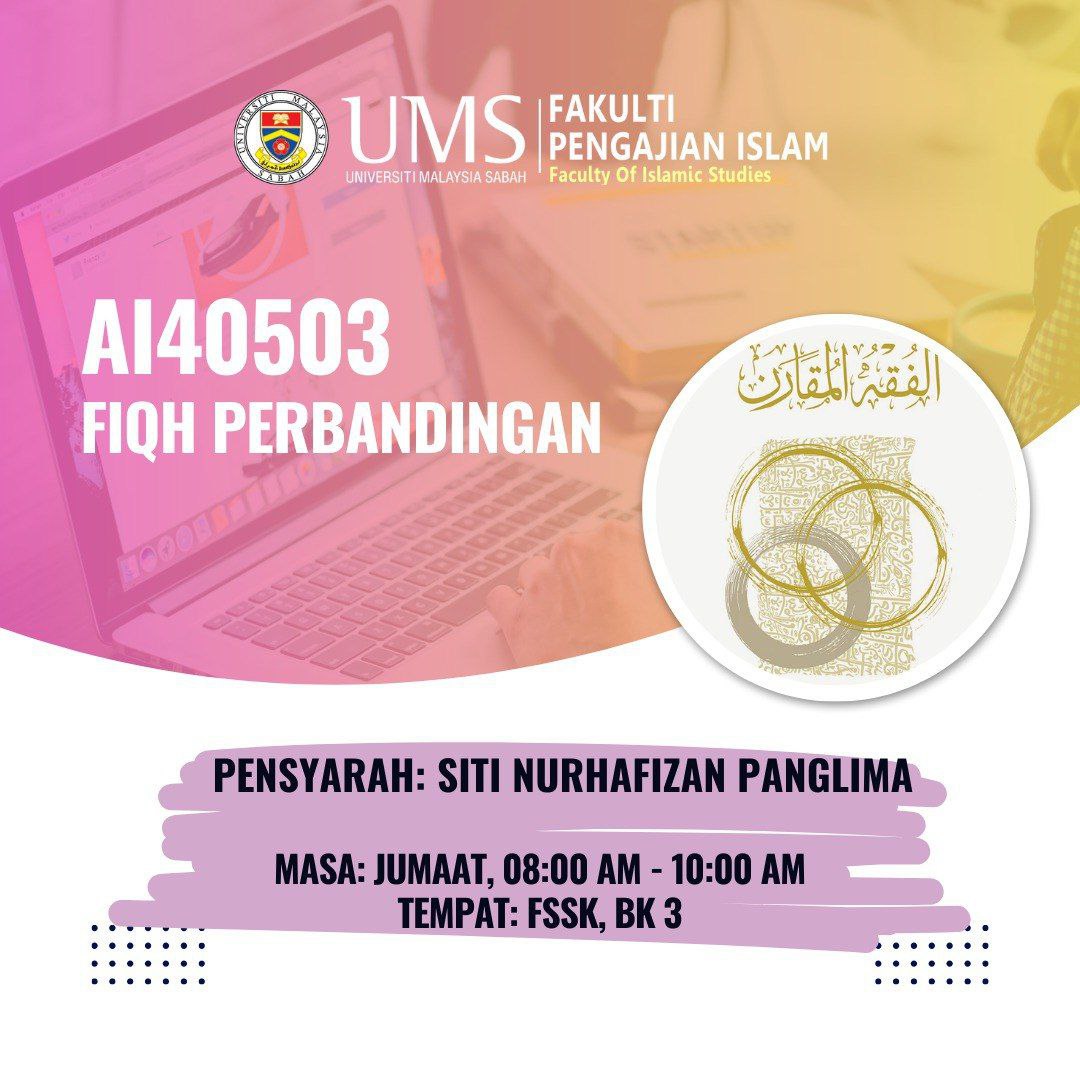
AI40503 FIQH PERBANDINGAN [2-2025/2026]
Assalamualaikum WBT.
Ahlan wa sahlan wa Marhaban Bikum kepada semua pelajar ke kursus AI40503 Fiqh Perbandingan.
Ahlan wa sahlan wa Marhaban Bikum kepada semua pelajar ke kursus AI40503 Fiqh Perbandingan.
![AI40503 FIQH PERBANDINGAN [2-2024/2025]](https://itel.ums.edu.my/pluginfile.php/1298123/course/overviewfiles/6305339830132917520.jpg)
![AK21103 PRINSIP PERHUBUNGAN AWAM [1-2025/2026]](https://itel.ums.edu.my/pluginfile.php/1586051/course/overviewfiles/Latif%20Lai%20Water%20Colour.png)
AK21103 PRINSIP PERHUBUNGAN AWAM [1-2025/2026]
This course introduces students to the foundational concepts and practices of public relations, tracing its historical evolution and examining its role in contemporary society. It provides a comprehensive overview of definitions, key theories, principles, and strategic planning approaches in communication management. Students will also explore career pathways and professional ethics within the field of public relations.
ABOUT THE LECTURER
Dr Lai is a Senior Lecturer in Communication at Universiti Malaysia Sabah (UMS), specialising in strategic communication and public engagement. As the head of the UMS–UNICEF C4D Research Unit, Dr Lai brings extensive experience in Social and Behaviour Change Communication (SBCC), working with government agencies, NGOs, and community stakeholders. His academic work bridges theory and practice, with a strong emphasis on ethical communication, strategic planning, and the societal impact of public relations. Dr Lai is passionate about guiding students to critically explore the evolution, principles, and professional pathways of public relations, equipping them with the analytical and practical skills needed to thrive in today’s dynamic communication landscape.
ABOUT THE LECTURER
Dr Lai is a Senior Lecturer in Communication at Universiti Malaysia Sabah (UMS), specialising in strategic communication and public engagement. As the head of the UMS–UNICEF C4D Research Unit, Dr Lai brings extensive experience in Social and Behaviour Change Communication (SBCC), working with government agencies, NGOs, and community stakeholders. His academic work bridges theory and practice, with a strong emphasis on ethical communication, strategic planning, and the societal impact of public relations. Dr Lai is passionate about guiding students to critically explore the evolution, principles, and professional pathways of public relations, equipping them with the analytical and practical skills needed to thrive in today’s dynamic communication landscape.
AK31503(UMSFLEC) KOMUNIKASI PENGURUSAN [1-2025/2026]
This course aims to provide knowledge of systematic planning, implementation, monitoring and control of communication activities and review of all communication channels within the organization and between organizations; it also includes the organization and dissemination of new communications directives related to the organization, network, or communication technology. It includes elements of the organization's strategic internal and external communications, and how it can enhance the productivity of internal stakeholders. Discussing emerging technologies and the implications of the development of advanced technologies, such as the internet and social media, possible changes in the planning, implementation and control of communications in communications management.
AS20303 ORGANISASI ANTARABANGSA [1-2025/2026]
AS20303 International Organizations
This course exposes students to the importance of international organizations as a leading actor in the modern international relations system. Students will be introduced to the historical background, function and role of international organizations in addressing global issues such as regional security, trade, human rights and environment. The course also discusses various types of international organizations including the Intercultural Organization (IGO) and non -governmental (NGOs), as well as how they operate and affect international policies and relations. In closing, this course will evaluate the importance and achievement of the United Nations (UN) as the most influential multi-functional organization in today's world.
This course exposes students to the importance of international organizations as a leading actor in the modern international relations system. Students will be introduced to the historical background, function and role of international organizations in addressing global issues such as regional security, trade, human rights and environment. The course also discusses various types of international organizations including the Intercultural Organization (IGO) and non -governmental (NGOs), as well as how they operate and affect international policies and relations. In closing, this course will evaluate the importance and achievement of the United Nations (UN) as the most influential multi-functional organization in today's world.
AS30903 UNDANG-UNDANG KEMANUSIAAN ANTARABANGSA [2-2022/2023]
The course explores the development and operation of International Humanitarian Law (IHL) in regulating the conduct of armed conflict and violence involving both combatants and non-combatants. This course provides a basic understanding of the historical and contemporary aspects of IHL. It explains the roles played by international bodies such as the International Committee of the Red Cross, United Nations, International Criminal Court, and States. In addition to the knowledge on IHL, the course also exposes the students to the field of humanitarian work and equip them with basic skills on responding to humanitarian emergencies such as first aid and disaster preparedness. This as an important social responsibility value among the youth.
AT10302 (UMSFLEC) PENGANTAR PENGAJIAN ISLAM [1-2025/2026]
Kursus ini membincangkan pengertian dan ciri-ciri Islam. Penumpuan diberikan terhadap sumber-sumber Pengajian Islam, ruang lingkup Pengajian Islam yang meliputi akidah, akhlak dan syariah. Kursus ini turut membincangkan isu-isu semasa yang melibatkan Pengajian Islam dan cabaran kontemporari yang dihadapi dalam bidang Pengajian Islam.
![BA21103 INTERNATIONAL MARKETING [2-2022/2023]](https://itel.ums.edu.my/pluginfile.php/47026/course/overviewfiles/Banner%20International%20marketing%20with%20my%20face.png)
BA21103 INTERNATIONAL MARKETING [2-2022/2023]
The importance of using an appropriate marketing strategy to enter foreign markets and compete globally is imperative. In formulating the effective marketing strategy, students must be fully equipped with a marketing mix know how. The globalization of markets has certainly accelerated through universal acceptance of the democratic free enterprise model and new communication technologies, including cell phones and the Internet. Markets are burgeoning in emerging economies that hold the promise of huge markets in the future. In the more mature markets of the industrialized world, opportunity and challenge also abound as consumers’ tastes become more sophisticated and complex and as increases in purchasing power provide consumers with new means of satisfying new demands. The economic, political, and social changes that have occurred over the last decade have dramatically altered the landscape of global business and understanding marketing in all cultures. Nevertheless, global market, also affected domestic market by competitive activity. Thus, the course aim to provides an approach and framework for identifying and analysing the important of cultural and environmental uniqueness of any nation or global region. Through describes concepts relevant to all international marketers, regardless of the extent of their international involvement. techniques in the context of business, economics and social sciences. Among the highlighted aspects include elementary functions, linear mathematics and calculus with both theoretical and real-life applications.
BA21103 PEMASARAN ANTARABANGSA [2-2023/2024]
The significance of employing an appropriate marketing strategy to enter foreign markets and compete on a global scale cannot be overstated. To develop an effective marketing strategy, students must be well-versed in the marketing mix. The globalization of markets has accelerated due to the widespread adoption of the democratic free enterprise model and advancements in communication technologies, such as mobile phones and the Internet. Emerging economies are rapidly expanding and present promising market opportunities for the future.
In contrast, mature markets in industrialized nations also offer both challenges and opportunities. As consumers' tastes become more sophisticated and purchasing power increases, there is a growing demand for diverse products and services. The economic, political, and social changes that have taken place over the last decade have dramatically transformed the landscape of global business, highlighting the need for an understanding of marketing across different cultures.
Moreover, global market dynamics have also impacted domestic markets through competitive activities. Therefore, this course aims to provide an approach and framework for identifying and analyzing the cultural and environmental uniqueness of various nations and global regions. It will cover concepts relevant to all international marketers, regardless of their level of international involvement, while integrating techniques from business, economics, and social sciences.
In contrast, mature markets in industrialized nations also offer both challenges and opportunities. As consumers' tastes become more sophisticated and purchasing power increases, there is a growing demand for diverse products and services. The economic, political, and social changes that have taken place over the last decade have dramatically transformed the landscape of global business, highlighting the need for an understanding of marketing across different cultures.
Moreover, global market dynamics have also impacted domestic markets through competitive activities. Therefore, this course aims to provide an approach and framework for identifying and analyzing the cultural and environmental uniqueness of various nations and global regions. It will cover concepts relevant to all international marketers, regardless of their level of international involvement, while integrating techniques from business, economics, and social sciences.
![BA31103 PENGURUSAN SUMBER MANUSIA ANTARABANGSA [2-2025/2026]](https://itel.ums.edu.my/pluginfile.php/1954675/course/overviewfiles/BT22303%20HRM%202%2020252026%20%281%29.png)
BA31103 PENGURUSAN SUMBER MANUSIA ANTARABANGSA [2-2025/2026]
This course is designed to enable learners to have exposure and experience in the process of System Development Life Cycle (SDLC) that involves systems planning, systems analysis, system evaluation and selection, systems design, systems conversion and implementation, as well as other related systems development approaches.
BA32303 PERDAGANGAN ANTARABANGSA [1-2025/2026]
This course introduces students to the principles, theories, policies, and practices of international trade. It explores the dynamics of trade between nations, trade agreements, institutions, logistics, and the impact of globalization on economies.
Unique among the concerns of economics, international trade always carried a note of romance-the lure of the exotic, the hint of danger. Traders’ dreams of bartering for the riches of the Orient spurred the European voyages of discovery that began in the fifteenth century. The world that emerged from World War II was one in which trade, financial, and even communication links between countries are limited. Today in the 21st century, the picture was very different. Today, geopolitics plays a crucial role in shaping international trade policies, practices, and patterns. Political relationships, strategic interests, trade agreements, and conflicts all impact how countries engage in trade. Understanding the geopolitical landscape is essential for navigating the complexities of global trade and for making informed decisions in international business and policy-making.
International trade and economics also play a role in global environmental and conservation matters. Surprisingly involved parties either states or countries, and governments or non-governmental organizations (NGOs), international business has expending from domestic to international logistics and trade; Multinational corporations increasing throughout the nations through FDI, outsourcing and off-shoring activities; continuous technologies advancement; financial and human capital movement globally; cooperation and even feud involving global governance, different political ideologies and international cooperation.
On the first part; the course provides a systematic and rigorous introduction to the theory and policy of international trade. On second part of the study, the focus is on the trade theories of international trade and its application. Thirdly, study will be extended to the development of technologies and contemporary issues related to trade and its economic impacts.
Using case study, articles related to international and regional trade issues, students are required to complete assessments which consist of;
(i) individual mark (examinations, on-going tutorial exercises, and quizzes), articles review, research essay), and
(ii) team works (organizing workshops and seminar, individual and group presentation).in person and with an application of digital works.
Unique among the concerns of economics, international trade always carried a note of romance-the lure of the exotic, the hint of danger. Traders’ dreams of bartering for the riches of the Orient spurred the European voyages of discovery that began in the fifteenth century. The world that emerged from World War II was one in which trade, financial, and even communication links between countries are limited. Today in the 21st century, the picture was very different. Today, geopolitics plays a crucial role in shaping international trade policies, practices, and patterns. Political relationships, strategic interests, trade agreements, and conflicts all impact how countries engage in trade. Understanding the geopolitical landscape is essential for navigating the complexities of global trade and for making informed decisions in international business and policy-making.
International trade and economics also play a role in global environmental and conservation matters. Surprisingly involved parties either states or countries, and governments or non-governmental organizations (NGOs), international business has expending from domestic to international logistics and trade; Multinational corporations increasing throughout the nations through FDI, outsourcing and off-shoring activities; continuous technologies advancement; financial and human capital movement globally; cooperation and even feud involving global governance, different political ideologies and international cooperation.
On the first part; the course provides a systematic and rigorous introduction to the theory and policy of international trade. On second part of the study, the focus is on the trade theories of international trade and its application. Thirdly, study will be extended to the development of technologies and contemporary issues related to trade and its economic impacts.
Using case study, articles related to international and regional trade issues, students are required to complete assessments which consist of;
(i) individual mark (examinations, on-going tutorial exercises, and quizzes), articles review, research essay), and
(ii) team works (organizing workshops and seminar, individual and group presentation).in person and with an application of digital works.
BA32503 PENGURUSAN PRODUK DAN JENAMA ANTARABANGSA [2-2022/2023]
This course provides an understanding of product and brand management concepts in the context of the global marketplace that emphasizes the importance of product and brand strategy in meeting customer needs and sustaining a competitive advantage. It covers various marketing elements, including product management, new product development process, digital marketing strategies and brand equity. Throughout the course, students will gain an understanding of the international marketing environment and its impact on product and brand management. This will include an overview of factors through country, industry and consumer analysis that influence the development and implementation of product and brand strategies in different counties of the world. Overall, this course aims to equip students with the knowledge and skills necessary to succeed in a global business environment by developing effective product and brand strategies that meet customer needs and drive business growth.
BA32503(SEKSYEN 1,2) PENGURUSAN PRODUK DAN JENAMA ANTARABANGSA [2-2023/2024]
This course provides a comprehensive understanding of product and brand management within the global marketplace. It emphasises the critical role of strategic planning in maintaining competitiveness and meeting evolving customer needs. Throughout the course, students will explore various essential marketing elements, including product management, the new product development process, brand management, and digital marketing strategies. Additionally, they will gain insights into the complexities of the international marketing environment and how factors such as country-specific regulations, industry dynamics, and consumer preferences influence product and brand strategies on a global scale. By analysing these factors, students will develop the skills necessary to create effective strategies tailored to different regions, enabling them to navigate and thrive in the global business landscape successfully.
BC33803 PENGENALAN KEPADA PERTUMBUHAN EKONOMI [2-2022/2023]
This course is designed to equip students with knowledge to the basic issue of economic growth and related elements to achieve such process. The primary focus of this course will be on the mechanism of how various growth factors or engine of growth such as capital, labour, human capital and innovations(ideas)play its role to achieve higher growth.
![BC34201(SEKSYEN 1) PROGRAM PENGLIBATAN INDUSTRI [2-2025/2026]](https://itel.ums.edu.my/pluginfile.php/1905901/course/overviewfiles/WIJAYA%20KAMAL%20RAMLAN%20%281%29.png)
BC34201(SEKSYEN 1) PROGRAM PENGLIBATAN INDUSTRI [2-2025/2026]
Course Description
The Industry Engagement Program is specially designed for final-year students as they prepare for their internship journey. This course provides step-by-step guidance, starting from the application process until the completion of their internship. Students will learn how to write effective resumes, prepare for interviews, and understand workplace expectations. By the end of the course, students will be well-prepared to start their internship with confidence and have a clearer understanding of their future career paths.
Course Learning Outcomes
At the end of the course, the students should be able to:
To prepare for and taking part in a profesional interview (PLO4, C3B)
To develop writing skills for effective communication (PLO5, C3C)
To build digital competence by producing professional digital content (PLO6, C3D)
The Industry Engagement Program is specially designed for final-year students as they prepare for their internship journey. This course provides step-by-step guidance, starting from the application process until the completion of their internship. Students will learn how to write effective resumes, prepare for interviews, and understand workplace expectations. By the end of the course, students will be well-prepared to start their internship with confidence and have a clearer understanding of their future career paths.
Course Learning Outcomes
At the end of the course, the students should be able to:
To prepare for and taking part in a profesional interview (PLO4, C3B)
To develop writing skills for effective communication (PLO5, C3C)
To build digital competence by producing professional digital content (PLO6, C3D)
![BC34201(UMSFLEC) PROGRAM PENGLIBATAN INDUSTRI [2-2025/2026]](https://itel.ums.edu.my/pluginfile.php/2031694/course/overviewfiles/WIJAYA%20KAMAL%20RAMLAN%20%2811%29.png)
BC34201(UMSFLEC) PROGRAM PENGLIBATAN INDUSTRI [2-2025/2026]
Course Description
The Industry Engagement Program is specially designed for final-year students as they prepare for their internship journey. This course provides step-by-step guidance, starting from the application process until the completion of their internship. Students will learn how to write effective resumes, prepare for interviews, and understand workplace expectations. By the end of the course, students will be well-prepared to start their internship with confidence and have a clearer understanding of their future career paths.
Course Learning Outcomes
At the end of the course, the students should be able to:
To prepare for and taking part in a profesional interview (PLO4, C3B)
To develop writing skills for effective communication (PLO5, C3C)
To build digital competence by producing professional digital content (PLO6, C3D)
![BC6023 (Section 1) Intercultural Management [3-2024/2025]](https://itel.ums.edu.my/pluginfile.php/1505503/course/overviewfiles/373477-PBEEAE-983-e1679562992562-369958899.jpeg)
BC6023 (Section 1) Intercultural Management [3-2024/2025]
As a result of the strong developments that have taken place in telecommunications and transportation, the world seems to have shrunk and is often referred to as a ‘global village’. This has brought about an increased interaction between managers from various cultures. The increase in the number and strength of multinational corporations from America, Europe, Japan, South Korea and emerging market nations has often times brought about a clash with local cultures. As a result, it is important that managers of today understand culture and the implications of culture in the development of individual and group culture as well as management style. This course will emphasize on the differences in management practices as a result of differences in culture. Focus will be given towards looking at the differences between the Western and Eastern management styles. Topics that will be discussed include the interaction between culture and organization, strategy and culture, human resource and culture, leadership and culture, as well as on communication and negotiation. Class discussions will focus on the practices of Western multinational and Eastern multinational corporations.
![BC6023 INTERCULTURAL MANAGEMENT [3-2022/2023]](https://itel.ums.edu.my/pluginfile.php/366958/course/overviewfiles/ICM%20book.jpg)
BC6023 INTERCULTURAL MANAGEMENT [3-2022/2023]
As a result of the strong developments that have taken place in telecommunications and transportation, the world seems to have shrunk and is often referred to as a ‘global village’. This has brought about an increased interaction between managers from various cultures. The increase in the number and strength of multinational corporations from America, Europe, Japan, South Korea, and emerging market nations has often brought about a clash with local cultures. As a result, it is important that managers of today understand culture and the implications of culture in the development of individual and group culture as well as management style. This course will emphasize the differences in management practices because of differences in culture. Focus will be given towards looking at the differences between the Western and Eastern management styles. Topics that will be discussed include the interaction between culture and organization, strategy and culture, human resources and culture, leadership, and culture, as well as communication and negotiation. Class discussions will focus on the practices of Western multinational and Eastern multinational corporations.
 iTEL
iTEL