 iTEL
iTEL
Hasil pencarian: 55
AH20703 PENGURUSAN SUMBER MANUSIA [1-2023/2024]
This course will introduce the student to labour management, including the development and function of HRM. The course will cover topics such as recruitment and selection, performance appraisal, payment systems and working hours, benefits and rewards, disciplinary systems, termination of service, managing industrial disputes, improving productivity and commitment, training and development, as well as safety and health.
![AK21103 PRINSIP PERHUBUNGAN AWAM [1-2025/2026]](https://itel.ums.edu.my/pluginfile.php/1586051/course/overviewfiles/Latif%20Lai%20Water%20Colour.png)
AK21103 PRINSIP PERHUBUNGAN AWAM [1-2025/2026]
This course introduces students to the foundational concepts and practices of public relations, tracing its historical evolution and examining its role in contemporary society. It provides a comprehensive overview of definitions, key theories, principles, and strategic planning approaches in communication management. Students will also explore career pathways and professional ethics within the field of public relations.
ABOUT THE LECTURER
Dr Lai is a Senior Lecturer in Communication at Universiti Malaysia Sabah (UMS), specialising in strategic communication and public engagement. As the head of the UMS–UNICEF C4D Research Unit, Dr Lai brings extensive experience in Social and Behaviour Change Communication (SBCC), working with government agencies, NGOs, and community stakeholders. His academic work bridges theory and practice, with a strong emphasis on ethical communication, strategic planning, and the societal impact of public relations. Dr Lai is passionate about guiding students to critically explore the evolution, principles, and professional pathways of public relations, equipping them with the analytical and practical skills needed to thrive in today’s dynamic communication landscape.
ABOUT THE LECTURER
Dr Lai is a Senior Lecturer in Communication at Universiti Malaysia Sabah (UMS), specialising in strategic communication and public engagement. As the head of the UMS–UNICEF C4D Research Unit, Dr Lai brings extensive experience in Social and Behaviour Change Communication (SBCC), working with government agencies, NGOs, and community stakeholders. His academic work bridges theory and practice, with a strong emphasis on ethical communication, strategic planning, and the societal impact of public relations. Dr Lai is passionate about guiding students to critically explore the evolution, principles, and professional pathways of public relations, equipping them with the analytical and practical skills needed to thrive in today’s dynamic communication landscape.
AS30903 UNDANG-UNDANG KEMANUSIAAN ANTARABANGSA [2-2022/2023]
The course explores the development and operation of International Humanitarian Law (IHL) in regulating the conduct of armed conflict and violence involving both combatants and non-combatants. This course provides a basic understanding of the historical and contemporary aspects of IHL. It explains the roles played by international bodies such as the International Committee of the Red Cross, United Nations, International Criminal Court, and States. In addition to the knowledge on IHL, the course also exposes the students to the field of humanitarian work and equip them with basic skills on responding to humanitarian emergencies such as first aid and disaster preparedness. This as an important social responsibility value among the youth.
![BD20403 ANALISA PELABURAN [1-2023/2024]](https://itel.ums.edu.my/pluginfile.php/408113/course/overviewfiles/Green%20Bold%20Aesthetic%20How%20To%20Invest%20Business%20Youtube%20Thumbnail.png)
BD20403 ANALISA PELABURAN [1-2023/2024]
This course intends to expose students with the principles, concepts and techniques in investment. Among the topics covered are investment settings, securities market and investment instruments, unit trusts, portfolio theory particularly the risk-return relationships and market equilibrium models, efficient market theory, fixed income securities, security analysis, derivative markets and portfolio management. Focuses will be given on the Malaysian equity market.
“If you do choose to invest in a financial market, invest for the lifetime.”
“If you do choose to invest in a financial market, invest for the lifetime.”
![BD20403(SEKSYEN 1) ANALISA PELABURAN [2-2022/2023]](https://itel.ums.edu.my/pluginfile.php/54688/course/overviewfiles/Investment%20Analysis.png)
BD20403(SEKSYEN 1) ANALISA PELABURAN [2-2022/2023]
Overview – This course intends to expose students with the principles, concepts and techniques in investment. Among the topics covered are investment settings, securities market and investment instruments, unit trusts, portfolio theory particularly the risk-return relationships and market equilibrium models, efficient market theory, fixed income securities, security analysis, derivative markets and portfolio management. Focuses will be given on the Malaysian equity market.
BD33103 (SEKSYEN 1) UNDANG-UNDANG DAN KAWAL SELIA KEWANGAN [2-2025/2026]
The course discusses the legal framework relating to banking and financial institutions in Malaysia as provided under the Financial Services Act 2013 (Act 758), Islamic Financial Services Act 2013 (Act 759), Central Bank of Malaysia Act 2009 (Act 701), and several other statutes. The important topics covered include the structure of the Malaysian banking system, banker and customer’s relationship, rights and duties of bankers and customers, customer’s mandate, types of customer accounts, regulation and supervision of banks by the Central Bank of Malaysia, negotiable instruments, electronic banking and internet banking, Islamic banking in Malaysia, the regulations on anti-money laundering and anti-terrorism financing in Malaysia, and the regulatory framework for Financial Markets in Malaysia. Related cases will be discussed to enable students to understand the course theoretically and practically. Knowledge of the law will be able to assist students in their every day relationships and is an asset in the face of their careers
BD33103 (UMSFLEC) UNDANG-UNDANG DAN KAWAL SELIA KEWANGAN [2-2025/2026]
The course discusses
the legal framework relating to banking and financial institutions in Malaysia
as provided under the Financial Services Act 2013 (Act 758), Islamic Financial
Services Act 2013 (Act 759), Central Bank of Malaysia Act 2009 (Act 701), and
several other statutes. The important topics covered include the structure of
the Malaysian banking system, banker and customer’s relationship, rights and
duties of bankers and customers, customer’s mandate, types of customer
accounts, regulation and supervision of banks by the Central Bank of Malaysia,
negotiable instruments, electronic banking and internet banking, Islamic
banking in Malaysia, the regulations on anti-money laundering and
anti-terrorism financing in Malaysia, and the regulatory framework for
Financial Markets in Malaysia. Related
cases will be discussed to enable students to understand the course
theoretically and practically.
![BP0023 INTRODUCTION TO ISLAMIC THOUGHT [2-2025/2026]](https://itel.ums.edu.my/pluginfile.php/1887190/course/overviewfiles/images.jpg)
BP0023 INTRODUCTION TO ISLAMIC THOUGHT [2-2025/2026]
Kursus ini membincangkan tentang konsep pemikiran Islam secara umum. Tumpuan perbincangan adalah definisi, asas, sumber, skop, matlamat dan kepentingan pemikiran Islam. Pelajar juga akan diperkenalkan dengan biografi, ketokohan serta sumbangan beberapa orang tokoh pemikir Islam. Pada akhir kursus, pelajar diharap dapat menganalisis isu-isu berkaitan cabaran serta ancaman terhadap pemikiran Islam dalam media sosial secara kritis berpandukan al-Quran dan al-hadis.
![BP24103 PERCUKAIAN I [2-2025/2026]](https://itel.ums.edu.my/pluginfile.php/1906207/course/overviewfiles/WhatsApp%20Image%202026-03-10%20at%2014.45.57.jpeg)
BP24103 PERCUKAIAN I [2-2025/2026]
Course Description
This course provides an introduction to the Malaysian income tax system based on the Income Tax Act 1967. It explains the basic principles and objectives of taxation, sources of government revenue, and the role of the Inland Revenue Board of Malaysia in tax administration. The course covers the determination of individual residence status, taxation of employment income, capital allowances, and business income for sole proprietorships and partnerships. It also discusses other sources of income such as dividends, interest, rental, and royalties.
Students will learn how to compute individual tax liability, including aggregate income, total income, chargeable income, personal reliefs, tax rebates, and applicable tax rates. The course also introduces tax administration procedures, e-filing through the MyTax Portal, and ethical issues in taxation to encourage responsible tax compliance.
Learning Outcomes
At the end of the course the students will be able to:
1. Analyze the scope and implementation of the tax system and the obligations of taxpayers in Malaysia (PLO1, C4)
2. Evaluate various tax strategies on different circumstances according to the current Malaysian taxation system (PLO2, C5)
3. Collaborate effectively in analyzng tax dilemmas regarding tax evasion and the implementation of 'Aadab' in tax compliance (PLO4, A3)
4. Exhibit digital literacy in data search for current tax compliance environment in Malaysia (PLO6, C5)
![BP37303 PASARAN DAN INSTITUSI KEWANGAN [2-2025/2026]](https://itel.ums.edu.my/pluginfile.php/1944265/course/overviewfiles/WhatsApp%20Image%202026-03-13%20at%2007.49.56.jpeg)
BP37303 PASARAN DAN INSTITUSI KEWANGAN [2-2025/2026]
Course Description
This course provides an overview of the structure, functions, and operations of financial markets and financial institutions, with emphasis on the Malaysian financial system. It examines the role of different markets such as money markets, capital markets, foreign exchange markets, and derivatives markets, as well as the institutions that facilitate financial intermediation. The course also explores regulatory frameworks, the role of the central bank, banking institutions, Islamic finance principles, and non-bank financial intermediaries. Students will gain an understanding of how financial markets operate, how financial instruments are traded, and how financial institutions contribute to economic development and financial stability in Malaysia.
Learning Outcomes
At the end of the course the students will be able to:
- Evaluate the structure, functions, instruments, and regulatory framework of Malaysian financial markets and institutions, including conventional and Islamic systems, within the context of Malaysian financial development (PLO1, C5)
- Evaluate appropriate financial market instruments and institutional mechanisms to address real-world financial and economic issues in Malaysia, including risk management, capital raising, and monetary policy implementation (PLO2, C5)
- Demonstrate analytical findings on Malaysian financial market developments, policies, and institutional roles using appropriate financial methodologies (PLO5, A3)
Learning Resources
Main:
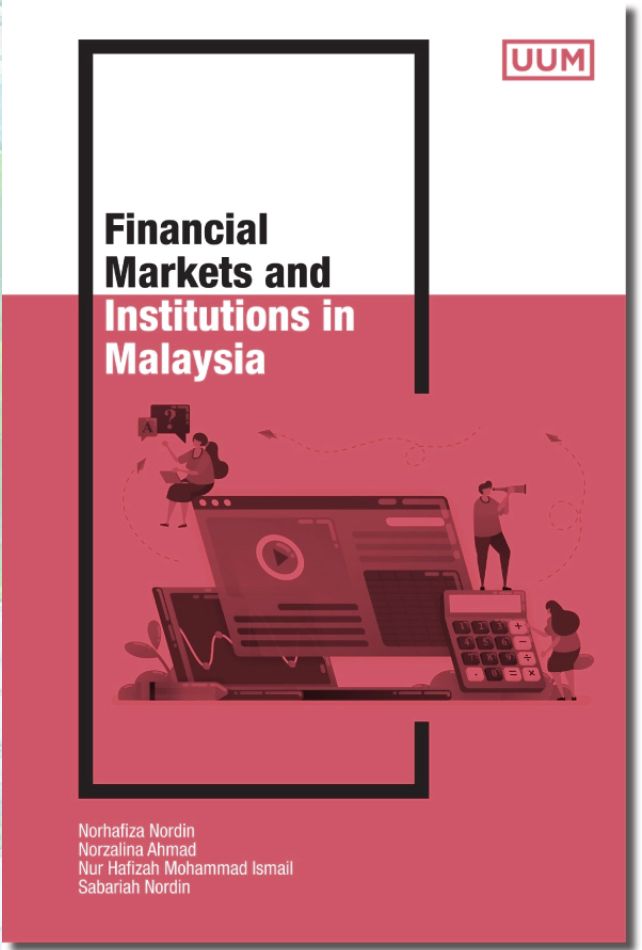
Norhafiza Nordin, Norzalina Ahmad , Nur Hafizah Mohammad Ismail & Sabariah Nordin (2025). Financial Markets and Institutions in Malaysia, UUM Press
Additional
- Taghizadeh‑Hesary, F., Mohd Thas Thaker, H., Bhatti, M. I., & Pitchay, A. A. (Eds.). (2025). Islamic financial markets and institutions: Challenges, financial stability, and inclusivity. Springer Singapore
- Haniff, M. N., Ali, N., Ismail, N., & Md Yusoff, N. (2022). Introduction to Malaysian financial markets
- Bank Negara Malaysia
- Islamic Financial Services Board. (2024). Islamic Financial Stability Report 2024. Islamic Financial Services Board.
![BT22303(SEKSYEN 1) PENGURUSAN SUMBER MANUSIA [2-2025/2026]](https://itel.ums.edu.my/pluginfile.php/1906453/course/overviewfiles/BT22303%20HRM%201%2020252026.png)
BT22303(SEKSYEN 1) PENGURUSAN SUMBER MANUSIA [2-2025/2026]
Human resource management (HRM) refers to the process of recruiting and developing a company's workforce. It focuses on the function of people within the business, ensuring best work practices are in place at all times, identifying talent gaps in a company, advertising for positions, evaluating potential candidates, hiring top talent, and keeping employees safe, healthy, and satisfied, as well as bridging the gap between employees' performance and the organisation's strategic objectives.
![BT22303(SEKSYEN 3) PENGURUSAN SUMBER MANUSIA [2-2025/2026]](https://itel.ums.edu.my/pluginfile.php/1906459/course/overviewfiles/Screenshot%202026-03-12%20172723.png)
BT22303(SEKSYEN 3) PENGURUSAN SUMBER MANUSIA [2-2025/2026]
This course introduces the principles, practices, and strategic role of Human Resource Management (HRM) in contemporary organisations. It focuses on how HR activities and practices support organisational effectiveness and sustainability through integrated problem-solving and strategic thinking. Students will examine key HR functions, including job design, recruitment and selection, training and development, performance management, compensation, employee relations, and workplace safety. The course also introduces HR standards, HR information systems, and data-driven decision-making. Emphasis is placed on collaborative learning, where students work with team members to develop inclusive and sustainable solutions to HR-related challenges in dynamic organisational environments.
![BT22303(SEKSYEN 4) PENGURUSAN SUMBER MANUSIA [2-2025/2026]](https://itel.ums.edu.my/pluginfile.php/1906462/course/overviewfiles/COVER%20PAGE%20.png)
BT22303(SEKSYEN 4) PENGURUSAN SUMBER MANUSIA [2-2025/2026]
This course introduces the principles, practices, and strategic role of Human
Resource Management (HRM) in contemporary organizations. It focuses on
how HR activities and practices support organizational effectiveness and
sustainability through integrated problem solving and strategic thinking.
Students will examine key HR functions such as job design, recruitment and
selection, training and development, performance management,
compensation, employee relations, and workplace safety. The course also
introduces HR standards, HR information systems, and data-driven decisionmaking.
Emphasis is placed on collaborative learning, where students work
with team members to develop inclusive and sustainable solutions to HRrelated
challenges in dynamic organizational environments.
Resource Management (HRM) in contemporary organizations. It focuses on
how HR activities and practices support organizational effectiveness and
sustainability through integrated problem solving and strategic thinking.
Students will examine key HR functions such as job design, recruitment and
selection, training and development, performance management,
compensation, employee relations, and workplace safety. The course also
introduces HR standards, HR information systems, and data-driven decisionmaking.
Emphasis is placed on collaborative learning, where students work
with team members to develop inclusive and sustainable solutions to HRrelated
challenges in dynamic organizational environments.
![BT22303(SEKSYEN 6) PENGURUSAN SUMBER MANUSIA [2-2025/2026]](https://itel.ums.edu.my/pluginfile.php/1906468/course/overviewfiles/Image.jpeg)
BT22303(SEKSYEN 6) PENGURUSAN SUMBER MANUSIA [2-2025/2026]
This course introduces the principles, practices, and strategic role of Human Resource Management (HRM) in modern organizations. It focuses on how HR activities support organizational effectiveness and sustainability through integrated problem-solving and strategic thinking. Students will explore key HR functions (like job design, recruitment, training, performance management, and compensation), alongside HR standards, information systems, and data-driven decision-making. The course strongly emphasizes collaborative learning to develop inclusive and sustainable solutions for dynamic organizational environments.
BT23203 (SEKSYEN 1) UNDANG-UNDANG PERNIAGAAN [2-2025/2026]
The course aims to provide the students with a general understanding of legal issues in a business environment. It enables the students to develop an understanding of the legal framework of business, develop an understanding of the purpose and logic of the law, develop a vocabulary that will be helpful in the future, and develop a general knowledge of how the law affects the business world. The important aspects to be covered in this course include an introduction to the Malaysian legal system, business entities, law of contract, in particular, the elements of a valid and enforceable contract, conditions and warranties, discharge of contract, remedies, the doctrine of privity, and exemption clauses. The course also discusses the law of agency, the law relating to sales of goods, consumer protection law, introduction to employment law, and introduction to intellectual property law.
![CA32402 TERAPI TARI [1-2025/2026]](https://itel.ums.edu.my/pluginfile.php/1584049/course/overviewfiles/Screenshot%202025-10-24%20011053.jpg)
CA32402 TERAPI TARI [1-2025/2026]
Kursus ini memberikan pengenalan asas terapi tari kepada para pelajar iaitu pendedahan tentang sejarah, konsep asas, teori-teori yang berkaitan serta bagaimana tari dapat digabungkan dalam proses psikoterapi. Seterusnya, meningkatkan apresiasi bidang tari serta membuka kemahiran alternative baharu kepada pelajar dalam dalam bidang tari.
FC10303(SEKSYEN 1) DENDROLOGI [1-2024/2025]
SYNOPSIS
This course provides an in-depth exploration of botanical concepts relevant to Dendrology. Students will gain a solid understanding of the International Code of Botanical Nomenclature (ICBN) and learn essential herbarium management techniques. A comprehensive overview of plant taxonomic systems will equip students with the knowledge to apply taxonomic concepts effectively in Dendrology. Practical sessions will focus on utilizing flora checklists, plant and wood classification systems, and identifying key characteristics of dipterocarps and non-dipterocarps. Field discussions and hands-on experiences at Sandakan Herbarium and Forest Reserve will reinforce learning and provide opportunities to apply theoretical knowledge. The course will also delve into global vegetation patterns, with a particular focus on forest types in Malaysia and the world. Students will explore dominant tree species within each forest type and examine the relationships between these species and their specific habitats.
![GC20003 PEMASARAN PERKHIDMATAN [2-2022/2023]](https://itel.ums.edu.my/pluginfile.php/28168/course/overviewfiles/COVER%20PAGE%20SERVICE%20MKT.png)
GC20003 PEMASARAN PERKHIDMATAN [2-2022/2023]
Service industries are progressively becoming an important source of income for countries worldwide. The exponential growth of the services sector has also been instrumental to stimulate employment opportunities. According to a recent report, Malaysia’s service sector accounted for more than 50 percent of the GDP in 2016 and 54 percent of its workforce is contributed by the service industry (The World Factbook, 2017).
This course examines the important and growing role of service marketing in both consumer and organizational target markets. Specifically, the course aims to acquaint students with the unique challenges inherent in marketing of services; and the theoretical concepts, tools, and strategies needed to address them. By discussing current issues in services marketing and customer service strategies, this course offers a better understanding of effective customer relationship management; key service delivery elements; and service recovery strategies that lead to the successful implementation of customer focus in service-based businesses.
GT30503 PENGURUSAN SUMBER MANUSIA ANTARABANGSA [1-2024/2025]
Managing talent is extremely crucial to ensure the sustenance of any organization. It consists of the process of recruiting, selecting, managing, and rewarding members of the organization. International human resource management is more complex in nature and associated with managing people across boundaries. It involves the interplay of three elements: HR practices, type of employees, and the countries involved. Therefore, this subject will cover a wide range of HR activities that are more responsive to international staffing requirements as organizational strategy changes. It will provide students with an understanding of the higher risk exposure of managing talents across countries while trying to achieve organizational goals.
![GT30503 PENGURUSAN SUMBER MANUSIA ANTARABANGSA [1-2025/2026]](https://itel.ums.edu.my/pluginfile.php/1550753/course/overviewfiles/images.jpg)
GT30503 PENGURUSAN SUMBER MANUSIA ANTARABANGSA [1-2025/2026]
Managing talent is extremely crucial to ensure the sustenance of any organizations. It consists of recruiting, selecting, managing, and organizational rewards. International human resource management is more complex and associated with managing people across boundaries. It involves three elements: HR practices, the type of employees, and the countries involved. Therefore, this subject will cover a wide range of HR activities that are more responsive to international staffing requirements as the organizational strategy changes. It will provide an understanding of the higher risk exposure of managing talents across countries while trying to achieve the organizational goals.
 iTEL
iTEL