 iTEL
iTEL
Search results: 52
AH31003 DINAMIKA HUBUNGAN PERBURUHAN DAN ISU-ISU KONTEMPORARI [2-2023/2024]
This course will examine the global and local labour landscape, exploring the impact of education and labour market demand, knowledge and skills for the 4.0 industrial revolution, social security and labour protection, labour migration, disabled workers and return to work unemployment, employability and the gig economy, labour markets and the COVID-19 pandemic, the aging workforce, and gender in the workplace. Students will engage in discussions and reflections on these topics to gain a deeper understanding of the challenges and complexities of the modern labour market. The course will provide critical thinking skills and the knowledge necessary to navigate the ever-evolving global labour landscape.
![AK21403 KOMUNIKASI FOTO [1-2023/2024]](https://itel.ums.edu.my/pluginfile.php/410237/course/overviewfiles/COURSE%20COVER.png)
AK21403 KOMUNIKASI FOTO [1-2023/2024]
This course introduces students to fundamental knowledge and skills requisite to producing photographs. This knowledge and skill base includes the anatomy, function and use of the camera, plus basic processing, printing, a brief introduction to computer technology and presentation information. Additionally, this course stresses the employment of photography as a means of recording events, people, or places (photojournalism) of interest and as a powerful tool of expression (art). Photography is an essential element in supporting a news story or features writing. Through this digital photo communication approaches, student will learn about digital photography concepts, digital photography techniques, and the relationships with the news and features writing.
BC31103 EKONOMI HARTA INTELEK [2-2023/2024]
Students will be introduced to the concept and issue of Intellectual Property Right Protections (IPRs) in economy. Students will be able to learn the significant role of intellectual property rights (IPRs) in assisting growth via various economic aspect IPRs has now becoming the new source of growth in the global innovation context and many countries in the world embracing it to stay relevant and competitive in the international arena.
![BG20103(SEKSYEN 1) KELAKUAN PENGGUNA [2-2023/2024]](https://itel.ums.edu.my/pluginfile.php/715797/course/overviewfiles/CB%20PIC.png)
BG20103(SEKSYEN 1) KELAKUAN PENGGUNA [2-2023/2024]
Hi all,
A big welcome to the BG20103 Consumer Behaviour Course. I am excited that we could all learn together some imperative in consumer behaviour that will help shape you as a marketing professional in the future.
This course focuses on understanding the major factors underlying consumer behavior. We explore theories and research emanating from marketing, psychology, and sociology, and learn to use these to better understand and predict how consumers will respond to marketing actions.
Hope we will have a great semester learning together.
Best regards,
DR BAMINI KPD BALAKRISHNAN
![BP24103 PERCUKAIAN I [2-2025/2026]](https://itel.ums.edu.my/pluginfile.php/1906207/course/overviewfiles/WhatsApp%20Image%202026-03-10%20at%2014.45.57.jpeg)
BP24103 PERCUKAIAN I [2-2025/2026]
Course Description
This course provides an introduction to the Malaysian income tax system based on the Income Tax Act 1967. It explains the basic principles and objectives of taxation, sources of government revenue, and the role of the Inland Revenue Board of Malaysia in tax administration. The course covers the determination of individual residence status, taxation of employment income, capital allowances, and business income for sole proprietorships and partnerships. It also discusses other sources of income such as dividends, interest, rental, and royalties.
Students will learn how to compute individual tax liability, including aggregate income, total income, chargeable income, personal reliefs, tax rebates, and applicable tax rates. The course also introduces tax administration procedures, e-filing through the MyTax Portal, and ethical issues in taxation to encourage responsible tax compliance.
Learning Outcomes
At the end of the course the students will be able to:
1. Analyze the scope and implementation of the tax system and the obligations of taxpayers in Malaysia (PLO1, C4)
2. Evaluate various tax strategies on different circumstances according to the current Malaysian taxation system (PLO2, C5)
3. Collaborate effectively in analyzng tax dilemmas regarding tax evasion and the implementation of 'Aadab' in tax compliance (PLO4, A3)
4. Exhibit digital literacy in data search for current tax compliance environment in Malaysia (PLO6, C5)
![BP27203(SEKSYEN 1&2) KEWANGAN KORPORAT [1-2023/2024]](https://itel.ums.edu.my/pluginfile.php/408290/course/overviewfiles/Untitled-design-52.jpg)
BP27203(SEKSYEN 1&2) KEWANGAN KORPORAT [1-2023/2024]
This course aims to build the fundamental financial knowledge to address the following areas: efficient market hypothesis, working capital management, dividend policy, leverage and capital structure, merger and acquisition and risk management mechanism
Lecturer Office: Level 3, Room A-3-6
Email: allif@ums.edu.my
Lecturer Office: Level 3, Room A-3-6
Email: allif@ums.edu.my
![BP34403 PERCUKAIAN II [2-2022/2023]](https://itel.ums.edu.my/pluginfile.php/47284/course/overviewfiles/Taxes_20181105095104_theedgemarkets.jpg)
BP34403 PERCUKAIAN II [2-2022/2023]
This course is designed to enable learners to have exposure, experience and familiarize with all aspects of partnership, company taxation, investment incentives, real property gains tax, withholding and double taxation agreement and sales taxes.
Lecturer Office: Level 3, Room A-3-6
Email: allif@ums.edu.my
Lecturer Office: Level 3, Room A-3-6
Email: allif@ums.edu.my
![BP34403 PERCUKAIAN II [2-2023/2024]](https://itel.ums.edu.my/pluginfile.php/713037/course/overviewfiles/QD3B58fDcaeg9xELQr7HHN.jpg)
BP34403 PERCUKAIAN II [2-2023/2024]
This course is designed to enable learners to have exposure, experience and familiarize with all aspects of partnership, company taxation, investment incentives, real property gains tax, withholding and double taxation agreement and sales taxes.
Lecturer Office: Level 3, Room A-3-6
Email: allif@ums.edu.my
Lecturer Office: Level 3, Room A-3-6
Email: allif@ums.edu.my
![BT11703(SEKSYEN 2) MAKROEKONOMI [2-2025/2026]](https://itel.ums.edu.my/pluginfile.php/1906276/course/overviewfiles/WIJAYA%20KAMAL%20RAMLAN.png)
BT11703(SEKSYEN 2) MAKROEKONOMI [2-2025/2026]
Course Description
This course provides introductory materials for macroeconomics. The syllabus focuses on applications and policy while explaining the formal economic theory. The first three chapters introduce students to the economist’s view of the world, the role of assumptions in developing theory or models, and the role of economists in making policy. The coverage of macroeconomics includes how to measure national income, cost of living, and the behavior of the real economy, money, and prices in the long run. The last few chapters present the macroeconomics of open economies, maintaining the long-run assumptions of price flexibility and full employment.
Course Learning Outcomes
At the end of the course, the students should be able to:
• Analyse key macroeconomic concepts and theories with clarity and accuracy in foundational economic contexts. (PLO1, C4)
• Analyse fundamental macroeconomic concepts to evaluate contemporary economic issues using logical reasoning and systems thinking to understand their interrelationships. (PLO2, C4)
• Demonstrate effective communication skills when discussing contemporary macroeconomic issues in both written and oral formats. (PLO5, A3)
• Demonstrate personal skills in analyzing macroeconomic concept in relation to current and global economics issues. (PLO9, A3)
This course provides introductory materials for macroeconomics. The syllabus focuses on applications and policy while explaining the formal economic theory. The first three chapters introduce students to the economist’s view of the world, the role of assumptions in developing theory or models, and the role of economists in making policy. The coverage of macroeconomics includes how to measure national income, cost of living, and the behavior of the real economy, money, and prices in the long run. The last few chapters present the macroeconomics of open economies, maintaining the long-run assumptions of price flexibility and full employment.
Course Learning Outcomes
At the end of the course, the students should be able to:
• Analyse key macroeconomic concepts and theories with clarity and accuracy in foundational economic contexts. (PLO1, C4)
• Analyse fundamental macroeconomic concepts to evaluate contemporary economic issues using logical reasoning and systems thinking to understand their interrelationships. (PLO2, C4)
• Demonstrate effective communication skills when discussing contemporary macroeconomic issues in both written and oral formats. (PLO5, A3)
• Demonstrate personal skills in analyzing macroeconomic concept in relation to current and global economics issues. (PLO9, A3)
![BT11703(UMSFLEC) MAKROEKONOMI [2-2025/2026]](https://itel.ums.edu.my/pluginfile.php/2025979/course/overviewfiles/WIJAYA%20KAMAL%20RAMLAN%20%2810%29.png)
BT11703(UMSFLEC) MAKROEKONOMI [2-2025/2026]
Course Description
This course provides introductory materials for macroeconomics. The syllabus focuses on applications and policy while explaining the formal economic theory. The first three chapters introduce students to the economist’s view of the world, the role of assumptions in developing theory or models, and the role of economists in making policy. The coverage of macroeconomics includes how to measure national income, cost of living, and the behavior of the real economy, money, and prices in the long run. The last few chapters present the macroeconomics of open economies, maintaining the long-run assumptions of price flexibility and full employment.
Course Learning Outcomes
At the end of the course, the students should be able to:
• Analyse key macroeconomic concepts and theories with clarity and accuracy in foundational economic contexts. (PLO1, C4)
• Analyse fundamental macroeconomic concepts to evaluate contemporary economic issues using logical reasoning and systems thinking to understand their interrelationships. (PLO2, C4)
• Demonstrate effective communication skills when discussing contemporary macroeconomic issues in both written and oral formats. (PLO5, A3)
• Demonstrate personal skills in analyzing macroeconomic concept in relation to current and global economics issues. (PLO9, A3)
EK00702 (SEKSYEN 1) PIDATO [1-2024/2025
|
|
Faculty/Pusat : Pusat Kokurikulum dan Pemajuan Pelajar
Course Code : EK00702 PIDATO
Semester : 1 – 2024/2025
Course Information:
Lecturer Information
Name : Mohammad Norazmi bin Haris
Office : Pusat Komunikasi Korporat, UMS
Phone Number : 014 675 7070
Email Address : mn_azmi@ums.edu.my
Lecture
Date : Saturday/Sunday (Base on PKPP timetable)
Time : 9.00 am - 11.00 am
Course Description:
This course aims to expose and educate students on the effective communication techniques used daily and for public speaking and elocution. Students will learn the language style and methods to choose suitable contents for public speaking. In class, students will be asked to familiarize themselves in speaking, building confidence and being smart in choosing the right words and sentence to convey specific meaning. Soft skills are a very important thing in this course, not only do we learn in speaking, but we will also learn soft skills for how to be someone who has various skills in the future.
Course Delivery Method:
- Lectures, discussion activities and LDK training.
- Activities based on modules prepared by PKPP UMS and carried out according to the current academic calendar.
- The lecture meeting session does not have to be conducted only in the lecture room, instead the location of the meeting can be changed according to the suitability of the topic and OBTAINING mutual AGREEMENT between the trainer and the student.
- Community activities outside the campus through the UMS SPRINT Program.
- Extracurricular Carnival Activities.
Used of Blended Learning:
- 70% Face-to-face Learning.
- 30% Online Learning
Course Materials:
- Field Lecture Slides according to course requirements:
§ Week 1 – Introduction Pidato Course
§ Week 2 – Field Course and Discussion for UMS-SPRINT Paperwork
§ Week 3 – Field Course and Presentation UMS-SPRINT Paperwork
§ Week 4 – Field Course and Submit UMS-SPRINT Paperwork (Online)
§
- Modul by PKPP UMS
§ Week 5 – Troubleshooting Module
§ Week 6 – Communication Module
§ Week 7 – Unity Module
§ Week 8 – Implementation of UMS-SPRINT for Pidato Course
§ Week 9 – Integrity Module
§ Week 10 – Patriotism Module
§ Week 11 – Personality Development Module
Week 12 – Personal Goals Through UMS-SPRINT
GB30403 ISU-ISU SEMASA PERBANKAN ANTARABANGSA DAN LUAR PESISIR [1-2024/2025]
In this global economy, onshore and offshore banking in the financial sector have become integral aspects of business and portfolio management, transcending the traditional realm of private accounts. Year by year, the world's increasing access to information technology and capital has underscored the importance of exploring and expanding our knowledge of banking information. Therefore, this course not only covers current issues in international offshore banking and finance but also emphasizes the alignment of these practices with Sustainable Development Goals (SDGs). The course introduces the basic concepts of international offshore banking and finance, including its pros and cons, recent trends, and developments in the international finance industry, all within the context of promoting sustainable economic growth. Furthermore, the course delves into the intricacies of financial cycles, encompassing booms, bear markets, recessions, and crises in the international financial sectors. Special attention is given to the integration of financial processes in the global market environment, emphasizing their impact on SDGs. The selected theoretical and methodological approaches in the financial industry will also be explored, with a focus on their alignment with sustainable practices and contributions to SDGs. By incorporating these perspectives, the course aims to foster a comprehensive understanding of international offshore banking and finance within the framework of sustainable development.
GB30403 ISU-ISU SEMASA PERBANKAN ANTARABANGSA DAN LUAR PESISIR [1-2025/2026]
In this global economy, onshore and offshore banking in the financial sector have become integral aspects of business and portfolio management, transcending the traditional realm of private accounts. Year by year, the world's increasing access to information technology and capital has underscored the importance of exploring and expanding our knowledge of banking information. Therefore, this course not only covers current issues in international offshore banking and finance but also emphasizes the alignment of these practices with Sustainable Development Goals (SDGs). The course introduces the basic concepts of international offshore banking and finance, including its pros and cons, recent trends, and developments in the international finance industry, all within the context of promoting sustainable economic growth. Furthermore, the course delves into the intricacies of financial cycles, encompassing booms, bear markets, recessions, and crises in the international financial sectors. Special attention is given to the integration of financial processes in the global market environment, emphasizing their impact on SDGs. The selected theoretical and methodological approaches in the financial industry will also be explored, with a focus on their alignment with sustainable practices and contributions to SDGs. By incorporating these perspectives, the course aims to foster a comprehensive understanding of international offshore banking and finance within the framework of sustainable development.
GB30403 ISU-ISU SEMASA PERBANKAN ANTARABANGSA DAN LUAR PESISIR [2-2022/2023]
In this global economy, onshore and offshore banking in financial sector is much more a function of business and portfolio management than private accounts in the past. Year by year, the world’s access to information technology and capital has reaffirmed the need to explore and expand our knowledge of banking information. Therefore, this course covers current issues in international offshore banking and finance, especially introduces the basic concepts of international offshore banking and finance including its pros and cons, recent trends, issues and developments in the international finance industry. Next, this course discusses in depth the financial cycles, including the booms, bear, recession and crisis in the international financial sectors. Integration of financial processes in the global market environment is also highlighted. Use of selected current theoretical and methodological approach in the financial industry will also be address in part of this course.
GB30403 ISU-ISU SEMASA PERBANKAN ANTARABANGSA DAN LUAR PESISIR [2-2023/2024]
Overview of the Course
In this global economy, onshore and offshore banking in the financial sector have become integral aspects of business and portfolio management, transcending the traditional realm of private accounts. Year by year, the world's increasing access to information technology and capital has underscored the importance of exploring and expanding our knowledge of banking information. Therefore, this course not only covers current issues in international offshore banking and finance but also emphasizes the alignment of these practices with Sustainable Development Goals (SDGs). The course introduces the basic concepts of international offshore banking and finance, including its pros and cons, recent trends, and developments in the international finance industry, all within the context of promoting sustainable economic growth. Furthermore, the course delves into the intricacies of financial cycles, encompassing booms, bear markets, recessions, and crises in the international financial sectors. Special attention is given to the integration of financial processes in the global market environment, emphasizing their impact on SDGs. The selected theoretical and methodological approaches in the financial industry will also be explored, with a focus on their alignment with sustainable practices and contributions to SDGs. By incorporating these perspectives, the course aims to foster a comprehensive understanding of international offshore banking and finance within the framework of sustainable development.
GT21103 EKONOMI ISLAM [1-2025/2026]
This course offers a comprehensive understanding of economics from an Islamic perspective. It begins with an introduction to Islamic economics, explaining the foundational principles and distinctions from conventional economics. Students will explore microeconomics from an Islamic perspective, covering key topics such as supply and demand, costs and production, and the behavior of firms within various market structures, all examined through the lens of Islamic values. On the macroeconomic front, the course addresses issues like aggregate supply and demand, the role of government debt, and fiscal policy from an Islamic viewpoint. It further examines the characteristics of macroeconomic equilibrium in an Islamic economy, helping students understand the unique approaches to maintaining economic stability and growth. The course also covers money and monetary policy within an Islamic framework, and delves into the concepts of economic and social welfare, highlighting the importance of fair wealth distribution and social justice in Islamic economics. Throughout the course, students will engage in practical applications of their learning through presentations, encouraging them to apply theoretical knowledge to contemporary economic issues.
GT30103 PERDAGANGAN ANTARABANGSA [1-2024/2025]
This course will analyze the causes and consequences of international trade and investment. We will investigate why nations trade, what they trade, and who gains (or not) from this trade. We will then analyze the motives for countries or organizations to restrict or regulate international trade and study the effects of such policies on economic welfare. Topics covered will include the effects of trade on economic growth and wage inequality, multinationals and foreign direct investment, international trade agreements and current trade policy disputes. We will also spend some time discussing aspects of the current debate on "globalization" such as the use of international labor standards, interactions between trade and environmental concerns, and the role of non-government organizations (NGOs). Although the course will emphasize the understanding of past and current events in the world economy, we will heavily rely on formal economic modelling to help us understand these events.
INCREASING ENGAGEMENT AND ACTIVE LEARNING IN ITEL WITH CANVA
Hello, I’m Alcy, an intern from Universiti Malaysia Kelantan (UMK) currently pursuing a Bachelor's Degree in Creative Technology with an elective in Animation. As part of my internship at Centre for e-Learning UMS, I’m working on a project to enhance engagement and active learning in ITEL using Canva. In this session, I’ll walk you through Canva’s interactive features and share how they can help make learning more engaging for both lecturers and students. My goal is to show you effective ways to create dynamic and interactive content that enhances the digital learning experience. Looking forward to learning together with you! 😄
![IT32703(Seksyen 2) INTERNET BENDA [2-2023/2024]](https://itel.ums.edu.my/pluginfile.php/698901/course/overviewfiles/IoT-banner.png)
IT32703(Seksyen 2) INTERNET BENDA [2-2023/2024]
Dear Students of Sections 2,
A warm welcome to each and every one of you to IT32703! I'm delighted to have you join me on this educational journey, where we'll explore the dynamic intersection of technology and learning.
As we navigate through the course material together, I encourage you to approach each lesson with curiosity and an open mind. This is a space for collaboration, innovation, and growth. Your unique perspectives and experiences will enrich our discussions and deepen our understanding of the subject matter.I invite you to actively engage with the course content, participate in discussions, and take advantage of the resources available to you. Your active involvement will not only enhance your own learning but also contribute to the collective learning experience of the entire class.
Should you have any questions, concerns, or ideas throughout the semester, please don't hesitate to reach out. My door is always open, and I am here to support you in any way I can. Let's embark on this journey together, embracing the opportunities that technology presents us. Here's to a semester filled with discovery, growth, and meaningful connections.
Best regards,
Nuraini
A warm welcome to each and every one of you to IT32703! I'm delighted to have you join me on this educational journey, where we'll explore the dynamic intersection of technology and learning.
As we navigate through the course material together, I encourage you to approach each lesson with curiosity and an open mind. This is a space for collaboration, innovation, and growth. Your unique perspectives and experiences will enrich our discussions and deepen our understanding of the subject matter.I invite you to actively engage with the course content, participate in discussions, and take advantage of the resources available to you. Your active involvement will not only enhance your own learning but also contribute to the collective learning experience of the entire class.
Should you have any questions, concerns, or ideas throughout the semester, please don't hesitate to reach out. My door is always open, and I am here to support you in any way I can. Let's embark on this journey together, embracing the opportunities that technology presents us. Here's to a semester filled with discovery, growth, and meaningful connections.
Best regards,
Nuraini
![IT32703(SEKSYEN 3 & 4) INTERNET PELBAGAI BENDA [2-2025/2026]](https://itel.ums.edu.my/pluginfile.php/1904998/course/overviewfiles/IoT.png)
IT32703(SEKSYEN 3 & 4) INTERNET PELBAGAI BENDA [2-2025/2026]
Dear Students of Sections 3&4,
A warm welcome to each and every one of you to IT32703! I'm delighted to have you join me on this educational journey, where we'll explore the dynamic intersection of technology and learning.
As we navigate through the course material together, I encourage you to approach each lesson with curiosity and an open mind. This is a space for collaboration, innovation, and growth. Your unique perspectives and experiences will enrich our discussions and deepen our understanding of the subject matter.I invite you to actively engage with the course content, participate in discussions, and take advantage of the resources available to you. Your active involvement will not only enhance your own learning but also contribute to the collective learning experience of the entire class.
Should you have any questions, concerns, or ideas throughout the semester, please don't hesitate to reach out. My door is always open, and I am here to support you in any way I can. Let's embark on this journey together, embracing the opportunities that technology presents us. Here's to a semester filled with discovery, growth, and meaningful connections.
Best regards,
Nuraini
A warm welcome to each and every one of you to IT32703! I'm delighted to have you join me on this educational journey, where we'll explore the dynamic intersection of technology and learning.
As we navigate through the course material together, I encourage you to approach each lesson with curiosity and an open mind. This is a space for collaboration, innovation, and growth. Your unique perspectives and experiences will enrich our discussions and deepen our understanding of the subject matter.I invite you to actively engage with the course content, participate in discussions, and take advantage of the resources available to you. Your active involvement will not only enhance your own learning but also contribute to the collective learning experience of the entire class.
Should you have any questions, concerns, or ideas throughout the semester, please don't hesitate to reach out. My door is always open, and I am here to support you in any way I can. Let's embark on this journey together, embracing the opportunities that technology presents us. Here's to a semester filled with discovery, growth, and meaningful connections.
Best regards,
Nuraini
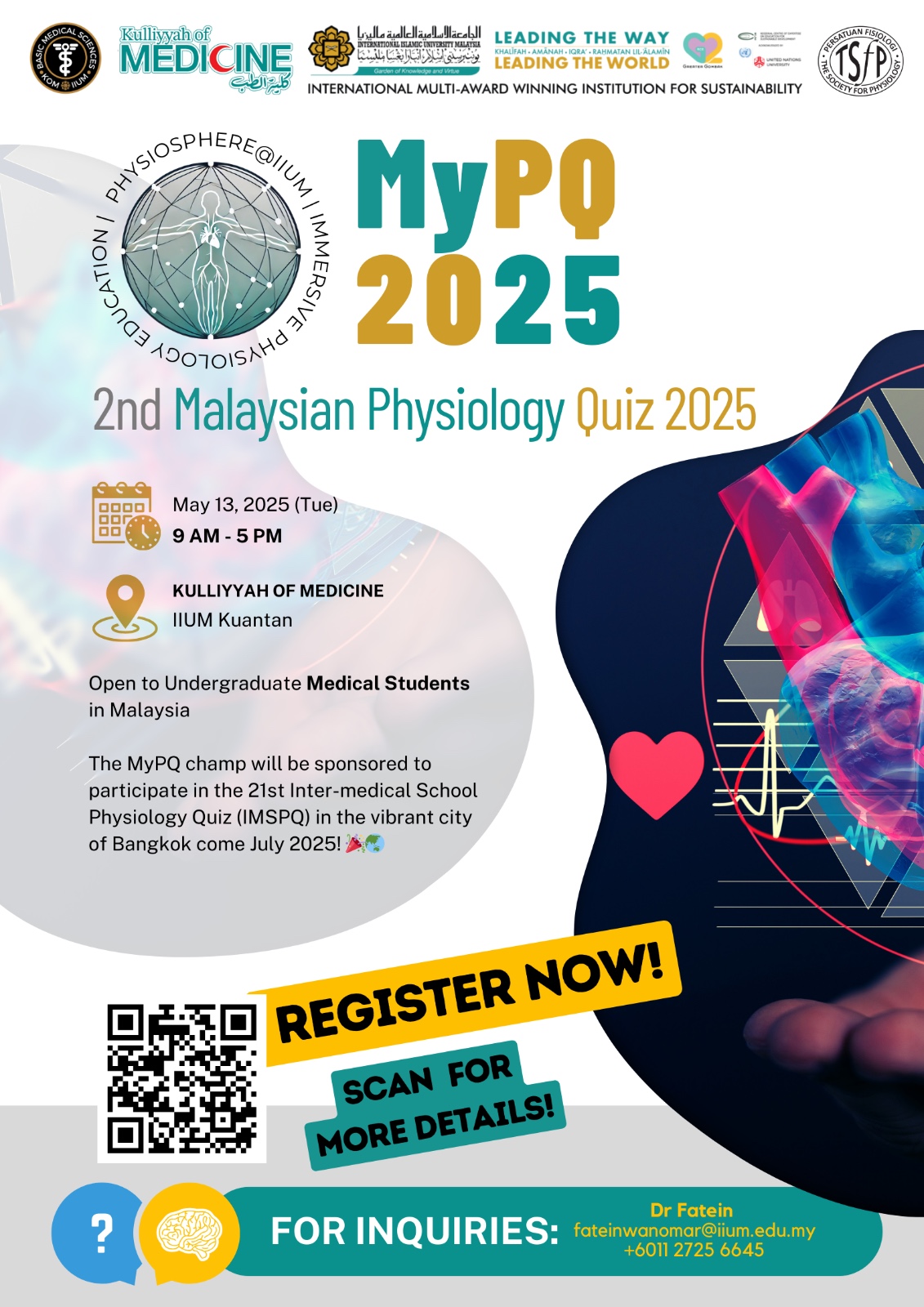
MM10102 BASIC CLINICAL SKILLS AND FIRST AID [1-2025/2026]
Assalamualaikum and greetings to all fellow students. Welcome to module MM10102, session 2025/2026.
Module Coordinator:
Dr Allia Najmie binti Muhammad Yusuf
012-833 0105
allia.najmie@ums.edu.my
Deputy Coordinator:
Dr Nur Damia Iwani binti Zulkiflee
011-2193 3760
damia@ums.edu.my
MLT In-charge:
Mr Barblay Jolumas
014- 851 5868
![MM20405 Musculoskeletal system and skin [1-2024/2025]](https://itel.ums.edu.my/pluginfile.php/969221/course/overviewfiles/MM20405.png)
MM20405 Musculoskeletal system and skin [1-2024/2025]
1.0 COURSE DESCRIPTION:
This course is to study the clinical disorder caused by abnormal changes in structure, function and bone biochemistry, muscle, joints and skin. Clinical disorders that will be discussed are including rheumatoid arthritis, gout, psoriasis, osteoarthritis, osteomyelitis, and tumours, etc. These discussions will cover organ / tissue that involved aetiology, pathogenesis, diagnosis, laboratory investigation, and treatment. The prevention of clinical disorder will also be discussed.
2.0 COURSE OBJECTIVES:
The program is expected to ensure the students be able to:
- understand and appreciate the clinical disorders resulting from abnormal changes in the structure, function, and biochemistry of the muscles, skin, bones and joints.
- understand the importance of clinical disorders such as rheumatoid arthritis, gout, psoriasis , osteoarthritis, tumours, etc.
- study and understand the organs and tissues involved as well as the relevant pathogenesis, laboratory investigations, and treatment.
- study and understand the prevention of clinical disorders.
3.0 LEARNING OUTCOMES:
At the end of the course students will be able to:
- understand the etiology, pathogenesis, clinical features, morphology, diagnosis and guideline of management.
- contribute to medical expertise in different settings, both rural and urban to meet the needs of community.
- contribute to research, scientific writing and publishing and development of ideas and technology that will be adopted globally.
4.0 ASSESSMENT:
4.1: Formative assessment (continuous assessment):
carried out throughout the course = through monthly tests=20%;
- Seminar = 5%;
- Attitude & behavior = 5%;
- SM =10%.
Total Mark weightage = 40%.
4.2: Summative assessment:
By examination at the end of 1st and 2nd semesters.
For summative assessment, assess student’s Knowledge: through –
MCQ; MEQ; long Essay on Problem based questions & viva voce.
Assess student’s Skill: through - OSPE & OSCE
Marks Weightage = 60%
Final Exam Passed Marks = 65%
5.0 REFERENCES:
1. Kumar V, Abbas A.K, Aster J.C, 2015. Robbins and Cotran Pathologic Basis of Disease. 9th Edition. Elsevier Saunders.
2. Kumar V, Abbas A.K, Aster J.C, 2017. Robbins Basic Pathology. 10th Edition. Elsevier Saunders.
3. Colledge N R, Walker B R, Ralston S H, 2018. Davidson’s Principles and Practice of Medicine. 23rd Edition. Churchill Livingstone, Elsevier Saunders.
4. Rang, H.P., Ritter, J.M., et al. (2019). Rang & Dale’s Pharmacology, 9th Edition, Elsevier Churchill Livingstone, London.
5. Macleod's Clinical Examination 14th edition 2019 Elsevier Saunders.
All the best!
![NN10003 PATOFISIOLOGI [2-2022/2023]](https://itel.ums.edu.my/pluginfile.php/37414/course/overviewfiles/FSMP.jpg)
NN10003 PATOFISIOLOGI [2-2022/2023]
This course is a continuation of the physiology component of NN10103 (Anatomy and Physiology) taken in the first semester. This semester, emphasis is on human pathophysiology, including aetiology, prognosis, medical treatment, signs and symptoms of common diseases of all body systems.
![NN10003 PATOFISIOLOGI [2-2023/2024]](https://itel.ums.edu.my/pluginfile.php/714087/course/overviewfiles/FSMP.jpg)
NN10003 PATOFISIOLOGI [2-2023/2024]
This course is a continuation of the physiology component of NN10103 (Anatomy and Physiology) taken in the first semester. This semester, emphasis is on human pathophysiology, including aetiology, prognosis, medical treatment, signs and symptoms of common diseases of all body systems.
![NN10003 PATOFISIOLOGI [2-2024/2025]](https://itel.ums.edu.my/pluginfile.php/1319381/course/overviewfiles/iTEL%20THUMBNAIL%20%285%29.png)
NN10003 PATOFISIOLOGI [2-2024/2025]
This course builds upon the foundational knowledge from NN10103 (Anatomy and Physiology) by focusing on the mechanisms of disease development across various body systems. Students will explore the aetiology, signs and symptoms, prognosis, and medical treatment of common diseases, emphasizing the distinction between normal and abnormal physiological functions. Teaching strategies incorporate lectures, tutorials, e-learning, and instructional reading, while assessments include assignment, quizzes, a mid-semester examination, and a final examination. This course enhances students’ ability to communicate disease processes to the public, preparing them for professional roles in healthcare and nutrition.
![NN10103 ANATOMI DAN FISIOLOGI [1-2024/2025]](https://itel.ums.edu.my/pluginfile.php/961907/course/overviewfiles/iTEL%20THUMBNAIL%20%281%29.png)
NN10103 ANATOMI DAN FISIOLOGI [1-2024/2025]
This course introduces Nutrition students to the fundamentals of human anatomy and physiology, providing a solid foundation for understanding the structure and function of the human body. The course covers the anatomy of organs and organ systems, alongside their physiological processes, emphasizing how these systems interrelate and support the body’s overall health and functionality. Students will explore key topics such as the skeletal, cardiovascular, digestive, and endocrine systems, among others. The knowledge and skills acquired will be essential for further studies in nutrition science, health, and clinical applications, providing a basis for informed decision-making in areas such as dietary planning, health assessments, and nutritional research.
![NN10103 ANATOMI DAN FISIOLOGI [1-2025/2026]](https://itel.ums.edu.my/pluginfile.php/1585503/course/overviewfiles/iTEL%20THUMBNAIL%20%286%29.png)
NN10103 ANATOMI DAN FISIOLOGI [1-2025/2026]
This course introduces Nutrition students to the fundamentals of human anatomy and physiology, providing a solid foundation for understanding the structure and function of the human body. The course covers the anatomy of organs and organ systems, alongside their physiological processes, emphasizing how these systems interrelate and support the body’s overall health and functionality. Students will explore key topics such as the skeletal, muscular, cardiovascular, respiratory, digestive, and endocrine systems, among others. Assessment comprises quizzes, assignments, and examinations to evaluate students’ ability to describe anatomical structures, explain physiological functions, and apply relevant concepts to health and disease scenarios. The knowledge and skills acquired will be essential for further studies in nutrition science, health, and clinical applications.
![NN10104 ANATOMI DAN FISIOLOGI [1-2023/2024]](https://itel.ums.edu.my/pluginfile.php/409418/course/overviewfiles/NN10104%20iTEL.png)
NN10104 ANATOMI DAN FISIOLOGI [1-2023/2024]
The course is designed for allied health science students to be equipped with basic anatomy and physiology. Anatomy is the normal structure of organs and organ systems. Physiology is the normal functions and mechanisms of organ systems. The information, knowledge and skills gathered from this course will be useful in the preclinical, clinical and research works.
![PH710402 Health Economic & Financing [1-2025/2026]](https://itel.ums.edu.my/pluginfile.php/1576916/course/overviewfiles/HE.jpeg)
PH710402 Health Economic & Financing [1-2025/2026]
The focus of this course is to study the impact of economics on the health care system. The subject of Health Economics (HE) is essential to have the understanding the value of spending money and managing it in the health care systems. The students will be introduced the economic in general before going to more specific subjects of health economics, and application of economics in healthcare, with special reference to economic evaluation. Sufficient knowledge of HE is crucial to develop certain policies for the smooth running and optimizing the delivery of health services to the community. It will prepare the students better understand the role economic plays in managing the healthcare system and apply this principle for managing the resource allocation in case of future health care reform especially with respect to healthcare financing. In ever changing world of innovations, it is imperative to obtain the skills and knowledge on how to take decision while evaluating the efficiency of any new health technology.
![Process Simulation using Aspen HYSYS [UMS MOOC: 2022 - 2026]](https://itel.ums.edu.my/pluginfile.php/16285/course/overviewfiles/intro%20HYSYS.jpg)
Process Simulation using Aspen HYSYS [UMS MOOC: 2022 - 2026]
Process Simulation using Aspen HYSYS is intended for participants who are using Aspen HYSYS for the first time and have little or no experience in computer simulation. It can be used as an introductory course in freshmen chemical engineering courses, or workshops where Aspen HYSYS is being taught. The course can also serve as a reference in more advanced chemical engineering courses when Aspen HYSYS is used as a tool for simulation and solving problems. It also can be used for self-directed study of Aspen HYSYS by students and practicing engineers. In addition, the course can be a supplement in courses where Aspen HYSYS is used, but the instructor does not have time to cover it extensively. This course has been interactively designed where every single chapter has it's own learning outcome with a simple activity as well as reflection. It is expected that participants will be able to articulate simulation skills obtained in this course to solve or plan the solution for complex chemical engineering process simulation problems.
![RC02203 FISIOLOGI TANAMAN [1-2024/2025]](https://itel.ums.edu.my/pluginfile.php/961244/course/overviewfiles/Screenshot%202024-10-04%20110817.png)
RC02203 FISIOLOGI TANAMAN [1-2024/2025]
This is an advanced level course which recognized that physiological processes play determinant roles in controlling plant growth and crop yields. This course will emphasize the application of physiology and agronomy in crop production and environmental effects on crop growth, and biological and economic yield.
![RC02203 FISIOLOGI TANAMAN [2-2023/2024]](https://itel.ums.edu.my/pluginfile.php/713157/course/overviewfiles/086aa880-0b11-11ec-9143-058cd7c30004.jpg)
RC02203 FISIOLOGI TANAMAN [2-2023/2024]
This is an advanced level course which recognized that physiological processes play determinant roles in controlling plant growth and crop yields. This course will emphasize the application of physiology and agronomy in crop production and environmental effects on crop growth, and biological and economic yield.
![RC02203 FISIOLOGI TANAMAN [2-2024/2025]](https://itel.ums.edu.my/pluginfile.php/1318823/course/overviewfiles/c.jpg)
RC02203 FISIOLOGI TANAMAN [2-2024/2025]
This is an advanced level course which recognized that physiological processes play determinant roles in controlling plant growth and crop yields. This course will emphasize the application of physiology and agronomy in crop production and environmental effects on crop growth, and biological and economic yield.
RC21003(UMSFLEC) BIOMETRI [2-2024/2025]
This course focuses on statistical analysis and its application in agriculture. The course will show how statistics is being used to evaluate the results of agricultural research. The course will cover both descriptive statistics, which summarize the data obtained in research, and inferential statistics, which are used to decide whether the results of research confirm the researcher’s hypotheses. Specific topics to be covered include sampling and estimation, hypothesis testing and methods of statistical analysis.
RL31301 AMALAN KEUSAHAWANAN TANI 2 [1-2025/2026]
Hi all students,
This course introduces the principles and practices of agro-entrepreneurship with a focus on livestock-based enterprises. It covers the value chain from planning and production to marketing and business sustainability. Students will work in teams to apply entrepreneurial skills, develop innovative business ideas, and implement strategies that enhance productivity, ensure animal welfare, and increase market competitiveness.
Emphasis on practical learning, critical thinking, and leadership in managing agro-based ventures to prepare students for real-world agricultural entrepreneurship.
The student learning outcomes achieved in this course will support the programme learning outcome (knowledge & understanding (C1); leadership, autonomy & responsibility (C3F); and entrepreneurial skill (C4B) learning outcome). Additionally, student will gain insight into how to monetise knowledge and skill in the real agriculture industry setting.
All the best!
Dr Fiza
This course introduces the principles and practices of agro-entrepreneurship with a focus on livestock-based enterprises. It covers the value chain from planning and production to marketing and business sustainability. Students will work in teams to apply entrepreneurial skills, develop innovative business ideas, and implement strategies that enhance productivity, ensure animal welfare, and increase market competitiveness.
Emphasis on practical learning, critical thinking, and leadership in managing agro-based ventures to prepare students for real-world agricultural entrepreneurship.
The student learning outcomes achieved in this course will support the programme learning outcome (knowledge & understanding (C1); leadership, autonomy & responsibility (C3F); and entrepreneurial skill (C4B) learning outcome). Additionally, student will gain insight into how to monetise knowledge and skill in the real agriculture industry setting.
All the best!
Dr Fiza
RT40402 ISU DAN PERKEMBANGAN SEMASA PERTANIAN [1-2025/2026]
RT40402 critically explores Malaysia’s agri-food systems through four interconnected modules:
1. Land, Adat, and Colonial Conservation
2. Trade Injustice, Price Inequality, and Market Power
3. Climate Governance and False Solutions
4. Commons, Cooperatives, and Sovereignty
Students will engage with concepts such as agrarian political economy, legal pluralism, climate justice, food sovereignty, and commons-based stewardship. Emphasis is placed on comparative regionalism, recognising Sabah and Sarawak as legally and historically distinct from Peninsular Malaysia.
1. Land, Adat, and Colonial Conservation
2. Trade Injustice, Price Inequality, and Market Power
3. Climate Governance and False Solutions
4. Commons, Cooperatives, and Sovereignty
Students will engage with concepts such as agrarian political economy, legal pluralism, climate justice, food sovereignty, and commons-based stewardship. Emphasis is placed on comparative regionalism, recognising Sabah and Sarawak as legally and historically distinct from Peninsular Malaysia.
![SG43303 PENILAIAN FORMASI [1-2023/2024]](https://itel.ums.edu.my/pluginfile.php/409622/course/overviewfiles/WhatsApp%20Image%202023-10-03%20at%201.18.36%20PM.jpeg)
SG43303 PENILAIAN FORMASI [1-2023/2024]
Formation Evaluation: Unmasking Earth's Mysterious Layers, One Chuckle at a Time!
Think of Formation Evaluation as the Earth's own stand-up comedy show, where our planet is the star performer, and we're the audience, trying to decipher its witty geological jokes. It's like Earth's way of keeping us entertained while hiding its secrets in plain sight!
In this geological game of "Guess Who," we explore deep underground, armed with tools and sensors that can "read" the rock's minds. We're basically the Sherlock Holmes of seismic, wireline, and sedimentary structures, trying to figure out if rocks are solid, porous, or just playing hard to get.

Picture this: you're in a cosmic disco, and the rocks are the dance floor. Formation Evaluation is like bringing in a funky DJ with rad gadgets to check if those rocks have the right moves! We're talking gamma rays, resistivity, and sonic waves - the ultimate party tools for Earth's groovy layers.
And the best part? We get to decipher rock personalities, from sandy extroverts to shaly introverts, all while wearing our geological detective hats. It's a hilarious journey of laughter, science, and endless surprises, as we unveil the Earth's underground comedy club, one well log at a time. So, get ready to rock and roll with Formation Evaluation - the Earth's geological sitcom that's sure to tickle your funny bone!
![SM13103 MATEMATIK I [1-2023/2024]](https://itel.ums.edu.my/pluginfile.php/531200/course/overviewfiles/iTel%20Card%20%283%29.jpg)
SM13103 MATEMATIK I [1-2023/2024]
This course provides a comprehensive introduction to several important areas of mathematics, including foundational concepts (logic, set theory, real numbers) and more advanced topics (complex numbers and calculus). It establishes a strong foundation for advancing in the study of mathematics and applying it across various fields.
![SS33203(SEKSYEN 1) OSHA SEKITARAN [2-2025/2026]](https://itel.ums.edu.my/pluginfile.php/1908370/course/overviewfiles/cover.png)
SS33203(SEKSYEN 1) OSHA SEKITARAN [2-2025/2026]
This course provides an overview of the important issues in Occupational Safety and Health (OSH). It is a cross-disciplinary area that protects the safety, health, and welfare of the people engaged in employment. All its programs aim to foster a safe work environment. The development of OSH must be aligned with vast development in all industry sectors, including Small and Medium Industries (SME). Industrial hygiene is challenging and yet it is a very important issue in demand for providing safe and healthy workplaces in the context of a market economy and global competition that produces pressure for low-cost production This course will not only focus on the Occupational Safety and Health standards in Malaysia, but on the larger political agenda of the global economy and how it impacts on the safety and health of workers around the world. The class style will be participatory, including small group discussions and activities. Related videos will complement the class or tutorial discussion. Students will learn major types of workplace health and safety problems, review existing public policy in the area, learn how to conduct a workplace audit, and consider how employers, unions, and public policy might improve health and safety outcomes. Issues are addressed using multiple disciplines, namely history, industrial hygiene, and employment relations.
TE40003 COMPARATIVE LITERATURE [1-2023/2024]
Comparative literature is the study of literature from around the world, transcending the restrictions of national and linguistic boundaries. Traditionally, comparative study was based on literary movements, periods and lines of influence, as well as on genres, themes, myths, and legends. In recent years comparative literature has come to include the comparison of literature with other areas of human experience. Comparative literature offers students the opportunity to study a broad range of literary subjects from various cultures throughout the world. Courses are offered in European literature from ancient to contemporary times; in the literature of Asia, Africa, and Latin America; in folk literature, legend, fantasy, and science fiction; in literary theory; and in special topics such as travel literature, literature and existentialism, and Malaysian literature and film (especially P.Ramlee’s work). All reading is done in English translation. The comparative literature is used as preparation for the single subject (secondary school) teaching credential in English language.
TE40003 COMPARATIVE LITERATURE [1-2024/2025]
Comparative literature is the study of literature from around the world, transcending the restrictions of national and linguistic boundaries. Traditionally, comparative study was based on literary movements, periods and lines of influence, as well as on genres, themes, myths, and legends. In recent years comparative literature has come to include the comparison of literature with other areas of human experience. Comparative literature offers students the opportunity to study a broad range of literary subjects from various cultures throughout the world. Courses are offered in European literature from ancient to contemporary times; in the literature of Asia, Africa, and Latin America; in folk literature, legend, fantasy, and science fiction; in literary theory; and in special topics such as travel literature, literature and existentialism, and Malaysian literature and film (especially P.Ramlee’s work). All reading is done in English translation. The comparative literature is used as preparation for the single subject (secondary school) teaching credential in English language.
 iTEL
iTEL