 iTEL
iTEL
523 Courses
RC31403(UMSFLEC) Perladangan Persis [2-2025/2026]
This course introduces students to the concepts, technologies and applications involved in precision farming (PF). This entails the use of ICT and some high-technology equipment for assessing field conditions and applying variable rates of production inputs for management of soil nutrients, weeds, pest & diseases. Topics include sampling procedures, and measurements of parameters through environmental sensors, GNSS, RS and PS. Data input into GIS or analysis using Geo-statistical & Mapping software to accomplish primary spatial data management tasks, creation of spatial variability maps for mechanized applications of farm inputs. Students will also be exposed to precision technologies in livestock production for locating as well as feeding, reproduction and health management. Students will participate in some hands-on experience in the use of enabling hardware and software in PF applications.
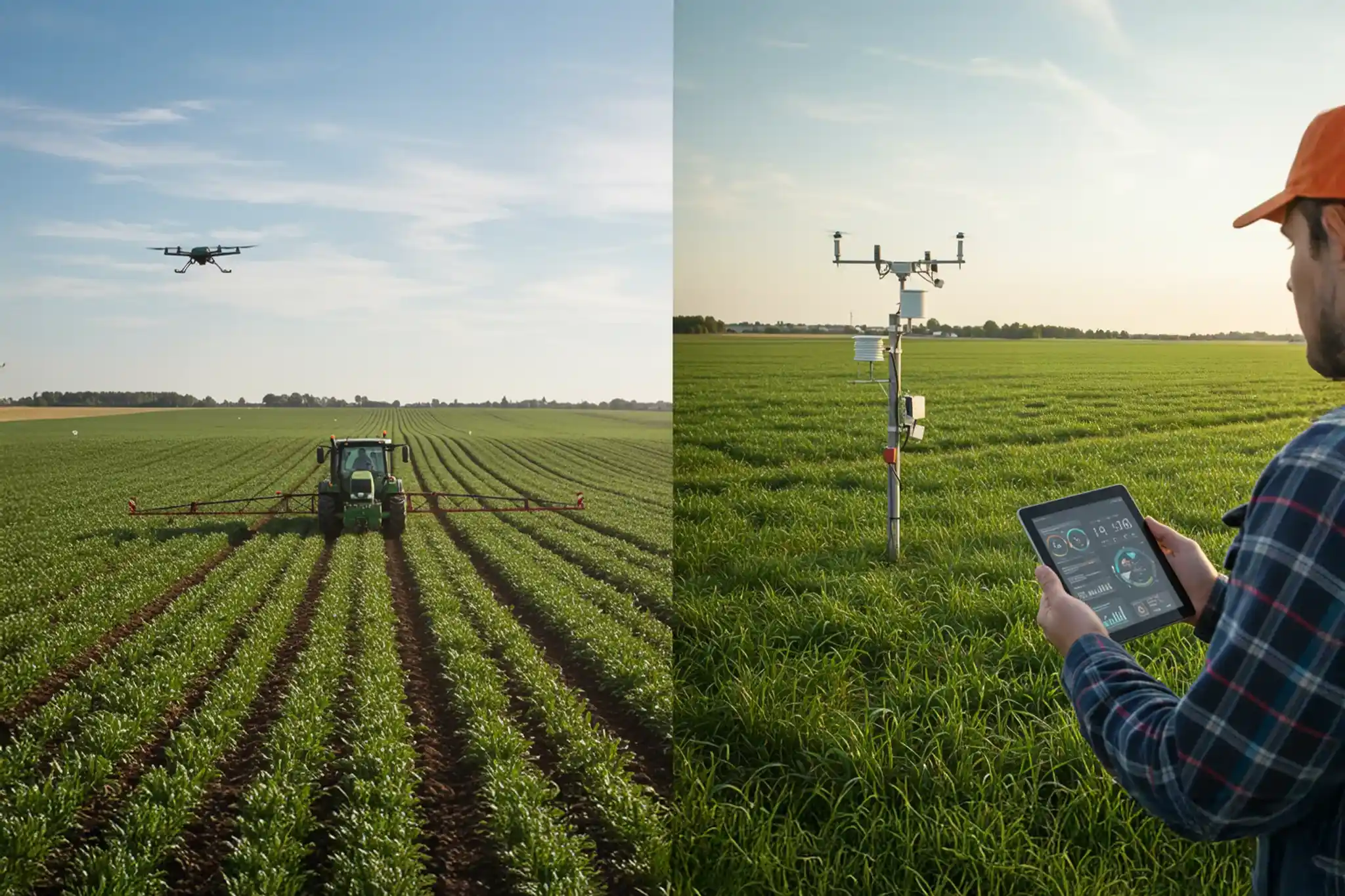
![RC21603/RL31403(UMSFLEC) Mekanisasi Ladang [2-2025/2026]](https://itel.ums.edu.my/pluginfile.php/2004070/course/overviewfiles/ChatGPT%20Image%20Mar%203%2C%202026%2C%2007_25_57%20AM.png)
RC21603/RL31403(UMSFLEC) Mekanisasi Ladang [2-2025/2026]
This course introduces the land application of farm mechanization in modern agriculture. This course also examines machinery used for land preparation, planting, crop maintenance, harvesting, and post-harvest processing. The construction, operation, and maintenance of common farm machinery will be discussed. Financial farm machinery performance and the economics of mechanization, including field efficiency, operating costs, fixed costs, and variable costs, for effective management decisions will be covered.
RC21003(UMSFLEC) Biometri [2-2025/2026]
Welcome to the course.
During the semester,
This course is designed to provide a learning environment for undergraduate students to acquire skills in basic descriptive and inferential statistics related to Agriculture. It involves learning about the various ways of describing, analysing and interpreting the results of the analysis of data. Students will learn how to do the data analysis using Excel. This course will provide important fundamentals to enable the students to carry out their final year research projects. The student learning outcomes achieved in this course will support the programme learning outcome (cognitive skills and numeracy skills learning domains) that students should be able to identify crop production problems, apply knowledge to solve these problems, and suggest ways to solve them using numerical and analytical approaches. At the end of this course, students should be able to:
•Describe some basic statistical concepts.
•Distinguish between descriptive statistics and inferential statistics.
•Conduct hypothesis testing for the selected parametric and non-parametric tests in order to solve biological problems.
Enjoy the course, have fun and work hard.
Aim for A+
You can do it.
RT20802(SEKSYEN 1) REVOLUSI INDUSTRI DAN BIOMETRI [2-2025/2026]
Welcome to the course.
During the semester,
This course will introduce and expose the student to the concept and fundamental pillars of IR4.0 in particular the knowledge digitization and machine learning. Students will be guided on how to use the machine learning algorithms to model data related to agriculture. These algorithms include supervised and unsupervised learning. Students will also be introduced to statistical analysis and its application in agriculture. The course will show how statistics are being used to evaluate the results of agricultural research. The course will cover both descriptive statistics, which summarize the data obtained in research, and inferential statistics, which are used to decide whether the results of research confirm the researcher’s hypotheses. Specific topics to be covered include sampling and estimation, hypothesis testing, t-tests, analysis of variance, correlation, regression analysis, and non-parametric methods of statistical analysis. At the end of this course, students should be able to:
- Understanding the fundamental aspects of IR 4.0 and techniques in Machine Learning
- Illustrate how practical application of existing machine learning methods can be used to solve real problems in agriculture
- To conduct descriptive and inferential statistics (hypothesis testing) for the selected parametric and non-parametric tests in order to solve biological problems.
Enjoy the course, have fun and work hard.
Aim for A+
You can do it.
During the semester,
This course will introduce and expose the student to the concept and fundamental pillars of IR4.0 in particular the knowledge digitization and machine learning. Students will be guided on how to use the machine learning algorithms to model data related to agriculture. These algorithms include supervised and unsupervised learning. Students will also be introduced to statistical analysis and its application in agriculture. The course will show how statistics are being used to evaluate the results of agricultural research. The course will cover both descriptive statistics, which summarize the data obtained in research, and inferential statistics, which are used to decide whether the results of research confirm the researcher’s hypotheses. Specific topics to be covered include sampling and estimation, hypothesis testing, t-tests, analysis of variance, correlation, regression analysis, and non-parametric methods of statistical analysis. At the end of this course, students should be able to:
- Understanding the fundamental aspects of IR 4.0 and techniques in Machine Learning
- Illustrate how practical application of existing machine learning methods can be used to solve real problems in agriculture
- To conduct descriptive and inferential statistics (hypothesis testing) for the selected parametric and non-parametric tests in order to solve biological problems.
Enjoy the course, have fun and work hard.
Aim for A+
You can do it.
 iTEL
iTEL